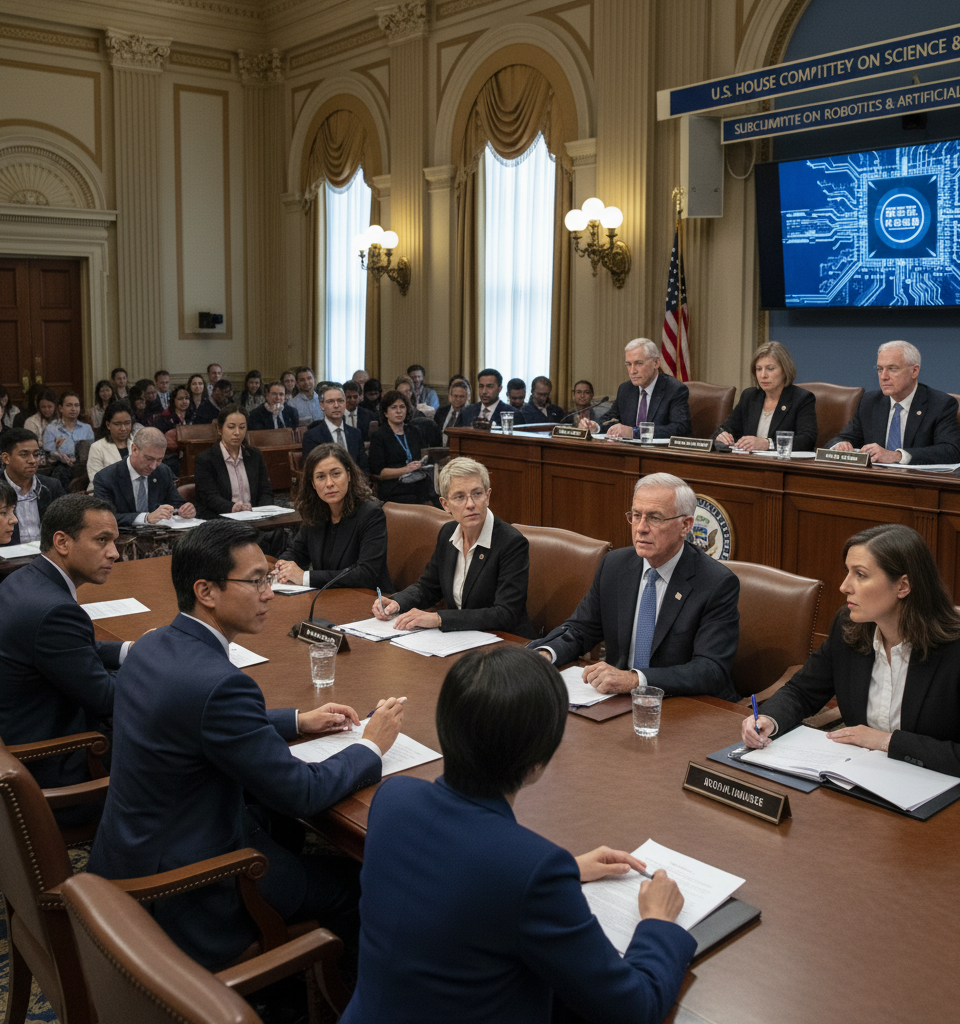
Washington D.C. — Robotics stakeholders testified before a congressional subcommittee on Tuesday, issuing a stark warning that the United States is rapidly falling behind China in the critical fields of robotics and artificial intelligence. Experts from industry and academia urged immediate federal support and policy initiatives to prevent the nation from losing its competitive standing in this pivotal technological race.
The Looming Threat to U.S. Dominance
This urgent call reflects a growing concern within the tech and defense sectors that the U.S.'s fragmented approach to AI and robotics development is no match for China's centralized, well-funded national strategy. The implications extend beyond economic competitiveness, touching upon national security, manufacturing resilience, and future workforce development. For decades, the U.S. has been a global leader in technological innovation, but the rapid advancements and aggressive investment by countries like China in AI-powered robotics threaten to reshape the global power balance. The semiconductor shortage during the pandemic and rising geopolitical tensions have further underscored the vulnerability of supply chains and the importance of domestic technological self-reliance.
Key Calls for Action During the subcommittee hearing, witnesses emphasized several critical areas requiring federal attention. Dr. Helen Chang, CEO of Quantum Robotics
Corp., highlighted the need for significant government funding comparable to initiatives seen in space exploration or the internet's early development. “We're talking about a multi-billion dollar investment over the next five to ten years, not just grants, but strategic partnerships,” Chang stated. She particularly pointed to China's Made in China 2025 initiative, which allocates immense resources to dominate high-tech sectors, including robotics and AI. Another key recommendation was the establishment of interagency coordination to streamline research, development, and deployment efforts, currently fragmented across various federal agencies. Furthermore, witnesses advocated for talent pipeline development, including STEM education reforms and immigration policies that attract and retain top AI and robotics researchers.
Industry and Market Implications Failure to act could have profound consequences for
U.S. industries. The manufacturing sector, in particular, stands to lose out on increased productivity, efficiency, and competitiveness that advanced robotics offer. Companies reliant on automation for complex tasks, from automotive assembly to precision agriculture, may find themselves at a disadvantage if foreign competitors acquire superior, federally-backed robotic solutions. The global market for robotics is projected to reach over $260 billion by 2030, with AI integration driving much of this growth. A significant portion of this market could be dominated by non-U.S. entities, leading to job losses in high-value sectors and a decline in patented innovations originating from the United States. Moreover, defense applications of robotics and AI are becoming increasingly critical, making national leadership in these areas a matter of strategic imperative.
Expert Perspectives on the Path Forward
Analysts generally agree on the urgency of the situation. Dr. Marcus Thorne, a senior fellow at the Center for Strategic and International Studies (CSIS), remarked, “This isn't just about economic competition; it's about defining the next century's geopolitical landscape. The nation that masters AI and robotics will hold unparalleled influence.” He stressed that while private sector innovation is crucial, foundational research and high-risk, high-reward projects often require substantial government backing. Thorne also pointed out that merely investing in research is not enough; policies must also facilitate the rapid commercialization and adoption of these technologies across industries, an area where the U.S. has historically excelled but is now competing against more centrally planned economies.
The Roadmap Ahead
The testimony on Capitol Hill serves as a critical juncture for U.S. policy makers. The immediate next steps include potential legislative proposals aimed at increasing funding for robotics and AI research through agencies like the National Science Foundation (NSF) and the Defense Advanced Research Projects Agency (DARPA). There is also growing discussion around the creation of a National Robotics and AI Strategy Office to coordinate efforts. Successful implementation would require bipartisan support and a sustained commitment of resources over many years, mirroring the sustained investments made in other era-defining technologies. The hope is that by engaging now, the U.S. can not only close the gap but reassert its leadership in a field that promises to redefine industries and societies globally.