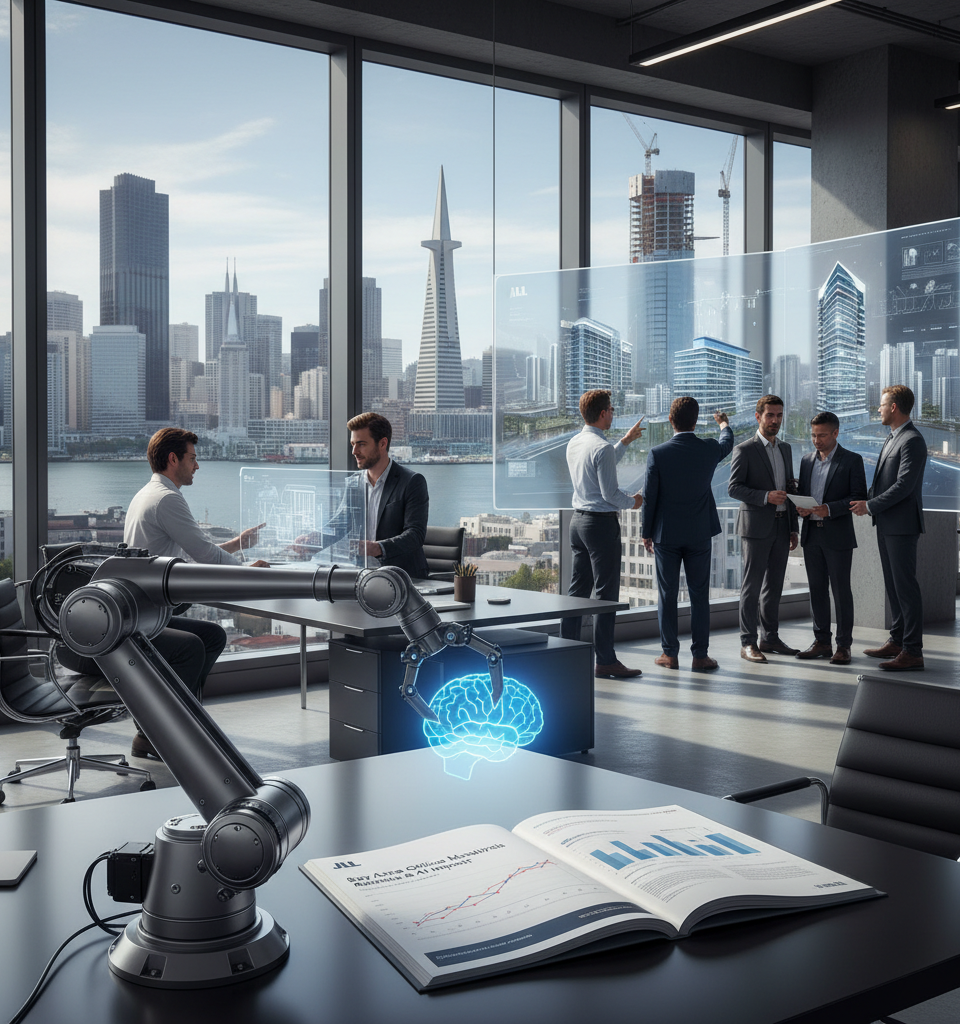
Robotics Roars: AI-Fueled Boom Drives Bay Area Office Market Surge
rob.sabo@bisnow.com•April 21, 2026•4 min read
Key Takeaways
Read this first — then go as deep as you need.
Robotics Sector Fuels Bay Area Office Market Expansion Amidst AI Surge SAN FRANCISCO – The burgeoning artificial intelligence revolution has ignited an unprecedented expansion within the robotics sector, leading to a significant surge in office space demand across the Bay Area. According to new research from commercial real estate giant JLL, robotics companies have dramatically increased their physical footprint over the past six years, becoming a prominent force in the region's commercial leasing market. This trend underscores AI's profound impact, not only on technological innovation but also on the more traditional dimensions of economic activity, such as real estate development and urban planning. This explosive growth in robotics directly reflects the heightened investment and rapid advancements in artificial intelligence. As AI becomes more sophisticated and integrated into various applications, the demand for physical spaces where these complex systems can be designed, tested, and commercialized has become critical. The Bay Area, a global epicenter for technological innovation, naturally serves as the primary incubator for these companies, necessitating larger and more specialized office and R&D facilities. This phenomenon is not merely an isolated sector boom but rather a bellwether for how AI-driven industries are reshaping urban economic landscapes. Key data from JLL's report illustrates the magnitude of this shift. Over the past six years, the occupied office space by robotics firms in the Bay Area has seen a substantial increase, significantly outpacing other technology sub-sectors. While specific square footage figures were not publicly disclosed in the initial description, the report emphasizes that this growth is directly correlated with the maturation and commercial viability of AI technologies. This expansion includes not only traditional office environments but also specialized laboratory and manufacturing spaces, indicating a comprehensive growth across R&D, production, and administrative functions. The demand is particularly pronounced in submarkets known for their tech concentration, such as Silicon Valley and certain parts of San Francisco. This robust appetite for office space by robotics companies is having a discernible impact on the broader Bay Area commercial real estate market. In an era where many traditional office tenants are re-evaluating their space needs due to remote work trends, the robotics sector provides a vital counter-cyclical demand driver. It signifies a diversification of the tenant base beyond enterprise software and social media, contributing to the market's resilience. The increased competition for prime locations could also lead to upward pressure on lease rates in specific tech-centric corridors, challenging for new entrants but beneficial for property owners and developers. Industry experts and analysts are closely monitoring this trend. "The robotics boom is a tangible manifestation of the 'AI effect' on the physical economy," notes Dr. Evelyn Chen, a technology market analyst at PropTech Ventures. "These aren't just software companies; they often require advanced facilities for hardware development, prototyping, and testing. This creates a distinct demand profile that developers are keenly responding to." She suggests that this sector's growth could also spur innovation in building design, with an increasing need for flexible spaces that can accommodate both traditional office work and specialized lab functions, often with enhanced power, cooling, and security requirements. Looking ahead, the trajectory of the robotics sector's office demand appears strong. Continued investment in AI, coupled with the increasing commercialization of robotics across logistics, healthcare, manufacturing, and consumer services, is expected to sustain this expansion. Developers and landlords are likely to increasingly tailor their offerings to meet the specific requirements of these advanced technology tenants. Future developments may include purpose-built campuses or specialized innovation hubs designed to foster collaboration and provide the infrastructure necessary for cutting-edge robotics R&D and deployment, further cementing the Bay Area's status as a global leader in AI and automation.
Discussion
Join the discussion
Sign in to leave a comment on this article.
Loading comments...
Enjoying this article?
Get more like it delivered to your inbox — free.
This article was compiled by GlobalSell News from publicly available reporting and has been edited for clarity and length. For full details, read the original source.