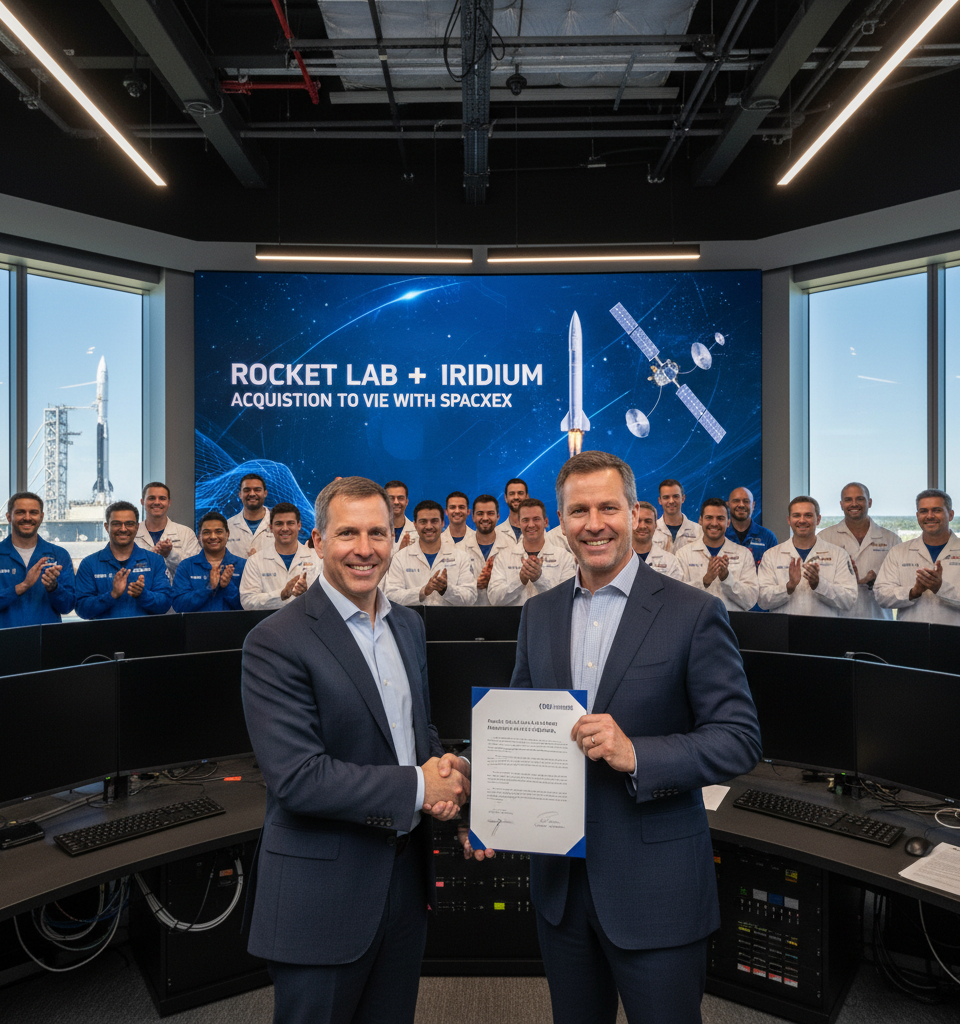
In a significant development that could reshape the competitive landscape of the commercial space industry, Rocket Lab, a leading space launch and spacecraft manufacturer, is reportedly eyeing the acquisition of satellite communications company Iridium. This strategic maneuver is poised to dramatically bolster Rocket Lab's operational footprint and grant it critical assets, including a well-established satellite constellation and a suite of wireless capabilities, directly challenging SpaceX's dominance in integrated space services. The proposed deal, if materialized, represents a bold escalation in Rocket Lab's ambition to become a full-spectrum provider in the space economy.
Strategic Rationale and Market Context
This potential acquisition underscores a growing trend in the space industry: vertical integration. Companies are increasingly looking to control more aspects of the value chain, from launch services to satellite manufacturing and in-orbit operations. For Rocket Lab, established as a key player in small satellite launches and satellite component manufacturing, the purchase of Iridium would unlock immediate access to a seasoned operator of a sophisticated Low Earth Orbit (LEO) satellite network.
Iridium's constellation, known for its global coverage and reliable communication services, offers a critical foundation upon which Rocket Lab could build expanded offerings. The move is not merely about acquiring assets, but about securing the infrastructure and expertise necessary to offer end-to-end solutions that rival the comprehensive services provided by SpaceX, particularly its Starlink internet constellation.
Leveraging Iridium's Assets
At the heart of this potential deal lies Iridium's extensive network and proprietary technologies. Iridium operates a constellation of 66 active LEO satellites, providing voice and data communication to areas beyond the reach of terrestrial networks. This includes critical services for maritime, aviation, government, and emergency response sectors.
By integrating Iridium's existing fleet and ground infrastructure, Rocket Lab would gain immediate operational capacity in satellite communications, bypassing years of independent development and deployment. The wireless resources inherited from Iridium would be invaluable, enabling Rocket Lab to explore new service offerings, from enhanced Earth observation data transmission to in-orbit services and potentially even connectivity solutions that could compete with Starlink on specific niches or enterprise markets. The strategic control over both launch vehicles (Electron rocket) and satellite operations would create powerful synergies, allowing for optimized mission planning, reduced costs, and accelerated deployment cycles for its own and future client satellites.
Industry Impact and Competitive Landscape
The aerospace and defense sector, currently dominated by a few major players like SpaceX, Boeing, and Lockheed Martin, could see a significant shake-up with this development. Rocket Lab, often seen as an innovator in the small launch market, would transform into a more formidable, horizontally integrated enterprise. This potential consolidation highlights the intense competition for market share in the rapidly expanding space economy, which encompasses everything from satellite internet and Earth imaging to space tourism and lunar missions.
The acquisition would likely intensify the race to provide comprehensive space-based solutions, potentially driving innovation and reducing costs across the industry as companies strive to maintain a competitive edge. Other players in the satellite communications and launch services markets would undoubtedly be watching closely, potentially reassessing their own strategies for growth and integration.
Analyst Perspectives and Future Implications
While specific analyst comments on this particular speculative acquisition are not available, market observers have long highlighted the strategic advantages of vertical integration in the space industry. Companies that can control multiple facets of a mission – from payload design and manufacturing to launch and in-orbit operations – are better positioned to offer competitive pricing, ensure mission success, and innovate faster. A merger with Iridium would provide Rocket Lab with a diversified revenue stream, reducing its reliance solely on launch services and opening up significant opportunities in the high-growth satellite services market.
The enhanced capabilities could also attract a broader array of government and commercial clients seeking a single provider for complex space endeavors. This move could ultimately accelerate Rocket Lab's long-term vision of becoming a comprehensive space systems provider, capable of end-to-end space missions from Earth to orbit and beyond.
Looking ahead, if the deal proceeds, Rocket Lab would likely focus on optimizing the integration of Iridium's existing operations while simultaneously exploring new applications for the combined entity's resources. This could include developing next-generation satellite platforms that leverage Rocket Lab's manufacturing expertise with Iridium's communication infrastructure, or expanding into new geosynchronous or lunar communication services. The immediate challenge would be to seamlessly integrate two distinct corporate cultures and technologies, ensuring that the combined entity operates with maximum efficiency and innovation. The ultimate goal, however, would clearly be to carve out a larger, more influential role in a space industry increasingly defined by large, integrated players.