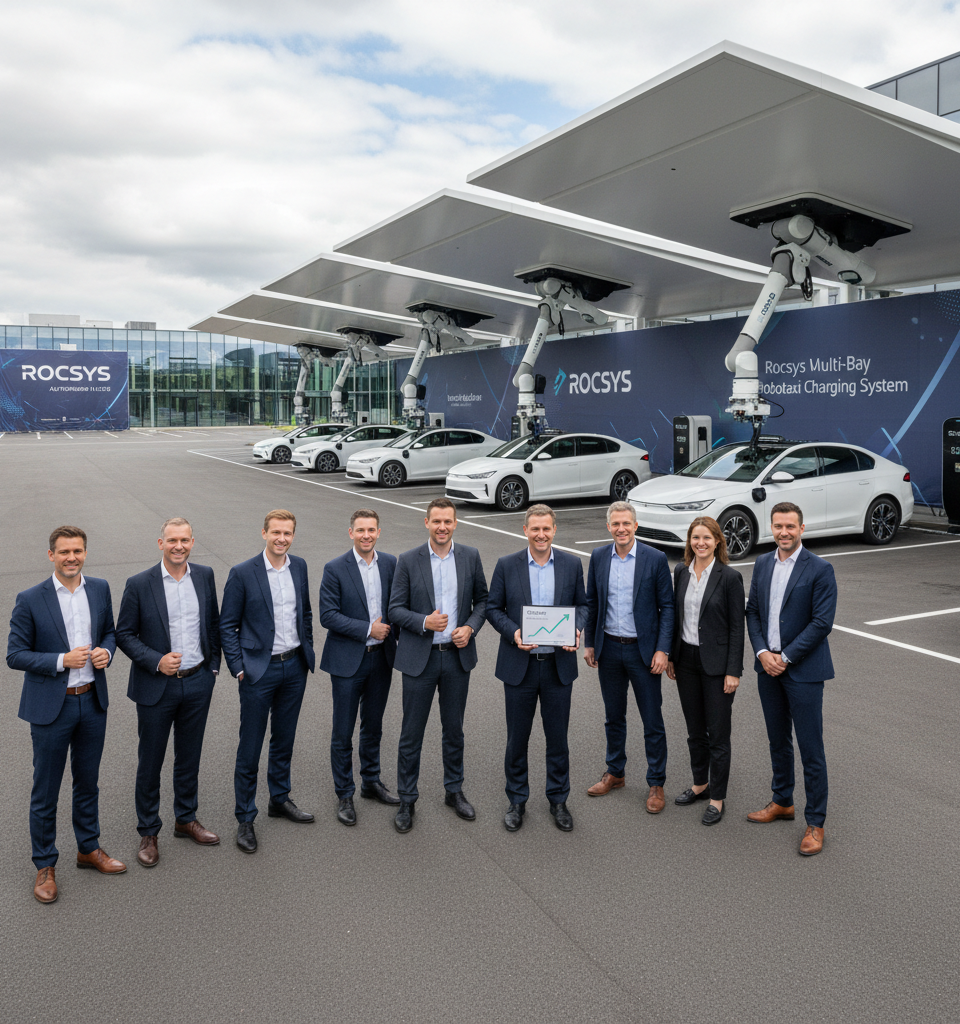
Rocsys, a Dutch pioneer in autonomous charging technology, announced today a substantial $13 million funding injection and the pilot deployment of its M1 multi-bay robotaxi charging system. The investment round was strategically led by Scania Invest, the corporate venture capital arm of the Swedish truck and bus manufacturer Scania, and Capricorn Partners, a European venture capital firm, signaling robust support for the company's autonomous charging solutions. This capital infusion is earmarked to scale the M1 system, which promises to revolutionize the operational efficiency of autonomous vehicle fleets by automating a critical infrastructure bottleneck.
The genesis of Rocsys's innovation addresses a quiet, yet significant, operational irony within the burgeoning robotaxi sector. While autonomous vehicles seamlessly navigate urban landscapes, the prosaic task of recharging has traditionally remained largely human-dependent, creating a choke point in scaling operations. Rocsys's M1 system directly tackles this inefficiency, offering a fully automated, hands-free charging solution. The system's ability to service multiple vehicles concurrently without requiring human oversight is poised to significantly reduce operational costs and enhance uptime for robotaxi operators, thereby accelerating the broader commercialization of autonomous mobility.
Central to this advancement is the M1, an overhead rail-mounted robot designed to charge up to ten vehicles per unit. This ingenious design maximizes bay utilization and throughput, a critical factor for high-volume autonomous fleets. The system is currently entering pilot deployment, with a full-scale rollout anticipated in 2027. Key technical specifications include its precision robotic arm, which utilizes advanced computer vision and soft-robotics to ensure reliable and gentle connection to vehicle charging ports, accommodating slight parking inaccuracies. This technological sophistication underpins the system's ability to operate around the clock, minimizing downtime and maximizing vehicle availability. The $13 million funding, a mix of equity and venture debt, will primarily support R&D, manufacturing scale-up, and strategic market expansion.
Industry & Market Impact
The introduction of Rocsys's M1 system is set to have a profound impact on the autonomous vehicle industry, particularly within the robotaxi and logistics sectors. By automating the charging process, Rocsys is effectively removing a major human labor component, which is a significant operational expenditure for fleet operators. This not only optimizes cost efficiency but also enhances the safety of charging operations, eliminating potential human errors associated with manual plug-ins.
The ability to charge multiple vehicles simultaneously in a compact footprint also addresses the challenges of limited urban space and power infrastructure, making autonomous fleet deployment more viable in dense environments. This innovation could catalyze the expansion of robotaxi services into new markets and significantly improve the utilization rates of existing fleets, driving down per-mile costs for consumers.
Expert Perspective
Industry analysts view Rocsys's development as a crucial step towards the widespread adoption of Level 4 and Level 5 autonomous vehicles. "The bottleneck for autonomous fleets has always been the 'last mile' of operation, and that includes infrastructure like charging," states Dr. Elena Petrova, an automotive technology analyst at Global Insight Group. "Rocsys's multi-bay solution could be a game-changer, pushing the industry closer to truly lights-out operations where human intervention is minimized across the entire value chain. The backing from Scania Invest is particularly telling, indicating a strategic alignment with future autonomous logistics and trucking solutions, not just passenger transport." Analysts estimate that automated charging could reduce fleet operational costs by 15-20% in the long term by improving efficiency and reducing labor dependency.
Future Implications & Next Steps
Looking ahead, Rocsys plans to leverage its latest funding to accelerate manufacturing and expand its engineering team, aiming to meet the demand for its M1 system. The company is actively collaborating with several leading autonomous vehicle developers and mobility service providers on the pilot programs, which will provide invaluable real-world data for further refinement of the technology. Beyond robotaxis, Rocsys sees significant potential for its automated charging technology in other segments, including autonomous trucks, warehouse logistics, and potentially even passenger electric vehicle charging stations as vehicle autonomy proliferates.
The planned scale-up for 2027 positions Rocsys to become a critical enabler for the next generation of electric and autonomous mobility, establishing the foundational infrastructure necessary for a truly self-sufficient transportation ecosystem. Further integration with smart grid technology and bidirectional charging capabilities are also on the company's long-term roadmap.