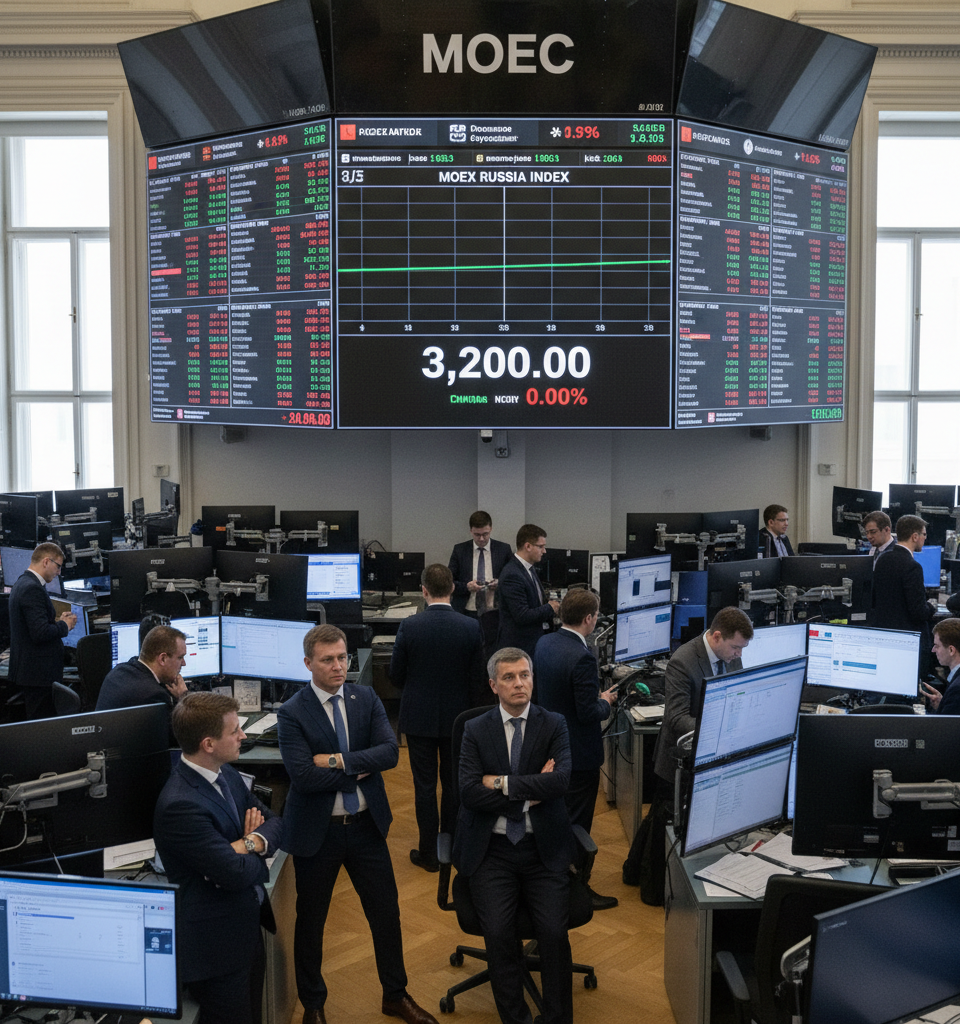
Russian Market Stagnates Amidst Geopolitical Uncertainty
Moscow, Russia — Russian equities concluded today's trading session largely flat, as the MOEX Russia Index registered an unchanged performance, underscoring a cautious sentiment among investors. The lack of significant movement reflects the ongoing influence of geopolitical pressures and a volatile global economic environment on the nation’s financial markets. Despite some minor intraday fluctuations in individual securities, the broader market remained anchored, signaling a wait-and-see approach from domestic and international participants.
A Landscape Shaped by Sanctions and Commodity Volatility
This period of market stagnation is not an isolated event but rather a continuation of trends observed since the imposition of extensive international sanctions following events in early 2022. The Russian economy has been forced to reorient significant portions of its trade and investment flows, leading to a largely domestic-driven market. The benchmark MOEX Russia Index, which primarily tracks the performance of the largest and most liquid Russian companies listed on the Moscow Exchange, has shown resilience but also a limited upside due to capital controls and restricted foreign investment. Historically, Russian markets have been heavily influenced by global oil and gas prices, given the nation's significant role as an energy exporter. While these commodity revenues continue to underpin the economy, the mechanisms by which they translate into stock market performance have been altered by external factors and internal policy responses.
Key Factors Influencing Market Inertia
Several factors contributed to today's flat close. Volume remained moderate, indicating limited speculative activity. While specific sector performance varied, with some energy and metals companies experiencing minor gains driven by commodity price movements, these were largely offset by declines in other sectors, particularly those with higher domestic consumer exposure. The Russian Central Bank's monetary policy, aimed at managing inflation and maintaining financial stability, also plays a crucial role in shaping market sentiment. High interest rates, while curbing inflation, can temper corporate investment and consumer spending, thus impacting company valuations. Furthermore, the ongoing impact of exit proceedings for foreign companies and the absorption of their assets into the domestic market continue to create both opportunities and uncertainties for local investors.
Broader Economic Implications and Industry Impact
The lack of significant directional movement in the MOEX index implies that the market is currently in a holding pattern, assimilating both internal economic policies and external geopolitical developments. The energy sector, comprising a substantial portion of the MOEX index, remains a critical determinant of overall market health. While oil prices have seen some fluctuations recently, the impact on Russian energy giants like Gazprom and Rosneft is often filtered through export quotas and evolving trade partnerships. The financial sector, represented by major banks such as Sberbank and VTB, is also navigating a landscape of restricted access to international capital markets and a focus on domestic lending and services. This stability, or lack of dynamism, suggests a market adapting to its new realities rather than anticipating a dramatic shift.
Expert Insights on Russia's Market Outlook
Market analysts generally interpret the current stability as a reflection of the market's successful adaptation to sanctions, but also its constrained growth potential. "The Russian market, while largely isolated from traditional Western capital, has found its equilibrium," stated Dr. Elena Petrova, a senior economist specializing in emerging markets at the Institute for Global Economics in Moscow. "Domestic liquidity and state-backed investments are providing a floor, but significant upward trajectory is challenging without a resolution to geopolitical tensions and a resumption of broader international capital flows." Other analysts point to the robust performance of some domestic industrial sectors, benefiting from import substitution policies, as a potential, albeit limited, driver for future growth.
The Path Forward: Geopolitical Shifts and Economic Diversification
Looking ahead, the trajectory of the Russian stock market will continue to be inextricably linked to geopolitical developments and the evolution of global energy markets. Any significant shifts in international relations or unexpected fluctuations in commodity prices could trigger more pronounced movements. Internally, the government's efforts towards economic diversification and enhancing domestic consumption will be critical for fostering sustainable growth beyond the energy sector. Investors will be closely watching upcoming corporate earnings reports for signs of resilience or strain within specific industries, as well as any indications of shifts in monetary or fiscal policy that could either stimulate or dampen market activity. The MOEX Index is likely to remain responsive to these multifaceted pressures in the coming months, reflecting the ongoing complexities of the Russian economic narrative.