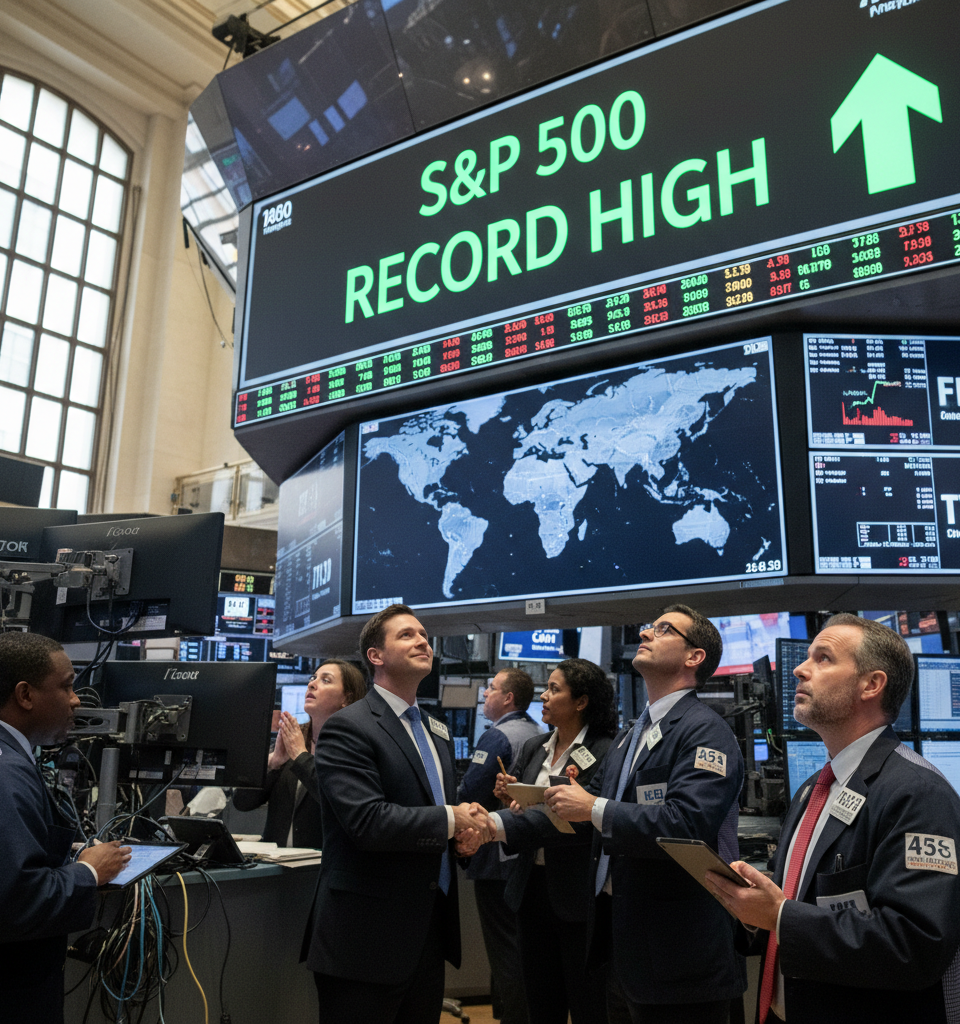
Historical Precedent: Market Resilience Amidst Conflict
This phenomenon is not new. A comprehensive review of market reactions to geopolitical events over the past century reveals a consistent trend: while initial shocks from conflicts can trigger volatility and temporary dips, the broader market typically recovers and often achieves new highs within a relatively short period. For instance, during the onset of the Gulf War in 1990-91, the S&P 500 experienced a brief decline before staging a significant recovery. Similarly, in the wake of the September 11th attacks in 2001, the market saw a sharp but short-lived contraction before resuming its upward trajectory. This historical context provides crucial perspective, suggesting that robust economic fundamentals and corporate earnings tend to be more dominant long-term drivers of market performance than transient geopolitical frights.
Key Drivers Beyond Geopolitics
Several factors are contributing to the S&P 500's current ascent. Strong corporate earnings reports from major tech and industrial companies have significantly bolstered investor sentiment. Furthermore, receding inflation concerns and the anticipation of potential interest rate cuts by the Federal Reserve later in the year are painting a more optimistic economic outlook. Technology stocks, in particular, continue to be a powerhouse, with several prominent firms reporting better-than-expected profits and revenue growth, driving a substantial portion of the index's gains. For example, a recent earnings call from a leading tech giant reported a 15% year-over-year increase in revenue, significantly exceeding analyst expectations.
Broader Market Dynamics and Investor Behavior
The record highs in the S&P 500 extend beyond just a few sectors, indicating broad-based market strength. This suggests a maturing investor demographic that is increasingly sophisticated in distinguishing between short-term noise and long-term value. Rather than panicking, institutional investors and long-term retail investors appear to be capitalizing on any temporary dips as buying opportunities. This disciplined approach underscores a shift away from reactive trading based on headlines towards a more fundamentally driven investment strategy. The current market valuation, while high, is being justified by strong corporate balance sheets and projected future earnings growth.
Expert Analysis: A Call for Long-Term Vision
Market strategists and financial analysts are largely in agreement regarding the market's resilience. Dr. Elara Vance, Chief Economist at Global Financial Insights, commented, "The S&P 500's new peak is a powerful reminder that short-term geopolitical headlines often present more noise than substance for long-term investors. Our research consistently shows that market fundamentals – corporate profitability, economic growth, and monetary policy – are the true navigators of equity performance over time." She added, "While caution is always warranted, the data suggests that selling en masse during global crises typically leads to missed opportunities for significant gains as markets inevitably recover."
Implications for Investment Strategy
For investors, the current market environment reinforces the importance of a well-diversified portfolio and a long-term investment horizon. Attempting to time the market based on breaking news of conflicts has historically proven to be a losing proposition. Instead, maintaining a strategic asset allocation and consistently investing, perhaps through dollar-cost averaging, appears to be a more prudent approach. The allure of quick profits or the fear of immediate losses can often overshadow the underlying strength of diversified equity markets.
What Lies Ahead: Continued Vigilance and Potential Headwinds
Looking forward, while the S&P 500's trajectory appears strong, potential headwinds remain. Lingering inflationary pressures, unpredictable shifts in central bank policy, and the possibility of new geopolitical flashpoints could introduce renewed volatility. However, the market's demonstrated ability to digest and overcome past challenges suggests that any future pullbacks might also be viewed as opportunities rather than reasons for capitulation. Investors will be closely watching upcoming unemployment figures and CPI data, as well as the Federal Reserve’s next policy decision, for further cues on economic direction and market sentiment. Continued vigilance, coupled with a fundamental understanding of market dynamics, will be key to navigating the evolving landscape.