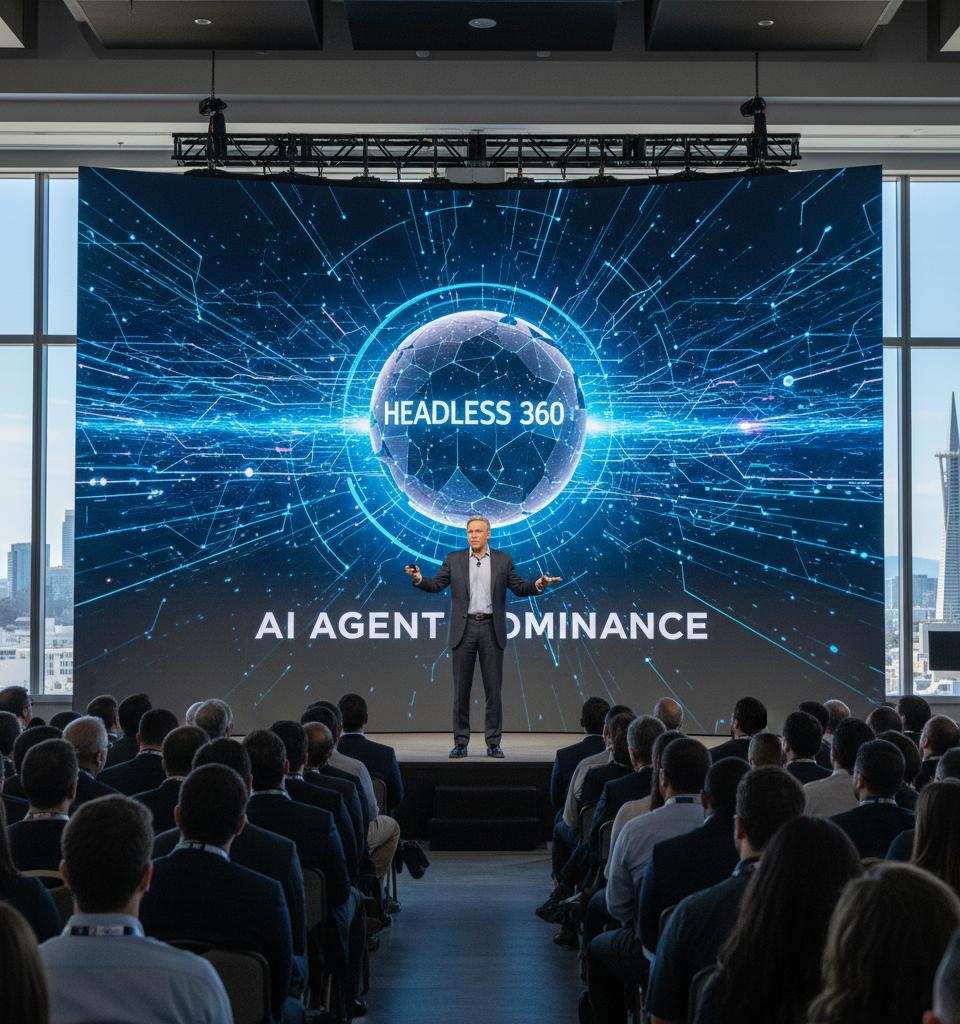
SAN FRANCISCO, CA – Salesforce, the global leader in CRM, on Wednesday unveiled its most ambitious architectural transformation to date, launching "Headless 360" at its annual TDX developer conference. This sweeping initiative reimagines the company's entire platform as infrastructure for AI agents, exposing every capability through APIs, low-code/no-code tools (MCP), and CLI commands. The move eliminates the need for AI agents to interact via traditional graphical user interfaces, signaling a profound shift towards an AI-native operational paradigm across its vast ecosystem.
The announcement, which immediately makes more than 100 new tools and skills available to developers, represents a strategic pivot for Salesforce. For nearly three decades, the company has championed the application-centric model. With Headless 360, Salesforce is effectively decomposing its monolithic platform into atomized, programmable components, laying the groundwork for a future where AI agents, rather than human users navigating browsers, are the primary operators of enterprise systems. This isn't merely an enhancement; it's a fundamental re-architecture designed to capitalize on the burgeoning artificial intelligence revolution.
Core Components and Immediate Impact
Headless 360 isn't a singular product but a conceptual umbrella encompassing a suite of developer tools and architectural principles. Key to its immediate rollout are enhanced APIs for core Salesforce functionalities, expanded capabilities for its MuleSoft integration platform, and a comprehensive set of CLI commands that allow developers to programmatically interact with the platform. This means that an AI agent could, for example, autonomously create complex CRM workflows, manage customer data, or even provision cloud resources without requiring human intervention through the traditional Salesforce UI. The availability of over 100 new tools and skills upon release empowers developers to immediately begin integrating and building AI-driven solutions atop this new infrastructure.
Strategic Rationale and Future Vision
The strategic impetus behind Headless 360 is clear: positioning Salesforce at the forefront of the AI-driven enterprise. As AI agents become more sophisticated and prevalent, the ability for them to seamlessly interact with enterprise software will be paramount. Salesforce aims to be the foundational layer for this interaction. The company envisions a future where AI agents can autonomously manage sales pipelines, execute marketing campaigns, and provide customer service, significantly boosting efficiency and innovation. This also positions Salesforce to better compete with emerging AI-first platforms and maintain its dominance in a rapidly evolving technological landscape.
Industry and Market Implications
The implications of Headless 360 extend far beyond Salesforce's immediate ecosystem. For the broader enterprise software market, this move sets a precedent for how legacy platforms can adapt to an AI-native future. It validates a 'headless' approach, pushing other vendors to consider exposing their entire stack programmatically. This could accelerate the development of a new generation of AI-powered enterprise applications and services, foster greater interoperability between disparate systems, and potentially disrupt traditional software consumption models. Developers gain unprecedented programmatic control, fostering an explosion of innovation that could see AI agents taking on increasingly complex tasks across the enterprise.
Expert Perspectives
Industry analysts are largely positive about Salesforce's bold move. "This is not just an incremental update; it's a foundational shift," commented Sarah Chen, a senior analyst at Tech Insights. "Salesforce is acknowledging that the future of enterprise software is not just AI-enhanced, but AI-operated. Headless 360 positions them to be the backbone of that future, allowing their vast customer base to integrate advanced AI capabilities much more deeply than ever before." Another expert, Dr. Alan Reed, a professor of computer science specializing in AI, noted, "By making every capability an API, Headless 360 significantly lowers the barrier for AI systems to interact with complex business logic. This could usher in a new era of 'composable AI' for the enterprise."
What's Next: Evolution and Expansion
The initial rollout of Headless 360 is merely the beginning. Salesforce is expected to continuously expand the range of exposed capabilities and tools, driven by developer feedback and the rapid advancements in AI technology. Future iterations could include more sophisticated AI governance tools, enhanced support for various large language models (LLMs), and deeper integration with external AI services. The company also anticipates fostering a robust ecosystem of third-party developers and partners who will build AI agents and solutions leveraging this new headless architecture. This strategic play ensures Salesforce remains central to the enterprise's digital transformation, even as AI reconfigures the very definition of software interaction.
Salesforce's Headless 360 represents a crucial turning point, not only for the company but for the enterprise software industry at large. It's a clear declaration that the era of AI-native operations is upon us, and Salesforce intends to lead the way by providing the foundational infrastructure for that revolution.