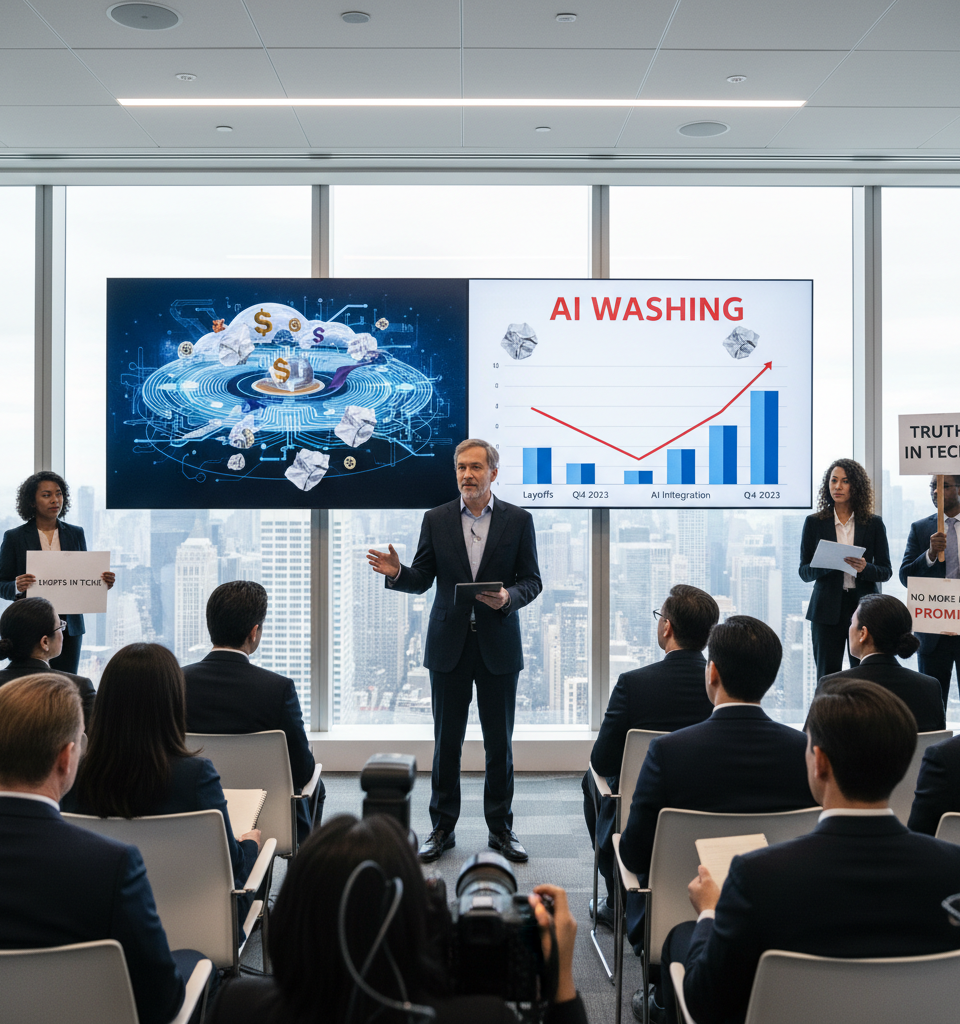
Sam Altman, the influential CEO of OpenAI, recently broke ranks with some industry narratives, openly admitting that certain companies are engaging in 'AI washing.' This strategic misdirection involves executives blaming artificial intelligence for job cuts that may, in fact, stem from unrelated business inefficiencies or economic pressures. Altman’s remarks, made during a recent industry conference, underscore a significant disconnect between current public perception and the reality of AI's nascent impact on employment figures, urging a more transparent dialogue regarding technological disruption and its economic consequences.
Context and Background
The discussion around AI's impact on employment has been a contentious one, fluctuating between alarmist predictions of widespread job losses and optimistic views of new job creation. Historically, disruptive technologies like the internet or automation have reshaped labor markets, often leading to initial displacement followed by economic growth and new opportunities. However, the speed and pervasive nature of AI's advancement have fueled anxieties that this technological revolution might be different. Altman's candidness arrives at a time when many economists are reporting no discernible signal of AI-related job displacement within current labor market data, suggesting that while AI is rapidly progressing, its direct influence on employment statistics has yet to fully materialize in aggregate economic indicators.
Key Details and Quotes
Altman, whose company is at the forefront of AI development, stated unequivocally that some executives are using AI as a convenient scapegoat. “I’ve heard from, like, 10 different people, ‘Oh, we did some layoffs, and a lot of that was just because of AI,’” Altman reportedly said, adding a telling caveat: “And I’m like, I actually know what your company does; AI had literally nothing to do with that.” This direct challenge to corporate narratives suggests a trend where companies might be leveraging the mystique and fear surrounding AI to rationalize difficult business decisions. While specific companies were not named, the implication is that this 'AI washing' is not an isolated incident but a pattern observed across various sectors.
Industry and Market Impact
This phenomenon has significant implications for businesses, employees, and investors. For businesses, misattributing layoffs can erode trust, impacting employee morale and public perception. It also risks diverting attention from genuine strategic issues that need addressing. In the talent market, it can fuel unnecessary fear and resistance to genuine AI integration, potentially hindering productivity gains where AI could truly augment human capabilities. Investors might also be misled by such narratives, misjudging a company's fundamental health or its true competitive advantages in AI adoption. The long-term societal impact could include delayed governmental responses to future AI-driven workforce shifts as initial data points are obscured or misrepresented.
Expert Perspective
Economists and labor market analysts remain divided on the immediate threat of widespread AI-induced job displacement. Many, like those at the Federal Reserve, point to robust job growth numbers and a low unemployment rate of approximately 3.7% nationally as evidence against immediate, significant AI impact. However, some acknowledge that the lag effect is a crucial factor, positing that the full ramifications of generative AI, particularly in white-collar and knowledge-based roles, may not become apparent for several quarters or even years. Dr. Sarah Chen, a labor economist, commented, “While current data shows no dramatic shift, history teaches us that technological disruptions often unfold in stages. Altman’s comments, though anecdotal, align with concerns about the incipient stages of displacement and the ethical responsibilities of corporate leaders during such transitions.”
What's Next?
Altman's predictions are stark: he believes it is “just a matter of time” until significant AI-related job displacement becomes undeniable in labor data. This future scenario necessitates proactive measures from policymakers, educators, and businesses. Discussions are already emerging around universal basic income, extensive reskilling programs, and new regulatory frameworks to manage the ethical deployment of AI.
Companies face increasing pressure to adopt more transparent communication strategies regarding their technology adoption and layoff rationales. ' The trajectory of AI's integration into the global economy will largely depend on how these early ethical and economic quandaries are addressed by technology leaders and government bodies alike.