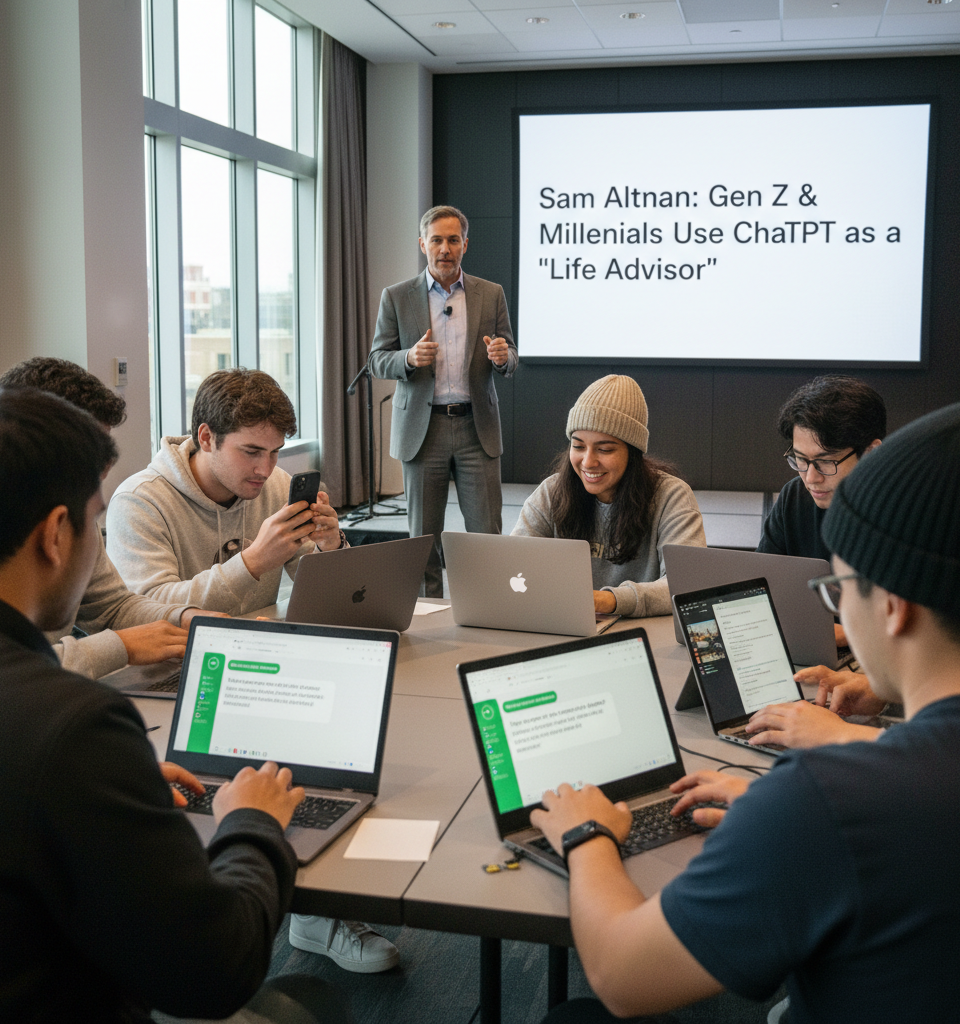
Sam Altman, the influential CEO of OpenAI, recently highlighted a burgeoning trend: younger demographics are engaging with artificial intelligence in ways that extend far beyond initial expectations. Speaking at a Sequoia Capital event, Altman remarked that Gen Z and millennials are actively utilizing ChatGPT not merely as an information retrieval tool, but as a comprehensive 'life advisor.' This observation underscores a significant shift in user behavior, particularly among college students, who are reportedly crafting intricate workflows and consulting AI before making substantial personal decisions.
The Evolving Role of AI in Daily Life
This phenomenon marks a pivotal moment in the public's adoption of advanced AI. Initially perceived by many as a novelty or a basic productivity enhancer, ChatGPT is now being integrated into the fabric of daily life for a generation that grew up with ubiquitous digital tools. Altman’s comments suggest that the utility of AI is expanding to encompass nuanced personal guidance, from academic choices to career paths and even social interactions. This indicates a growing trust in AI's analytical capabilities and its potential to offer diverse perspectives on complex personal challenges.
A New Paradigm of Decision-Making
Altman specifically noted the ingenuity of college students, describing their use of ChatGPT as exceptionally advanced. He observed that these students “don't really make life decisions without asking ChatGPT what they should do,” indicating a deep reliance and integration. This level of engagement goes beyond simple prompts; it involves building sophisticated, multi-step AI workflows to analyze scenarios, weigh potential outcomes, and propose recommendations. Such advanced usage suggests an intuitive understanding of AI's capabilities and limitations, allowing them to extract maximum value from the technology.
Industry Implications and Generational Divides
This evolving pattern of AI adoption carries significant implications for various industries. For technology companies, it validates the accelerating investment in AI research and development, pointing towards a future where AI-powered personal assistants are commonplace. For educational institutions, it prompts a reevaluation of teaching methodologies and digital literacy, as students increasingly outsource certain cognitive tasks to AI. Moreover, it highlights a potential generational divide, where digital natives are pioneering new applications of AI, while older generations may still view it with skepticism or primarily as a professional tool.
Expert Perspectives on AI as a 'Life Advisor'
Experts in AI ethics and psychology offer varied perspectives on this trend. Dr. Anya Sharma, a leading AI ethicist, cautions that while AI can provide valuable insights, it lacks genuine understanding of human nuance, emotion, and lived experience. “Relying solely on AI for life decisions could lead to a 'filter bubble' of advice, potentially narrowing perspectives or reinforcing biases present in the training data,” she states. Conversely, Dr. David Chen, a cognitive scientist researching human-AI interaction, sees it as a natural progression. “For a generation accustomed to seeking information and validation online, AI offers an incredibly efficient way to process complex problems, akin to having an always-available sounding board,” Chen elaborates. This dual perspective underscores the need for continued critical evaluation and responsible deployment of AI technologies.
The Future of Human-AI Collaboration
Looking ahead, Altman's observations paint a picture of a future where the line between human and artificial intelligence blurs further in personal decision-making. The advancements in large language models, coupled with increasingly intuitive interfaces, are likely to make AI 'life advisors' even more accessible and sophisticated. This could lead to new ethical frameworks, regulatory considerations for AI's influence on personal choices, and a paradigm shift in how individuals seek guidance and make critical decisions, potentially fostering unprecedented levels of human-AI collaboration in navigating the complexities of modern life.