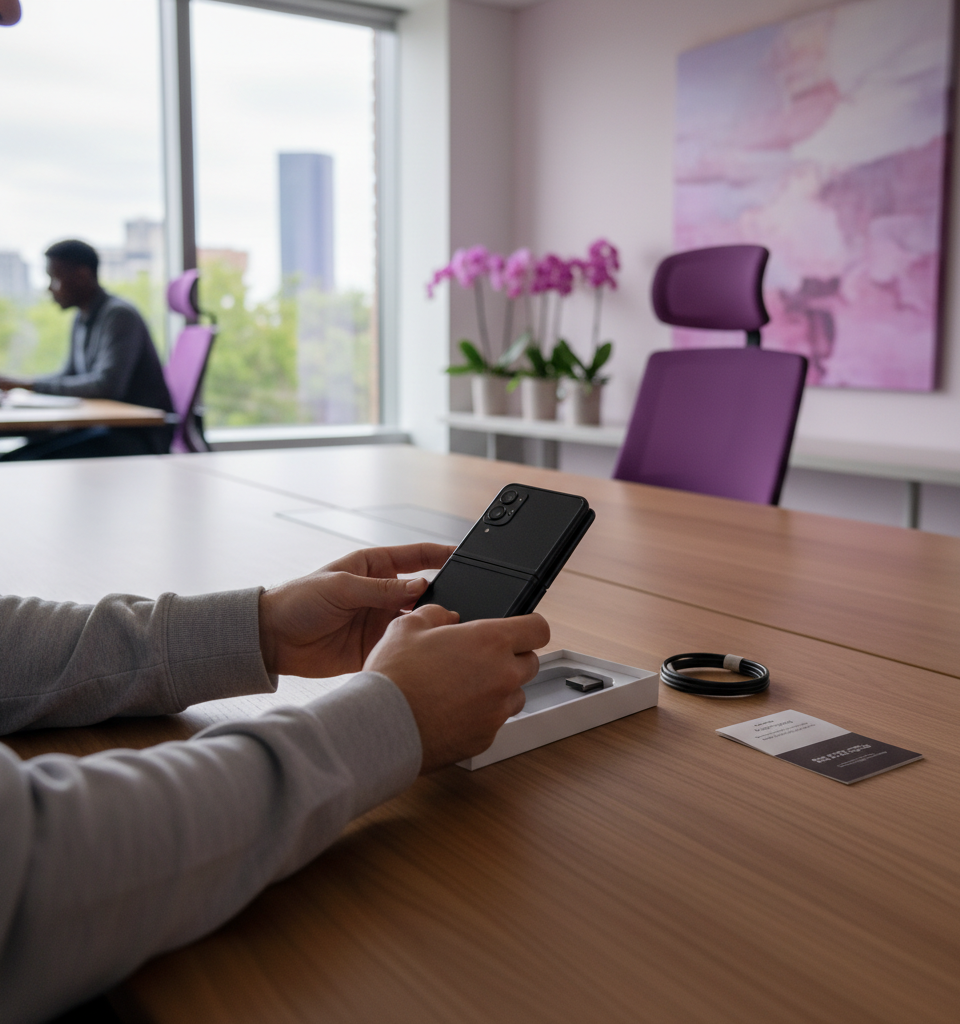
The early unboxing and hands-on evaluations of Samsung's newest foldable offer a crucial glimpse into the company's strategic evolution within the competitive smartphone market. For investors and industry watchers, understanding where Samsung chooses to innovate—and where it maintains continuity—provides key insights into its market positioning and the future trajectory of the premium foldable segment, particularly concerning adoption rates and potential for broader consumer appeal.
Samsung's Galaxy Z Flip8, the technology giant's latest iteration in its clamshell foldable series, has commenced its initial hands-on evaluation phase. The device's first public appearance reveals a product that, in terms of external design, largely mirrors its direct predecessor, the Galaxy Z Flip7. Instead of a radical aesthetic overhaul, Samsung appears to have concentrated its efforts on enhancing the device's internal mechanics and introducing new functionalities, a common strategy for mature product lines.
Design Continuity and Under-the-Hood Innovations
Initial assessments confirm a strong visual resemblance between the Galaxy Z Flip8 and the Z Flip7. This design continuity suggests Samsung is comfortable with the established form factor and ergonomic appeal of its clamshell foldable line. While the exterior may feel familiar, the significant advancements are reported to lie beneath the surface. The device is said to feature an updated internal processor, a critical component that drives overall performance, speed, and energy efficiency. Such an upgrade is typically designed to offer smoother multitasking, faster app launches, and improved graphics processing, catering to the demands of increasingly complex mobile applications and user expectations.
Beyond the processor, the Z Flip8 is also noted for introducing new features. While specific details of these features were not immediately disclosed in the initial unboxing, they could range from enhanced camera capabilities, improved battery management, advanced display technologies, or new software integrations designed to leverage the foldable form factor. These additions are crucial for maintaining user interest and justifying an upgrade, especially when the external design remains largely unchanged.
Market Context and Competitive Landscape
The foldable smartphone market continues to be a high-stakes arena for innovation and differentiation. Samsung, having been an early and dominant player in this niche, faces increasing competition from other manufacturers who are also investing heavily in foldable technology. By focusing on internal improvements, Samsung could be aiming to solidify its performance leadership and refine the user experience, rather than chasing purely aesthetic novelty.
This approach might signal a strategic move towards maturation in the foldable segment, where hardware reliability, software optimization, and powerful processing become primary selling points. For businesses, the performance of such high-end devices can influence enterprise mobility strategies, as employees increasingly rely on powerful, versatile smartphones for productivity and communication. The ability of the Z Flip8 to seamlessly handle demanding applications and offer new utility features will be key to its adoption in professional settings.
Industry Implications and Future Outlook
The consistent design philosophy, coupled with internal enhancements, positions the Z Flip8 as an evolutionary rather than revolutionary step for Samsung's foldable lineup. This strategy has implications for the broader smartphone industry, suggesting that the initial phase of groundbreaking form-factor innovation might be giving way to a period of refinement and performance optimization. Other manufacturers may observe Samsung's emphasis on internal power and feature sets as a benchmark for their own foldable development.
Looking ahead, the success of the Galaxy Z Flip8 will likely depend on how effectively its updated processor translates into tangible user benefits and how compelling its new features prove to be. The upcoming full reviews and detailed specifications will provide a more comprehensive understanding of Samsung's latest offering and its potential impact on the premium smartphone market.
Industry analysts will be closely watching not only the raw performance metrics but also the real-world utility of the new features, especially in a market increasingly focused on practical innovation rather than just cosmetic changes. The long-term durability and sustained performance of these internal upgrades will be critical for Samsung to maintain its leadership in the competitive foldable segment.