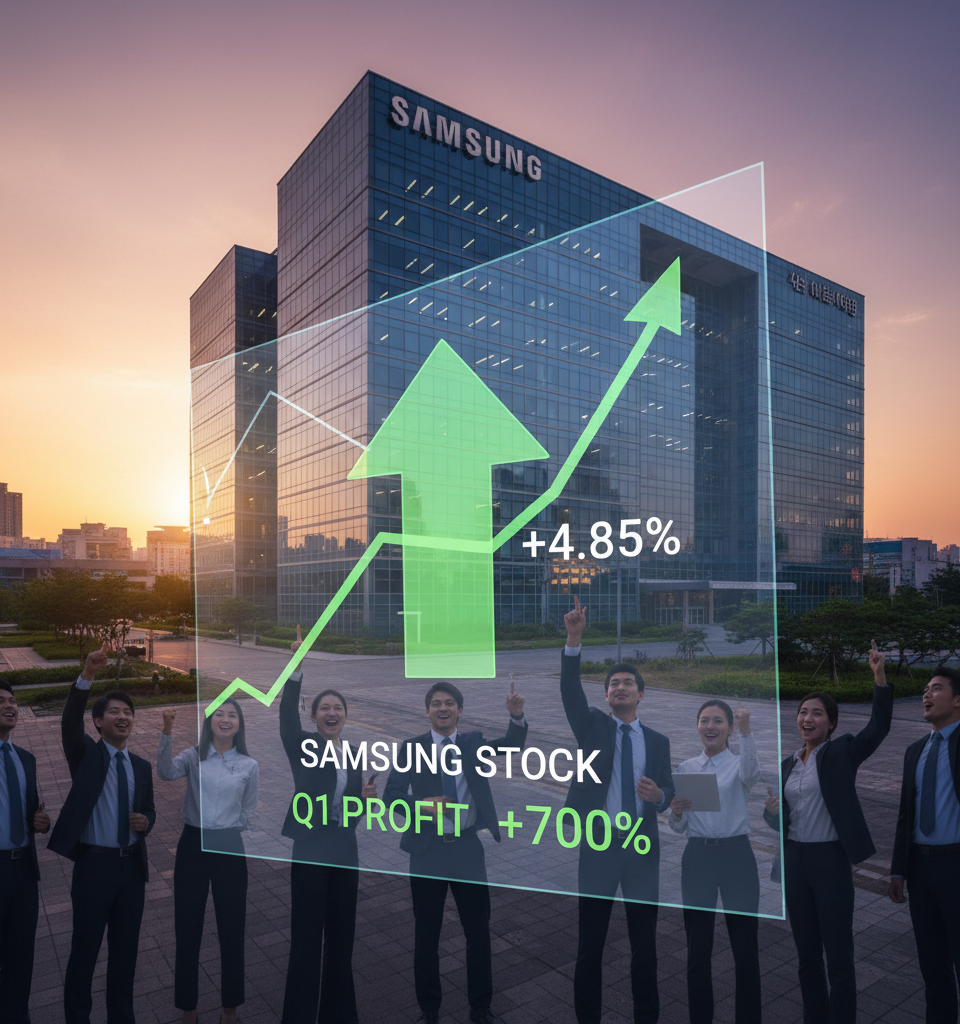
SEOUL, South Korea – Samsung Electronics, the global technology titan, has stunned the market with a preliminary forecast indicating an approximately eight-fold increase in its first-quarter operating profit, far exceeding prior analyst estimates. This blockbuster announcement sent its shares soaring by nearly 5% in early trading, signaling robust investor confidence amid a powerful surge in demand for specialized artificial intelligence (AI) memory chips.
The preliminary consolidated operating profit for the January-March period is projected to hit 6.6 trillion won (approximately $4.89 billion), a monumental leap from the 640 billion won recorded in the same quarter last year. This figure not only represents a staggering year-on-year improvement but also comfortably outstrips the average analyst forecast of 5.37 trillion won, compiled by LSEG SmartEstimate. The remarkable turnaround underscores the profound impact of the burgeoning AI industry on a key global semiconductor player.
The core driver behind this exceptional performance is unequivocally the booming market for high-bandwidth memory (HBM) chips. These advanced memory solutions are indispensable for training and deploying complex AI models, particularly those powering generative AI applications. Samsung, a significant player in the HBM market alongside rivals like SK Hynix, is strategically positioned to capitalize on this exponential growth. The company's sales are also projected to rise by 11.4% to 71 trillion won, further solidifying its recovery trajectory after a challenging 2023.
This robust recovery is particularly significant given the downturn experienced by Samsung's semiconductor division through much of 2023, which saw the company report record losses. The current rebound signifies a monumental shift, largely fueled by aggressive price increases for NAND and DRAM memory products, coupled with the insatiable appetite for high-performance HBM chips from global tech giants. Analysts project that the recovery in the memory chip market will extend throughout 2024, driven by the sustained expansion of AI infrastructure.
Industry analysts are largely optimistic about Samsung's trajectory. "HBM demand is clearly a differentiating factor," noted Kim Dong-won, an analyst at KB Securities. "Samsung's aggressive investment in HBM capacity and technology is now paying dividends." Other experts point to a broader market recovery in traditional DRAM and NAND as contributing factors, with inventory levels normalizing and pricing power returning to manufacturers. The company's diverse portfolio, encompassing smartphones, consumer electronics, and foundry services, also offers resilience against market fluctuations.
Looking ahead, Samsung is expected to aggressively expand its HBM production capacity and enhance its technological leadership to meet the escalating demand. The company recently announced plans to triple its HBM production capacity by 2025, signaling its ambition to remain a dominant force in the AI memory landscape. Future developments will likely focus on next-generation HBM technologies, such as HBM4 and beyond, which will be crucial for powering increasingly sophisticated AI workloads. Furthermore, the company's foundry division is poised to benefit from increased orders for AI-specific chips, solidifying its position in the broader AI ecosystem.
Investors will be keenly watching Samsung's forthcoming full earnings report for more detailed insights into its strategic plans for HBM production, capital expenditure, and guidance for upcoming quarters. The solid performance projection not only bodes well for Samsung but also serves as a strong indicator of the continued boom in the broader AI sector, with ripple effects expected across the technology supply chain. The company’s ability to execute on its HBM roadmap will be paramount to sustaining this impressive growth trajectory.