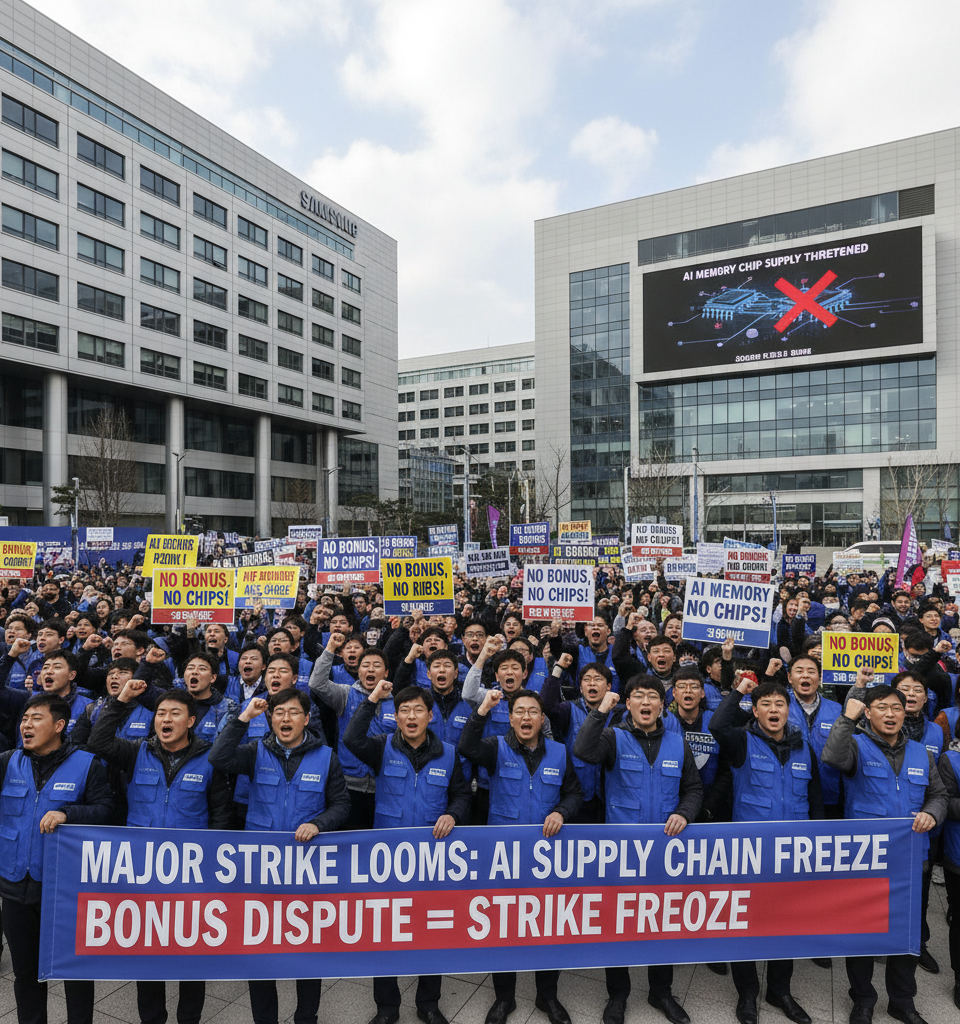
Samsung Electronics, a global technology titan that recently surpassed an impressive $1 trillion market capitalization, is teetering on the brink of a potentially disruptive industrial action. The National Samsung Electronics Union (NSEU), representing a substantial portion of the company's workforce, is preparing for an 18-day strike, a move that could severely impact the production and supply of high-bandwidth memory (HBM) chips, vital components for the burgeoning artificial intelligence sector. This escalating tension originates from a perceived wage gap with competitor SK Hynix and, more critically, Samsung's reluctance to formalize its bonus calculation methodology in writing.
Historical Context and Underlying Tensions
For decades, Samsung operated largely without significant union intervention, a distinct characteristic in South Korea's often-contentious labor landscape. However, the NSEU's growth and increasing assertiveness mark a significant shift. The union's current stance reflects a growing frustration among employees who believe their compensation has not kept pace with the company's immense success, particularly when benchmarked against industry peers like SK Hynix, a key player in the HBM market. The absence of a transparent, written bonus formula fuels distrust and makes it challenging for employees to understand or predict their financial incentives, a sentiment that has reached a boiling point after months of negotiation.
Key Demands and Company Response
The central demand from the NSEU is the formal documentation of Samsung's bonus formula. While Samsung typically awards performance-based bonuses, the union argues that the lack of clear, written criteria leaves the process opaque and subject to arbitrary decisions. This demand is intrinsically linked to the broader compensation struggle, as the union points to a significant wage disparity, estimated at several percentage points, when comparing average salaries at Samsung Electronics to those at SK Hynix. In response to the impending strike action, Samsung Electronics recently dispatched letters to its two largest unions, including the NSEU, urging a return to the negotiating table. The company's management has publicly reiterated its commitment to dialogue, emphasizing the importance of a swift resolution to avoid disruptions.
Broader Industry and Market Impact
The potential 18-day strike carries significant implications for the global technology supply chain, particularly for the red-hot AI memory chip market. Samsung is a critical supplier of HBM chips, which are essential for advanced AI accelerators and data centers. Any sustained disruption to its production lines could lead to shortages, price volatility, and delays in the deployment of AI infrastructure, impacting major tech giants heavily reliant on these components. Analysts are closely watching the situation, with concerns that even a partial slowdown could reverberate across the semiconductor industry, which is still recovering from recent supply chain challenges.
Expert Perspective on the Dispute
Industry analysts believe that while Samsung has significant manufacturing capabilities, a prolonged strike could erode its competitive edge in the rapidly expanding HBM sector. "Samsung's brand and market position are formidable, but its reliance on high-volume, precision manufacturing makes it uniquely vulnerable to labor disputes of this scale," noted one semiconductor industry expert. "The clarity requested by the union on the bonus formula is not an unreasonable demand in modern corporate governance. Resolving this amicably is crucial for maintaining employee morale and ensuring consistent output in a critical market." The consensus is that a resolution hinges on Samsung's willingness to concede on transparency regarding its compensation structures.
Future Implications and Next Steps
The immediate future depends on Samsung's approach to the union's demands. Should the strike proceed as planned, the ramifications for its HBM production and, by extension, the global AI supply chain, could be substantial. The company's ability to maintain its market valuation and meet soaring demand for cutting-edge memory will be severely tested. Both parties are under immense pressure to find common ground, with observers suggesting that a compromise involving a formalized, albeit flexible, bonus structure might be the most viable path forward. The outcome of these negotiations will not only set a precedent for labor relations within Samsung but also could influence compensation discussions across the broader South Korean technology sector.