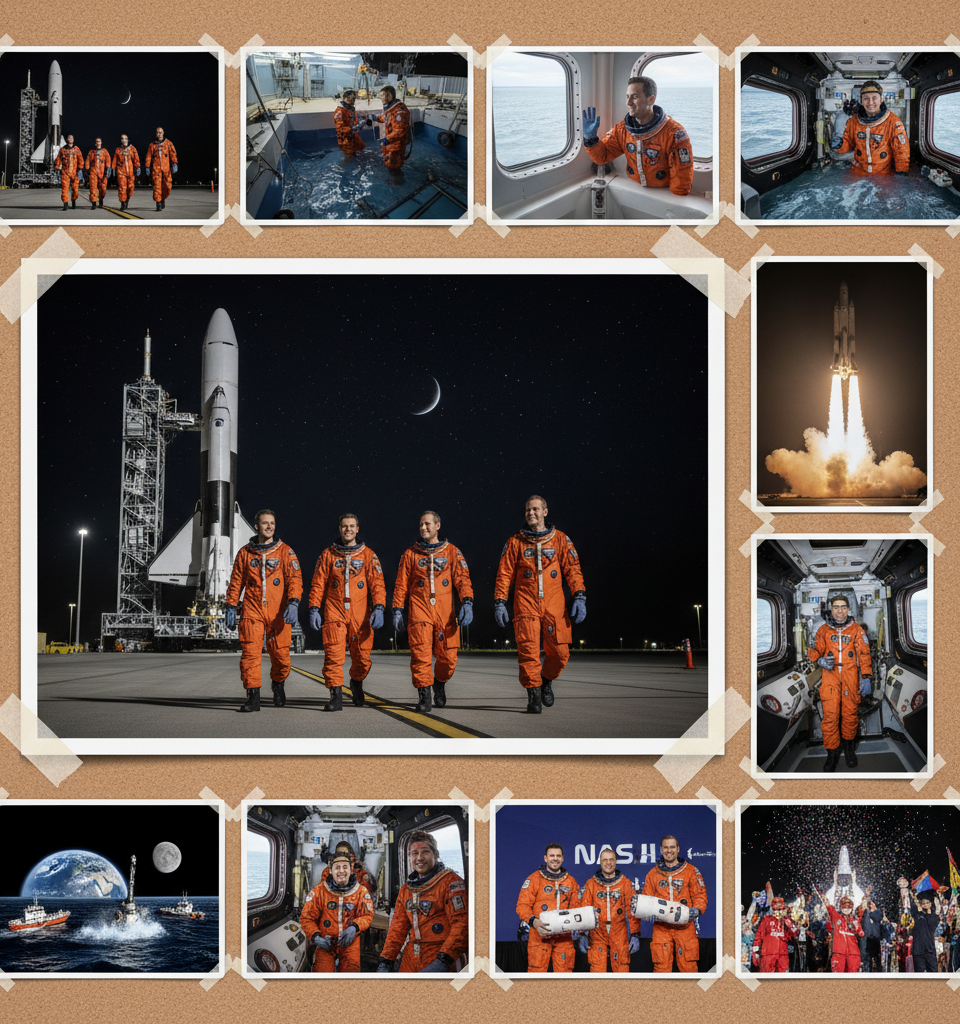
The astronauts aboard NASA’s Artemis II mission have successfully navigated 10 demanding days orbiting the Moon, marking a significant milestone in humanity’s return to deep space. As of May 19, 2026, the crew has achieved what many considered to be a near impossible feat, meticulously executing a complex series of maneuvers and scientific observations throughout their lunar flyby. This mission represents a critical step in NASA's broader Artemis program, which aims to establish a sustainable human presence on the Moon and lay the groundwork for future missions to Mars.
The Artemis II mission, often described as a dress rehearsal for future lunar landings, has been under intense global scrutiny since its launch. The successful navigation and execution of its ambitious objectives underscore the renewed capabilities of human spaceflight and international collaboration in space exploration. For a generation that has not witnessed a human-crewed mission to the vicinity of the Moon, Artemis II offers a compelling visual narrative, showcasing not just technological prowess but also the indomitable spirit of exploration. The mission’s success validates years of meticulous planning, engineering, and astronaut training, setting a powerful precedent for the challenges that lie ahead.
Mission Accomplishments and Photographic Documentation
Throughout the 10-day duration, the Artemis II crew systematically documented their journey, capturing stunning photographs that offer a unique perspective on their accomplishments. While specific details about scientific findings are pending official release, the visual record promises to be invaluable for public engagement and scientific analysis. These images, ranging from Earth-rise over the lunar horizon to intricate views of the spacecraft itself, are expected to provide critical data on hardware performance, crew operations, and the psychological impacts of deep-space travel. The mission's primary objective was to test the Orion spacecraft’s systems with humans aboard in the environment of deep space, ensuring it can safely carry astronauts to and from the Moon.
Broader Implications for Space Exploration
Beyond the immediate success of the flyby, the Artemis II mission carries substantial implications for the commercial space industry and geopolitical dynamics. The validation of the Orion capsule and the Space Launch System (SLS) rocket as reliable vehicles for human spaceflight is expected to catalyze further investment and innovation in lunar infrastructure. Companies involved in propulsion systems, life support, and habitat development are likely to see increased demand as the Artemis program progresses towards its goal of sustained lunar presence. Furthermore, the visibility of such a mission often fuels public interest in science, technology, engineering, and mathematics (STEM) fields, potentially inspiring a new generation of space explorers and engineers.
The successful execution of Artemis II also sends a clear signal about the United States' continued leadership in space exploration, fostering international partnerships while demonstrating technical capabilities. The data gathered from the mission, particularly concerning radiation exposure and spacecraft longevity in cis-lunar space, will be crucial for refining plans for the Artemis III landing mission and subsequent long-duration lunar stays. Understanding the nuances of operating human missions far from Earth's protective magnetic field is paramount to ensuring astronaut safety and mission success in the harsh environment of deep space.
Looking Ahead: The Path to Lunar Landings
The completion of Artemis II now squarely focuses attention on the upcoming Artemis III mission, which aims to land astronauts on the Moon's surface. The lessons learned from these 10 days — from crew procedures to spacecraft systems performance — will directly inform the preparation and execution of that historic landing. Engineers and mission planners will meticulously dissect every piece of data, every photograph, and every communication log to optimize future missions. The photographic evidence accumulated will not only serve as a historical record but also as a powerful tool for public education and inspiration, bringing the wonder of lunar exploration closer to home.
The photographs from this mission are more than just visual records; they are testaments to human ingenuity and perseverance. They will undoubtedly become iconic images, joining the pantheon of space photography that has shaped our understanding of Earth and our place in the cosmos. As NASA pushes the boundaries of human exploration, the narrative created by these images will be instrumental in maintaining public and political support for continued investment in ambitious space endeavors. The Artemis program, with Artemis II now completed, is steadily advancing towards its audacious goals, paving the way for humanity's enduring presence beyond Earth.