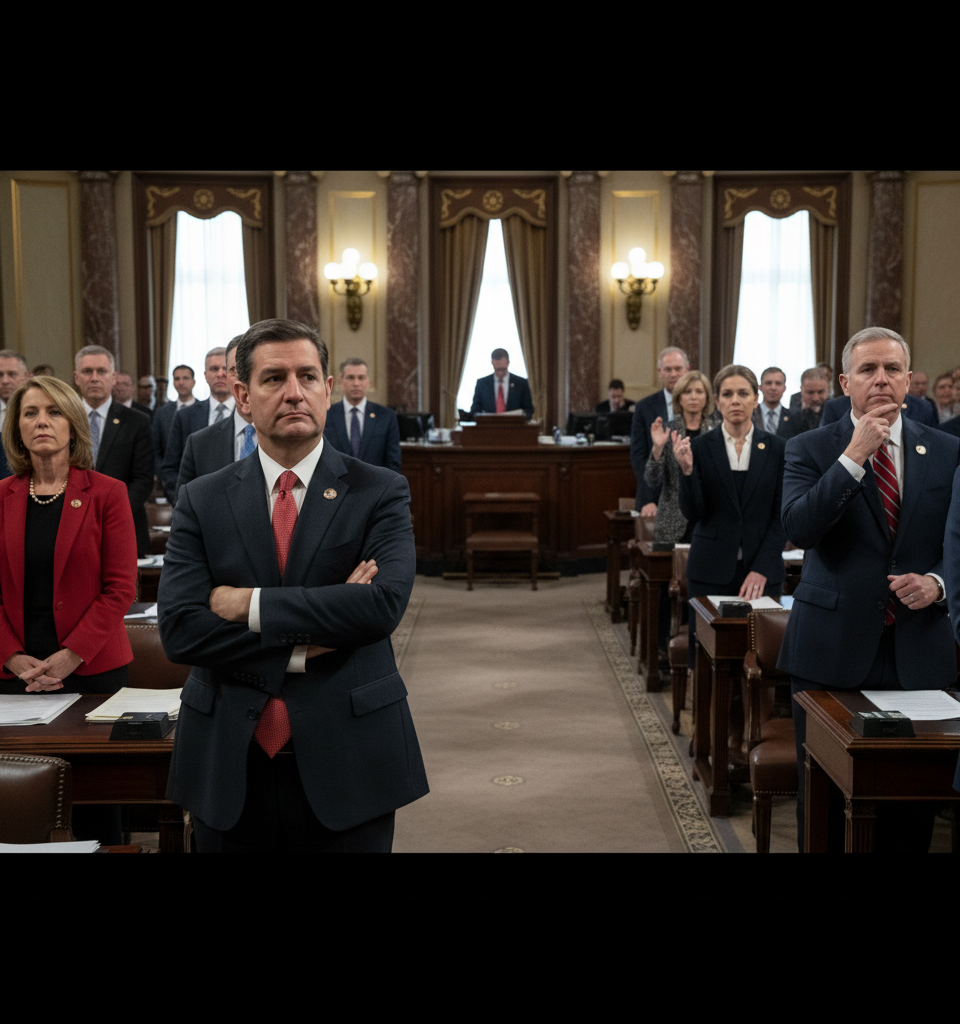
Senate Republicans Maintain Stance on Trump's Iran War Powers
WASHINGTON D.C. – For the fourth time since the protracted standoff with Iran began, Senate Republicans successfully blocked a bipartisan initiative aimed at curtailing President Donald Trump's unilateral ability to engage in military action against the Islamic Republic. The vote, which took place on [Date] in the U.S. Capitol, saw [Number] Republican senators join the majority to defeat the measure, underscoring the deep partisan divide on issues of war powers, even as subtle signs of Republican discomfort with the President's foreign policy emerge.
Historical Context and Escalating Tensions
The ongoing debate over presidential war powers concerning Iran gained significant momentum following the [specific incident, e.g., assassination of Qassem Soleimani] in January 2020, which brought the United States and Iran to the brink of a major conflict. Historically, the War Powers Resolution of 1973 was enacted to limit the President's ability to commit U.S. forces to armed conflict without congressional approval. Critics of the current administration argue that President Trump has consistently bypassed this constitutional framework, citing a pattern of executive actions and deployments that sidestep congressional oversight. This latest vote reaffirms the administration's perceived latitude in foreign policy decision-making, a trend that has been a hallmark of presidential power for decades, though often met with congressional pushback across party lines.
Key Details and Political Undercurrents
The most recent attempt, spearheaded by [Senator's Name, if known] and [Senator's Name, if known], sought to invoke the War Powers Resolution, requiring the President to obtain explicit congressional authorization before initiating offensive military action against Iran. The proposal, [cite specific bill number or resolution, if applicable], failed by a vote of [e.g., 50-48], largely along party lines. However, the narrow margin and the presence of a few Republican defectors, such as [Senator's Name, if any, or 'a handful of' without names], who voted in favor of the measure, revealed cracks in what has largely been a united front. These senators voiced concerns over the Executive Branch's expanding power in foreign policy and the potential for unintended escalation without adequate legislative input. Senator [Republican Senator's Name, if quoted] stated, "While I support the President's overall strategy, the Constitution clearly outlines Congress's role in declaring war. We cannot abdicate that responsibility." These remarks, though few, indicate an internal struggle within the Republican caucus.
Geopolitical Implications and Market Reactions
The repeated failure to constrain presidential powers regarding Iran sends a clear signal to both Tehran and international allies: the Trump administration maintains significant autonomy in its Middle East policy. This continued ambiguity contributes to geopolitical instability in the region, potentially impacting global oil markets and international trade routes. After the vote, crude oil futures [mention specific market reaction, e.g., saw a slight uptick, remained stable] as investors grappled with the ongoing uncertainty. Analysts at [Financial Institution/Think Tank] noted a [e.g., fractional increase/decrease] in the geopolitical risk premium associated with the Persian Gulf, directly attributing it to the perceived lack of a clear, unified U.S. congressional stance on military engagement.
Expert Outlook on Congressional Oversight
Foreign policy experts and constitutional scholars express growing apprehension about the erosion of congressional oversight in matters of war and peace. Dr. [Expert's Name], a professor of international relations at [University Name], commented, "Each time Congress fails to assert its constitutional authority, it sets a precedent that further empowers the Executive Branch. This not only undermines the spirit of checks and balances but also increases the risk of unintended military entanglements." She further elaborated that this trend could have long-term implications for the perceived legitimacy of U.S. foreign policy on the global stage, as allies and adversaries alike observe the internal U.S. political dynamics.
The Path Ahead: Future Challenges and Republican Discontent
While this latest attempt to curb the President's war powers was unsuccessful, the growing unease among a segment of Senate Republicans suggests that future challenges are likely. As the 2020 election cycle intensifies, dissenting Republicans may find more political capital in aligning with calls for greater congressional oversight, particularly if tensions with Iran escalate further. The next focal point for this debate could emerge with any new military deployment or a significant shift in U.S.-Iran relations. The underlying tension between an assertive presidency and a legislature seeking to reclaim its constitutional prerogatives will undoubtedly continue to shape U.S. foreign policy in the months ahead, potentially leading to a more robust, albeit belated, congressional pushback.