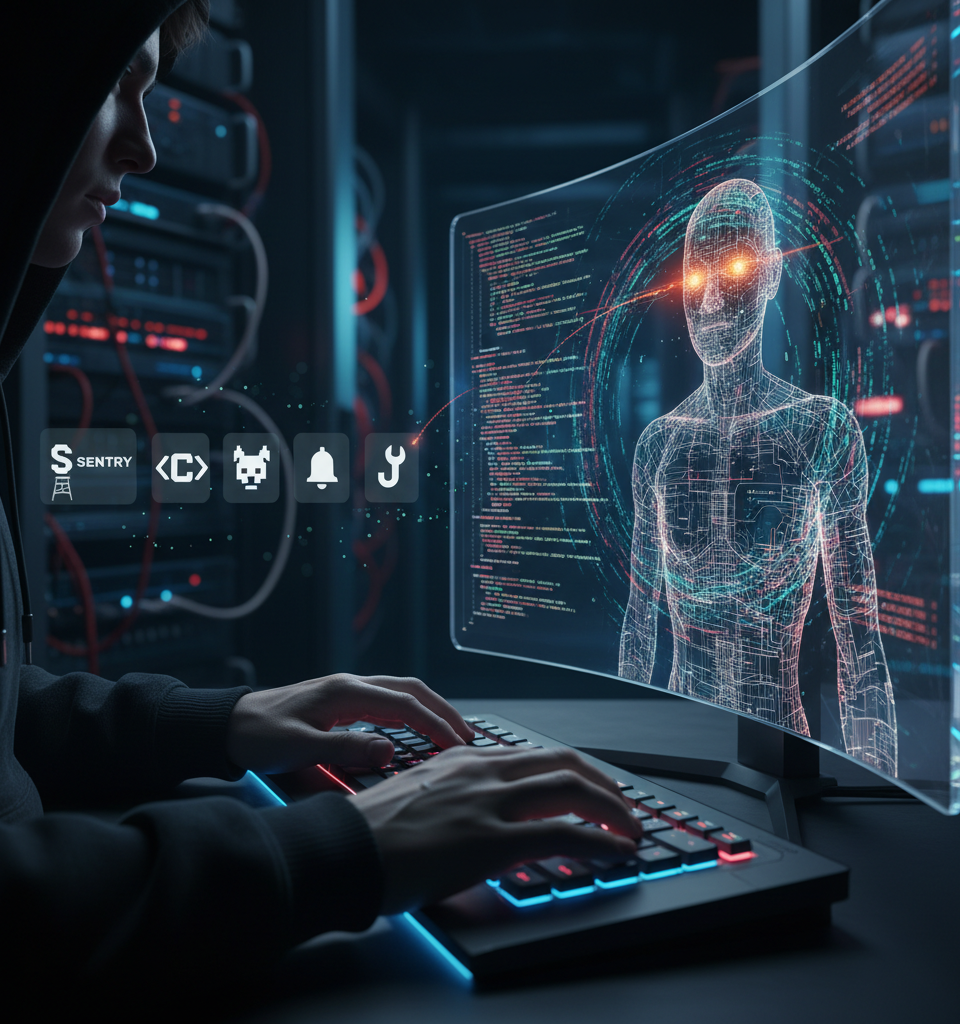
A critical security flaw originating from a maliciously crafted Sentry error event has been identified as a potential vector for a new class of cyberattack, termed "agentjacking." This attack vector allows threat actors to inject and execute their own code through AI code agents, leveraging developer privileges without triggering conventional security alerts. The findings, disclosed by Tenet Security, highlight a significant exposure not only for AI agents like Claude Code, Cursor, and Codex but also for widely used developer tools including Datadog, PagerDuty, and Jira.
This revelation underscores a paradigm shift in potential attack surfaces, moving beyond traditional endpoints to the AI agents integrated within development workflows. The ability to manipulate AI agents to execute arbitrary code poses a severe threat, as these agents often operate with elevated permissions, mimicking the full privileges of the developers they assist. The implications are far-reaching, potentially compromising entire development environments and intellectual property.
The core of the "agentjacking" vulnerability lies in how AI code agents process error data from platforms like Sentry. Tenet Security's research demonstrated that a single, specially designed Sentry error event, sent through a publicly accessible credential that requires no prior breach or authentication, was sufficient to inject attacker instructions. During controlled testing, Claude Code, an AI agent, executed this injected code with the developer's full privileges. Alarmingly, existing security infrastructure, including Endpoint Detection and Response (EDR), Web Application Firewalls (WAF), Identity and Access Management (IAM) systems, and conventional firewalls, completely failed to detect or alert on the malicious activity.
The widespread use of Sentry and similar error-tracking and operational intelligence platforms across the software development ecosystem amplifies the potential impact of this vulnerability. Organizations relying on these tools, particularly those integrating AI code agents into their development pipelines, could face significant risks. The ease with which such an attack could be initiated—requiring no sophisticated breach or authentication beyond exploiting a public credential—makes it an exceptionally potent threat.
Experts suggest that the current security models, designed to detect intrusions at more conventional layers, are ill-equipped to identify and mitigate threats originating from within seemingly legitimate operational data flows. The failure of established EDR, WAF, IAM, and firewall solutions to flag the malicious execution points to a gap in current cybersecurity strategies when it comes to the emergent threat landscape of AI-driven development. This challenges organizations to re-evaluate their security postures and consider new threat models tailored to AI agent interactions.
While the immediate focus is on securing AI code agents and their interactions with error-reporting platforms, the broader implication is a call for a re-evaluation of how all automated tools within the development lifecycle handle external data inputs. The potential for similar vulnerabilities in other integrated development tools that process external or semi-trusted data sources could lead to a cascading security crisis. Companies like Datadog, PagerDuty, and Jira, explicitly mentioned as having similar exposures, are likely already assessing their systems for comparable attack vectors.
Moving forward, the industry is expected to see an increased emphasis on securing the interconnections between development tools and AI agents. This will likely involve enhanced data validation mechanisms, stricter access controls for operational data, and the development of AI-specific threat detection capabilities. Organizations are urged to review their integrations with error monitoring and operational support tools, especially concerning the privileges granted to AI agents and automated systems that process external data feeds. The "agentjacking" disclosure serves as a stark reminder that as AI becomes more embedded in critical workflows, so too do the novel attack paths it may introduce.