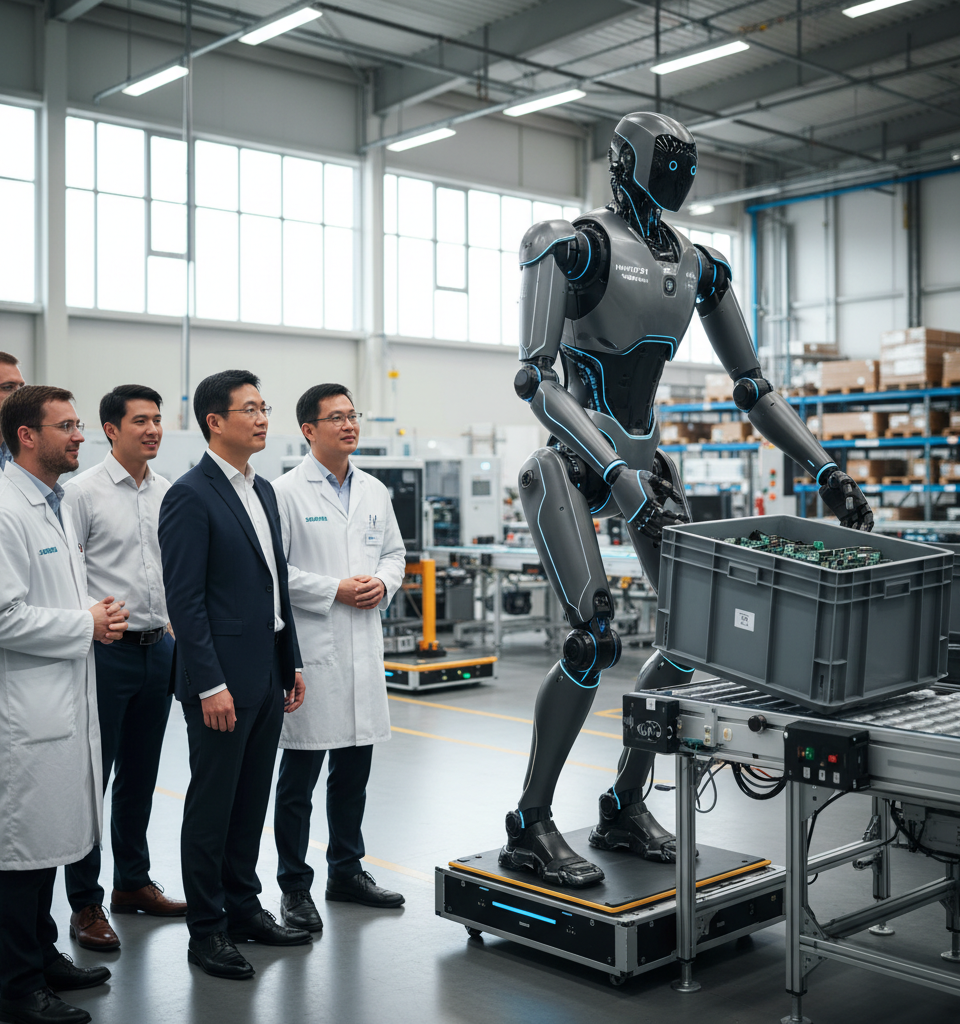
The Dawn of a New Industrial Era
The successful deployment of the HMND 01 Alpha signifies a crucial inflection point in the narrative of industrial automation. For decades, factories have relied on highly specialized, often stationary robotic arms designed for singular, repetitive tasks. The introduction of a mobile, humanoid form factor capable of nuanced manipulation and autonomous navigation within a dynamic human-centric environment portends a shift towards more flexible, adaptable, and ultimately, more efficient manufacturing processes. This initiative not only addresses the rising demand for increased productivity and resilience in supply chains but also begins to tackle persistent labor shortages in logistics and material handling, particularly in developed economies.
Key Performance and Technical Prowess The HMND 01
Alpha's performance during its inaugural factory shift was meticulously documented. Operating autonomously, the robot sustained a pace of over 60 moves per hour, translating to hundreds of successful tote transfers across the facility. Its high pick-and-place accuracy, exceeding 90%, highlights the efficacy of its AI-driven perception and manipulation systems, likely powered by NVIDIA's advanced robotics platforms and Humanoid's specialized robotic design. Integration into Siemens' existing logistics framework, which encompasses a multitude of proprietary systems and workflows, further demonstrates the robot's interoperability and the scalability of the solution. This was not a test in isolation but rather a seamless embedding into live manufacturing operations, a testament to the robustness of the collaborative engineering.
Reshaping the Manufacturing and Logistics Landscape
This pilot program has profound implications for the manufacturing and logistics sectors. The ability of humanoid robots to navigate human-designed spaces and execute tasks traditionally performed by human workers opens up vast possibilities for automation beyond structured assembly lines. Industries grappling with labor costs, safety concerns, and the need for increased throughput, such as automotive, electronics, and e-commerce fulfillment, stand to benefit immensely. This development could catalyze a broader adoption of general-purpose robots, enabling factories to reconfigure production lines more rapidly, adapt to varying product demands, and ultimately enhance overall operational flexibility and resilience in an increasingly volatile global economy.
Expert Commentary on the Robotics Revolution
Robotics experts and industry analysts are closely watching these developments. Dr. Armitage, a leading robotics ethicist, comments, "This achievement by Siemens, NVIDIA, and Humanoid is more than a technical feat; it's a practical demonstration of integrating intelligent robotics into complex human-centric workflows. The high success rate and sustained performance over an eight-hour shift address many of the skeptics' concerns regarding robustness and reliability. We are clearly moving beyond proof-of-concept into viable commercial deployment." Industry reports project the global industrial robotics market to exceed $70 billion by 2028, with a significant portion of this growth expected from humanoid and collaborative robot segments, directly influenced by breakthroughs such as this.
The Road Ahead: Scalability and Human-Robot Collaboration
The successful pilot at the Erlangen plant is merely the first step. Future implications include the expansion of the HMND 01 Alpha's capabilities to handle an even wider array of tasks, including more complex manipulation and interaction with diverse factory equipment. The focus will undoubtedly shift towards scaling this technology across other Siemens facilities and potentially offering it as a commercial solution to other manufacturers. Further research and development will also center on enhancing human-robot collaboration, ensuring these advanced machines can safely and efficiently work alongside human employees, ultimately augmenting human capabilities rather than simply replacing them. The long-term vision is a flexible, intelligent factory floor where humans and robots seamlessly cooperate to achieve unprecedented levels of productivity and innovation.