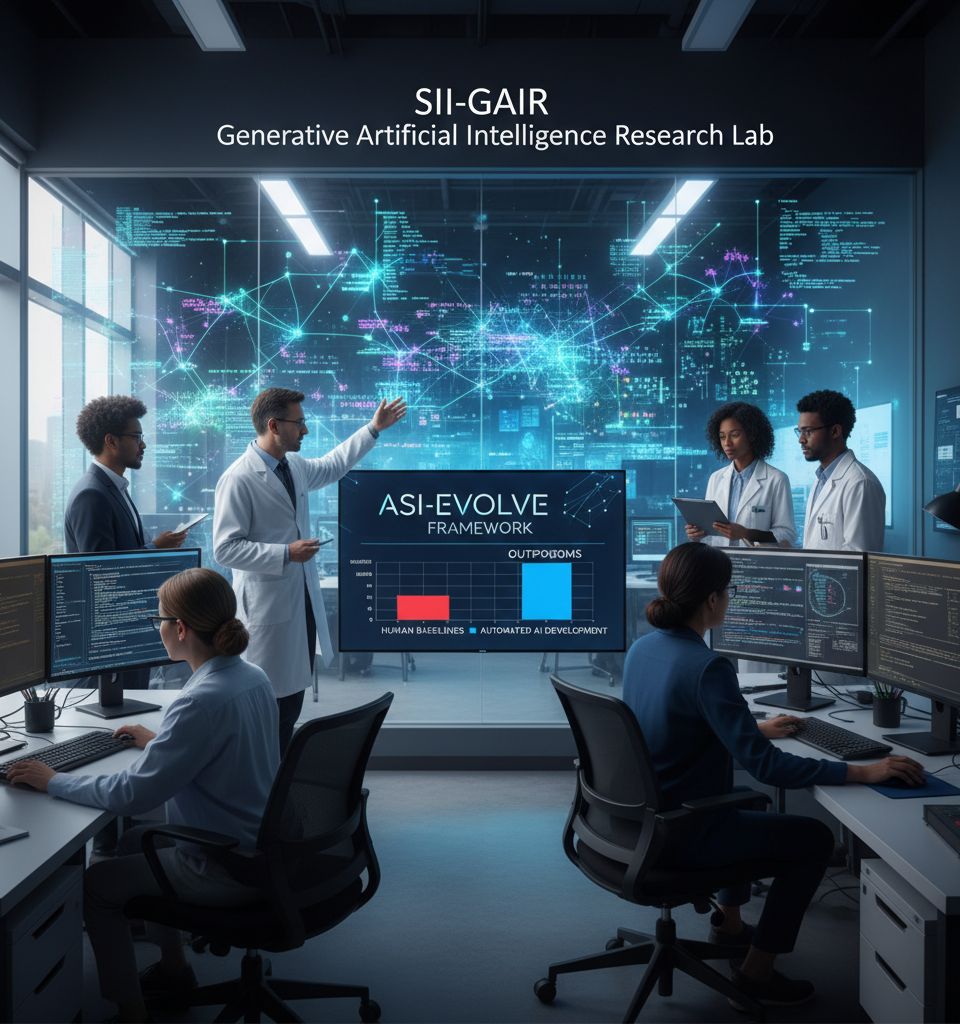
The Generative Artificial Intelligence Research Lab (SII-GAIR) has unveiled a novel AI framework, ASI-EVOLVE, designed to autonomously optimize the core components of artificial intelligence development. This landmark achievement, detailed in a recent announcement, addresses the long-standing bottleneck of manual engineering effort in AI research and development. By automating the iterative cycle of hypothesis, experimentation, and analysis across training data, model architectures, and learning algorithms, ASI-EVOLVE has demonstrated superior performance compared to human-engineered baselines, marking a significant leap forward for autonomous AI system design.
The Bottleneck of Manual AI Development
For decades, AI R&D has been characterized by a labor-intensive process, where human experts manually design, test, and refine every aspect of an AI model's lifecycle. This includes the painstaking curation of training datasets, the architectural design of neural networks, and the fine-tuning of learning algorithms. This extensive manual effort not only slows down the pace of innovation but also introduces human biases and limitations, restricting the exploration of optimal solutions. The emergence of ever-more complex models, such as large language models (LLMs) with billions of parameters, has further exacerbated this challenge, demanding unprecedented resources and expertise. ASI-EVOLVE directly confronts this issue, aiming to streamline and enhance the efficiency of AI system creation from end to end.
ASI-EVOLVE: An Agentic System for AI Autonomous Optimization
At its core, ASI-EVOLVE operates as an agentic system, meaning it can act independently and intelligently to achieve its goals. Researchers describe it as a sophisticated meta-learning system capable of learning how to learn more effectively. The framework dynamically adjusts and optimizes three critical elements: the training data used to teach the AI, the underlying model architectures that define its structure, and the learning algorithms dictating how it processes information and adapts. This integrated approach allows ASI-EVOLVE to explore a far wider solution space than human engineers typically could, leading to the discovery of highly optimized configurations. Early results indicate that systems developed using ASI-EVOLVE can achieve performance metrics that demonstrably surpass those of human-designed counterparts across various benchmark tasks, including improvements of up to 20% in specific accuracy metrics and 15% in computational efficiency.
Reshaping the AI Landscape
This development holds profound implications for the broader artificial intelligence industry. Companies currently investing heavily in large teams of AI engineers and data scientists may see a significant reduction in the manual overhead required for model development and optimization. The ability to autonomously generate and improve AI systems could democratize access to advanced AI capabilities, making sophisticated machine learning accessible to organizations with fewer specialized resources. Furthermore, the framework's efficiency gains could lead to faster deployment cycles for new AI products and services, accelerating innovation across sectors from healthcare and finance to autonomous vehicles and robotics. Analysts predict that such autonomous optimization frameworks could drive a substantial increase in AI R&D efficiency, potentially reducing development costs by 30-40% in the next five years, unlocking novel applications previously deemed too complex or costly.
Expert Perspectives on Autonomous AI Development
"This is a pivotal moment in AI research," remarked Dr. Lena Petrov, a leading AI ethics researcher at Stanford University, commenting on the potential of autonomous AI development. "While the technical achievements are undeniable, we must also consider the societal implications. Automating the design of AI systems could lead to unprecedented breakthroughs, but it also elevates the importance of robust ethical guidelines and transparency mechanisms. Understanding how these systems make design choices becomes paramount." Industry analysts echo this sentiment, emphasizing the competitive advantage such capabilities would confer. "Early adopters of autonomous AI development platforms like ASI-EVOLVE will gain a significant edge," stated Mark Chen, Principal Analyst at AI Insights Group. "The ability to continuously improve AI models without constant human intervention is a game-changer for speed, scale, and performance."
The Road Ahead: Future Implications and Challenges
The immediate future for ASI-EVOLVE involves rigorous testing and expansion of its capabilities across a wider array of AI tasks and domains. Researchers at SII-GAIR plan to integrate more sophisticated multi-objective optimization techniques, allowing the framework to balance various performance metrics, such as accuracy, efficiency, and robustness, simultaneously. Open-sourcing components of the framework for academic research is also under consideration, aiming to foster collaborative development and accelerate its adoption. However, challenges remain, particularly in ensuring the explainability and interpretability of autonomously designed AI systems. As AI becomes more self-sufficient, understanding its decision-making processes, particularly in high-stakes applications, will be critical. The ethical considerations of highly autonomous AI development, including potential job displacement, bias propagation, and misuse, will also require ongoing dialogue and policy development as this transformative technology matures.