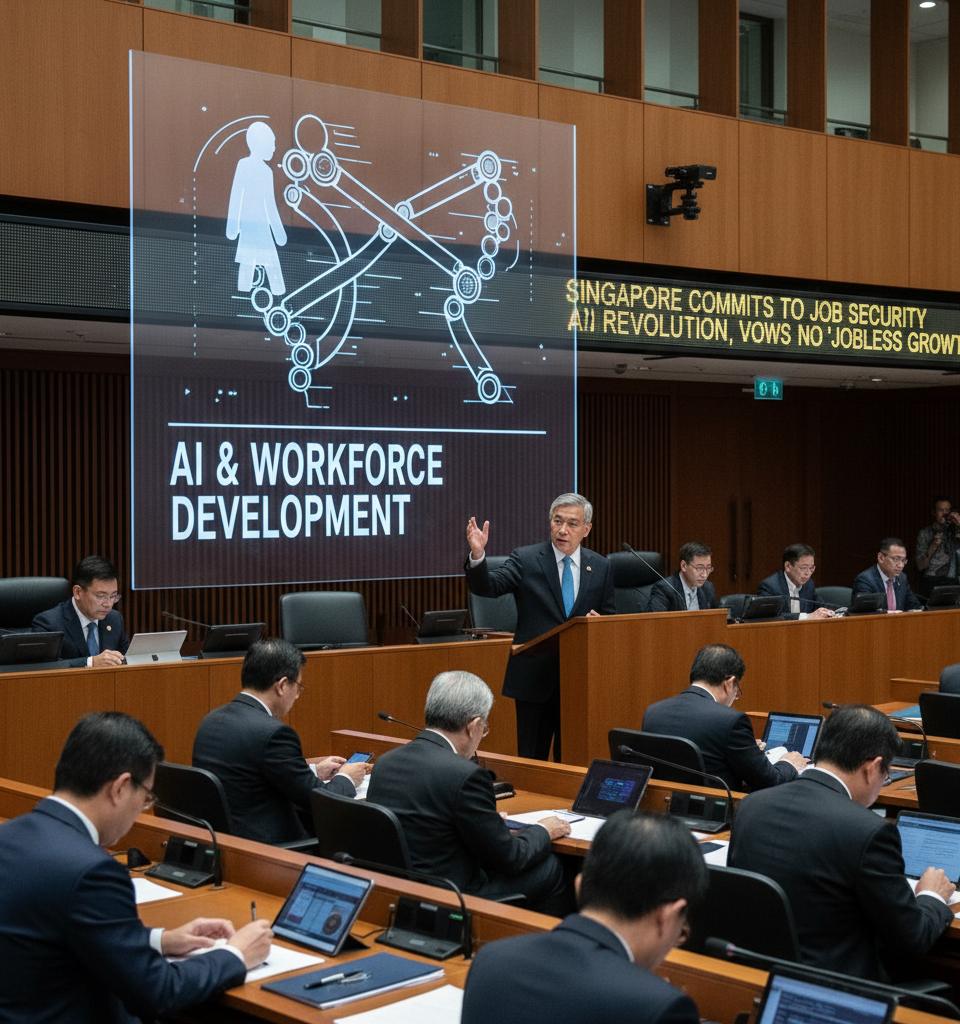
Singapore's parliamentary body has explicitly reaffirmed its national pledge that the country will not experience 'jobless growth' as artificial intelligence continues to reshape the global economic landscape. This declaration, widely reported this week following coverage by Bloomberg and Channel NewsAsia, solidifies a position initially articulated by Prime Minister Lawrence Wong during his parliamentary debate on the 2026 Budget in February. It represents one of the most emphatic commitments by a major economy to proactively manage the social and economic ramifications of AI adoption, aiming to safeguard its workforce against potential displacement.
The Urgency of Proactive Policy
The government's steadfast commitment is rooted in a recognition of AI's transformative potential, both in boosting productivity and creating new opportunities, but also in its capacity to automate tasks historically performed by humans. This proactive policy distinguishes Singapore, a nation heavily reliant on its human capital and skilled workforce, from others grappling with the ethical and economic dilemmas posed by rapidly evolving technology. The concern over 'jobless growth'—economic expansion that does not lead to a proportionate increase in employment—is a significant global worry, and Singapore aims to set a precedent for mitigating this risk.
The February 2026 Budget debate provided the critical platform for PM Wong to outline the government's strategic framework, emphasizing investment in upskilling and reskilling initiatives over punitive measures or outright opposition to AI integration.
Strategic Pillars for Workforce Resilience
Central to Singapore's strategy are several key pillars designed to foster a resilient and adaptable workforce. These include substantial investments in lifelong learning programs, ensuring that workers possess the necessary skills to thrive in an AI-driven economy. The government has already allocated significant resources towards the SkillsFuture movement, which provides grants and subsidies for citizens to pursue continuous education and training.
Additionally, there is a strong emphasis on job redesign, working with companies to restructure roles rather than eliminating them entirely, integrating AI tools to augment human capabilities. Specific initiatives include collaboration with industry giants and local enterprises to identify emerging skill gaps and co-develop training curricula. For example, recent reports indicate that over 100,000 workers have participated in AI-related training programs over the past two years, reflecting a tangible commitment to these lofty goals.
Broader Economic and Market Implications
This resolute stance has significant implications for Singapore's economic landscape and its position as a global business hub. By assuring job security amidst technological change, the government aims to attract further foreign direct investment, particularly from companies seeking a stable and skilled talent pool to develop and deploy cutting-edge AI technologies. It also influences local companies, encouraging them to invest in AI adoption without fear of public backlash over mass layoffs.
The financial services, manufacturing, and logistics sectors—key pillars of Singapore's economy—are expected to be among the earliest and most significantly impacted by AI. The government's assurances aim to prevent capital flight or a slowdown in innovation due to concerns about social disruption. This commitment could also establish Singapore as a leader in responsible AI adoption, setting a global benchmark for integrating advanced technology with social responsibility.
Expert Perspectives on Singapore's Approach
Analysts generally commend Singapore's forward-thinking approach. Dr. Lee Meng, a prominent economist specializing in labor markets at the National University of Singapore, recently commented, "Singapore's strategy isn't just about preventing job losses; it's about creating higher-value jobs and ensuring a more productive workforce. The focus on upskilling is critical, transforming potential threats into opportunities." Another expert, Ms. Tan Hwee Ling from a leading regional think tank, added, "This isn't merely an economic policy; it's a social compact. By explicitly stating its intentions, the government builds trust and encourages workers to embrace technological change rather than resist it." However, some observers caution that successful implementation will require continuous adaptation, given the unpredictable pace of AI development and the need for agile policy responses.
The Path Ahead: Sustained Investment and Global Dialogue
Looking ahead, Singapore's commitment will necessitate sustained investment in its human capital and technological infrastructure. The government is expected to continue rolling out new initiatives aimed at fostering innovation, such as expanding grants for AI research and development and strengthening partnerships between academia and industry. Further legislative frameworks may also emerge to address specific challenges related to AI's impact on employment, intellectual property, and ethical guidelines. Singapore is also poised to play a crucial role in international discussions on AI governance, sharing its experience and contributing to global best practices. The long-term vision is clear: to leverage AI for national prosperity while ensuring that no segment of the workforce is left behind, cementing Singapore's reputation as a smart nation committed to inclusive growth.