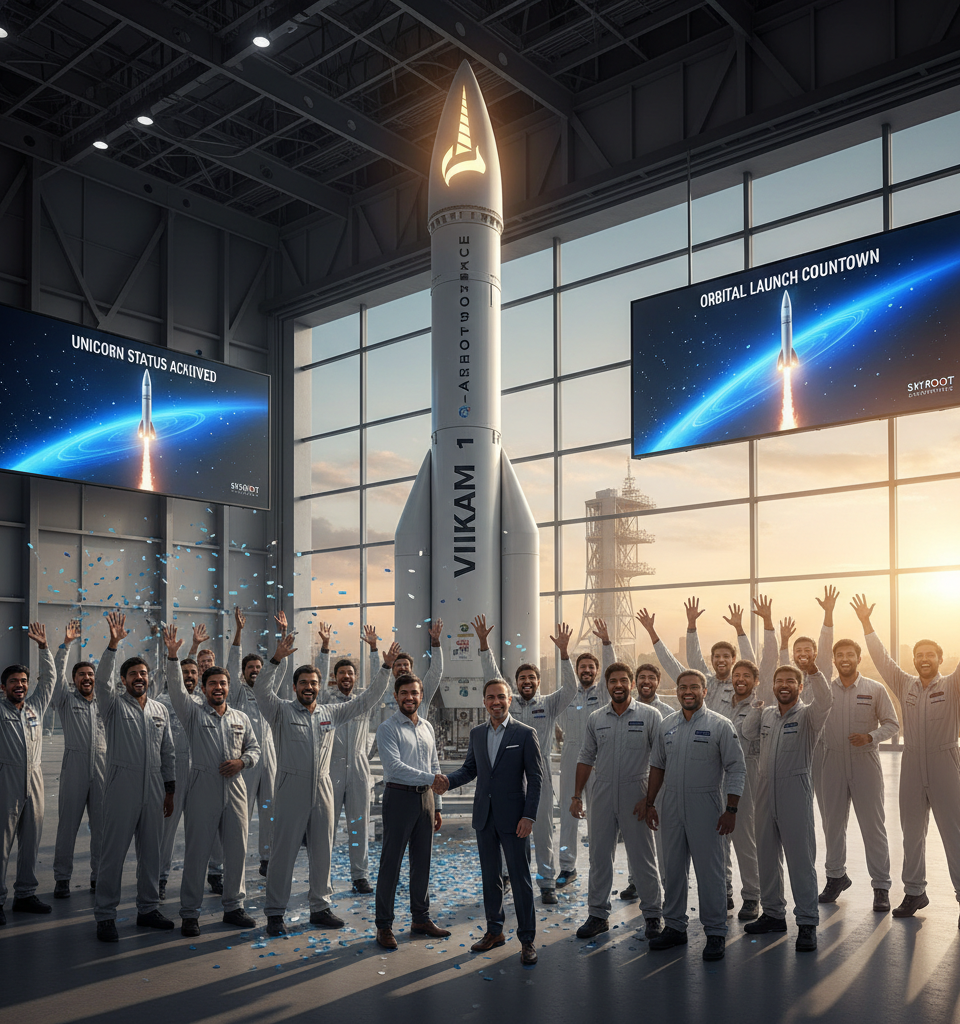
Skyroot Aerospace, the pioneering Hyderabad-based developer of private launch vehicles, has officially entered the coveted unicorn club, achieving a valuation exceeding $1 billion. This landmark financial achievement, anchored by a fresh investment round from prominent global investors including GIC and BlackRock-managed funds, more than doubles the company's 2023 valuation. The funding round is strategically timed with the impending orbital launch of its Vikram-1 rocket from Sriharikota, an event poised to mark the first private Indian rocket to attempt such a milestone and cement Skyroot's leadership in the burgeoning Indian space economy.
Context and Background
This development marks a pivotal moment in India's space narrative, traditionally dominated by the Indian Space Research Organisation (ISRO). The liberalization of India's space sector in 2020 opened doors for private enterprises, fostering an ecosystem much akin to the early private space ventures seen in the United States. Skyroot Aerospace, founded in 2018 by Pawan Kumar Chandana and Naga Bharath Daka, has been at the forefront of this transformation, demonstrating rapid advancements in propulsion technology and launch vehicle development. Their previous sub-orbital launch, 'Prarambh,' in November 2022, utilizing the Vikram-S rocket, showcased their capabilities and garnered significant international attention, laying the groundwork for this latest financial and operational leap.
Key Details and Investment Specifics
The latest funding round saw substantial capital injection, propelling Skyroot beyond the $1 billion valuation threshold. While specific figures for the current round were not fully disclosed, the participation of global investment giants like GIC and BlackRock-managed funds underscores strong investor confidence in Skyroot's technology and market potential. This capital infusion is earmarked for scaling production capabilities, accelerating research and development into more advanced launch systems, and supporting the strategic execution of the Vikram-1 orbital mission. The Vikram-1, named after the father of India's space program, Vikram Sarabhai, is a small-lift launch vehicle designed to carry payloads of up to 480 kg to low-Earth orbit, offering cost-effective and flexible launch solutions for satellite operators worldwide.
Industry and Market Impact
Skyroot's ascent to unicorn status is a powerful validation for India's private space sector. It signals to both domestic and international investors that the Indian space market is not only viable but ripe for significant growth and innovation. This milestone is expected to catalyze further investment into other Indian space-tech startups, fostering a more competitive and dynamic ecosystem. For the global space industry, Skyroot offers an alternative and potentially more economical launch service provider, diversifying the market beyond established players and contributing to increased access to space for various applications, from communication to Earth observation.
Expert Perspective
Industry analysts view Skyroot's valuation as a testament to its technological prowess and strategic vision. "Skyroot has not only demonstrated technical readiness but also an astute understanding of market needs," comments Dr. Rajeev Kumar, a space industry consultant. "Their focus on affordable, reliable small-satellite launches taps into a rapidly expanding segment of the global space economy. The backing from such prestigious funds validates their business model and enhances their credibility on the international stage." Experts also highlight the importance of their homegrown propulsion technology, including fully 3D-printed cryogenic engines, as a significant competitive advantage.
What's Next: Upcoming Developments
The immediate focus for Skyroot Aerospace remains the successful orbital launch of Vikram-1 from the Satish Dhawan Space Centre in Sriharikota. This mission is critical not only for demonstrating full orbital launch capability but also for attracting further commercial contracts. Beyond Vikram-1, Skyroot plans to develop heavier launch vehicles, including the Vikram-II and Vikram-III series, to cater to a broader range of satellite sizes and orbital requirements. The company is actively pursuing international partnerships and commercial agreements, positioning itself as a key player in the global space launch market. This unicorn status will undoubtedly fuel their ambitious roadmap, paving the way for India to become a global hub for private space technology and launch services.
Future Growth and Vision
Looking ahead, Skyroot's long-term vision extends beyond merely being a launch service provider. The company aims to innovate across the entire space value chain, potentially exploring in-space services, satellite manufacturing, and even lunar missions in collaboration with national and international partners. The significant capital base provided by its unicorn valuation will enable aggressive expansion into these new territories. With a strong engineering team and a visionary leadership, Skyroot Aerospace is poised to continue its upward trajectory, contributing substantially to India's ambition of becoming a global space power and democratizing access to space for a multitude of applications and industries.