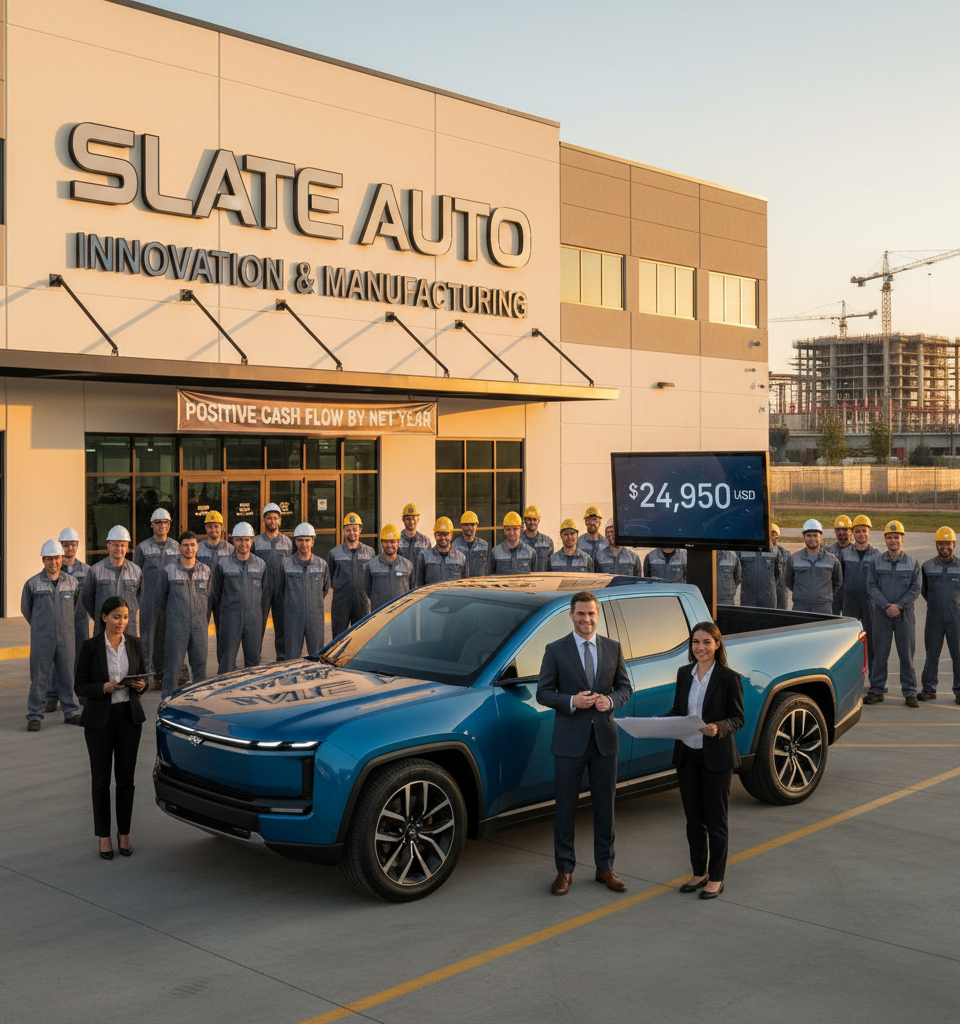
Slate Auto, an emerging player in the electric vehicle (EV) market, is staking an aggressive claim on the economics of its upcoming product line. The company's CEO, Peter Faricy, recently informed CNBC that every electric pickup truck it produces, priced at a competitive $24,950, is expected to be "gross margin positive." This assertion underscores Slate Auto's stated ambition to achieve cash-flow positivity as early as next year, a significant milestone for any startup in the capital-intensive automotive industry.
Challenging the Industry Norms
The declaration comes at a pivotal time for the EV sector. While established automakers and a wave of new entrants are pouring billions into electrification, many continue to grapple with profitability, particularly in the nascent stages of scaling production. Faricy's confidence in individual vehicle profitability, even at a price point designed to appeal to a broader market segment, suggests a potentially disruptive business model or highly optimized manufacturing and supply chain strategies. For context, many EV startups have faced significant challenges in reaching positive gross margins per vehicle, often citing high battery costs and initial production inefficiencies.
Strategic Pricing and Market Positioning
Slate Auto's decision to price its electric pickup at $24,950 positions it as one of the most affordable options in the burgeoning electric truck market. This pricing strategy could be critical in attracting a cost-conscious demographic currently underserved by premium-priced EVs. By ensuring each unit sold contributes positively to its gross margin, Slate Auto aims to build a sustainable revenue model from the outset, rather than relying solely on venture capital or debt financing for operational costs. This approach contrasts with several other EV players who initially prioritized market share and technological advancement over immediate vehicle-level profitability.
The Path to Cash-Flow Positivity
Achieving cash-flow positivity by 2027 would mark a rapid ascent for Slate Auto. This projection indicates that the company anticipates generating enough revenue from its operations to cover its expenditures without needing additional external funding. This financial independence is a highly coveted status for startups and could significantly enhance investor confidence and expedite future expansion plans. The ability to fund operations through sales, particularly of a high-volume, lower-cost product, would differentiate Slate Auto in a crowded and competitive landscape.
Implications for the EV Pickup Segment
The entry of a $24,950 electric pickup truck with stated gross margin profitability could reshape consumer expectations and competitive dynamics within the EV pickup segment. If Slate Auto successfully delivers on its promises, it could pressure other manufacturers to re-evaluate their pricing strategies and cost structures to remain competitive. The focus on affordability combined with profitability could accelerate the broader adoption of electric trucks by making them more accessible to a wider demographic, mirroring the trajectory seen in other mass-market vehicle categories. The market has long awaited more affordable EV options, and Slate Auto aims to capitalize on this demand.
Looking Ahead: Production and Supply Chain
While the financial projections are ambitious, critical factors for Slate Auto will include executing its production ramp-up efficiently and managing its supply chain effectively. The global automotive industry has seen its share of production delays and supply chain disruptions, particularly concerning essential components like semiconductors and battery materials. Faricy’s confidence implies that Slate Auto has either secured robust supply agreements or developed innovative manufacturing techniques to mitigate these common challenges. The coming months will likely reveal more details regarding the company’s production timelines and strategies to meet its ambitious targets.
Investor and Market Reaction
News of Slate Auto’s profitability projections and cash-flow targets will undoubtedly be closely watched by investors and industry analysts. The successful execution of such a plan could position Slate Auto as a significant disruptor in the EV space, offering a model for sustainable growth at a lower price point. Conversely, any divergence from these targets could lead to scrutiny, given the high expectations set by the CEO. The EV sector has seen both triumphant successes and notable struggles, making strong financial performance a critical differentiator for emerging companies.