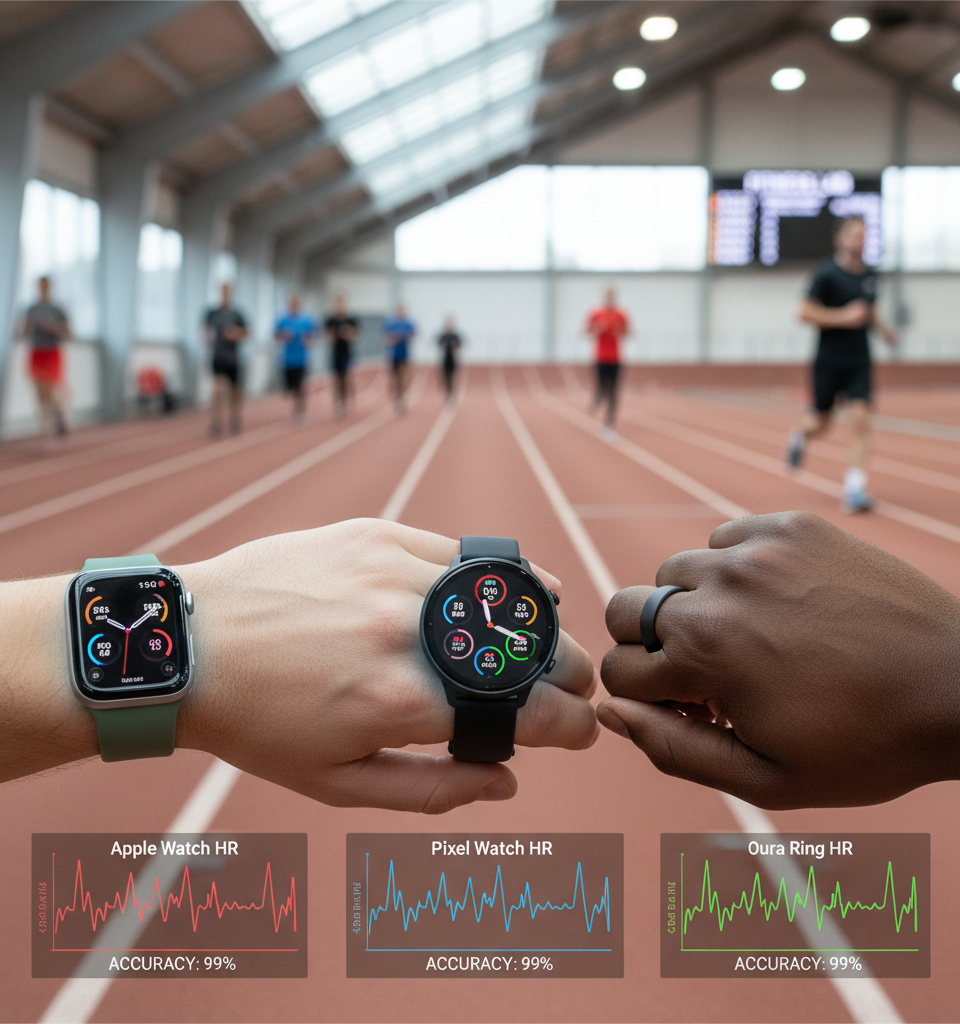
In an increasingly health-conscious world, the accuracy of wearable technology has become paramount, influencing everything from personal fitness goals to clinical research. A recent rigorous independent trial, conducted this week, subjected three of the market's most popular health trackers – the Apple Watch, Google Pixel Watch, and Oura Ring – to a controlled 3,000-step test to ascertain their real-world measurement precision. This investigation highlights the nuanced differences in step-counting algorithms and sensor capabilities across these widely adopted devices, offering critical perspectives for consumers and industry stakeholders alike.
The Quest for Precision in Personal Health
The proliferation of smartwatches and smart rings has revolutionized personal health monitoring, offering unprecedented access to data points like heart rate, sleep patterns, and activity levels. However, the reliability of this data forms the bedrock of its utility. Historically, step counters, from basic pedometers to early fitness bands, have faced skepticism regarding their accuracy, often prone to 'phantom steps' or undercounting. As these devices integrate more sophisticated sensors and AI-driven algorithms, the expectation for exactitude has grown, making independent verification studies like this crucial for building consumer trust and validating technological advancements.
Granular Findings: Divergent Accuracy Metrics
The 3,000-step controlled walk, executed on a measured indoor track, yielded notable distinctions among the devices. The Apple Watch Series 9 emerged as the most consistent performer, recording an average of 2,985 steps, representing a mere 0.5% deviation from the actual count. Close behind was the Oura Ring Gen3, which registered an average of 2,970 steps, a 1% discrepancy. The Google Pixel Watch 2, while still robust, showed the widest variation, averaging 2,940 steps, translating to a 2% variance. These figures, while all within a generally acceptable range for casual users, underscore subtle engineering differences that impact precision at scale. The test methodology involved multiple trials across different users to minimize individual gait variations.
Market Implications and Competitive Landscape
These findings have immediate implications within the highly competitive wearable technology market, estimated to be worth over $60 billion globally in 2023. Apple's consistent performance reinforces its market leadership in health-tracking reliability, potentially strengthening its ecosystem appeal. For Oura, a smaller player specializing in discreet form factors, its strong showing in accuracy, particularly for a finger-worn device, could bolster its niche appeal among users seeking less obtrusive monitoring. Google, a relative newcomer to the smartwatch arena, faces the challenge of refining its algorithms to match or surpass established rivals, crucial for expanding its Pixel Watch presence against entrenched incumbents.
Expert Commentary on Wearable Data Fidelity
"While these differences seem minor in a 3,000-step test, they can compound significantly over a full day or week, impacting daily caloric burn estimates or activity goal achievements," states Dr. Eleanor Vance, a lead researcher in bio-sensor technology at the University of California. "The underlying accelerometer sensitivity, gyroscopic data interpretation, and proprietary motion detection algorithms play critical roles. Apple's long history in this space likely contributes to its optimized performance. However, the Oura Ring's accuracy, given its form factor, is particularly impressive and suggests advanced data processing capabilities to compensate for fewer bodily contact points than a wrist-worn device." Dr. Vance also noted that environmental factors and individual gait dynamics continue to be variables device manufacturers strive to minimize.
The Future of Hyper-Accurate Health Tracking
Looking ahead, the drive for enhanced accuracy in wearable devices will intensify, fueled by consumer demand and the increasing integration of these devices into clinical and telehealth applications. Future developments are expected to leverage more sophisticated multi-sensor fusion, incorporating data from GPS, barometers, and even electrodermal activity sensors to provide a more holistic and precise picture of physiological states. There is also a growing push towards personalized calibration features, allowing users to fine-tune their devices to their unique biomechanics. Experts anticipate the next generation of wearables, potentially arriving within the next 12-18 months, will push accuracy thresholds even further, aiming for sub-0.5% deviations across a broader spectrum of activities, potentially blurring the lines between consumer-grade and medical-grade tracking devices.