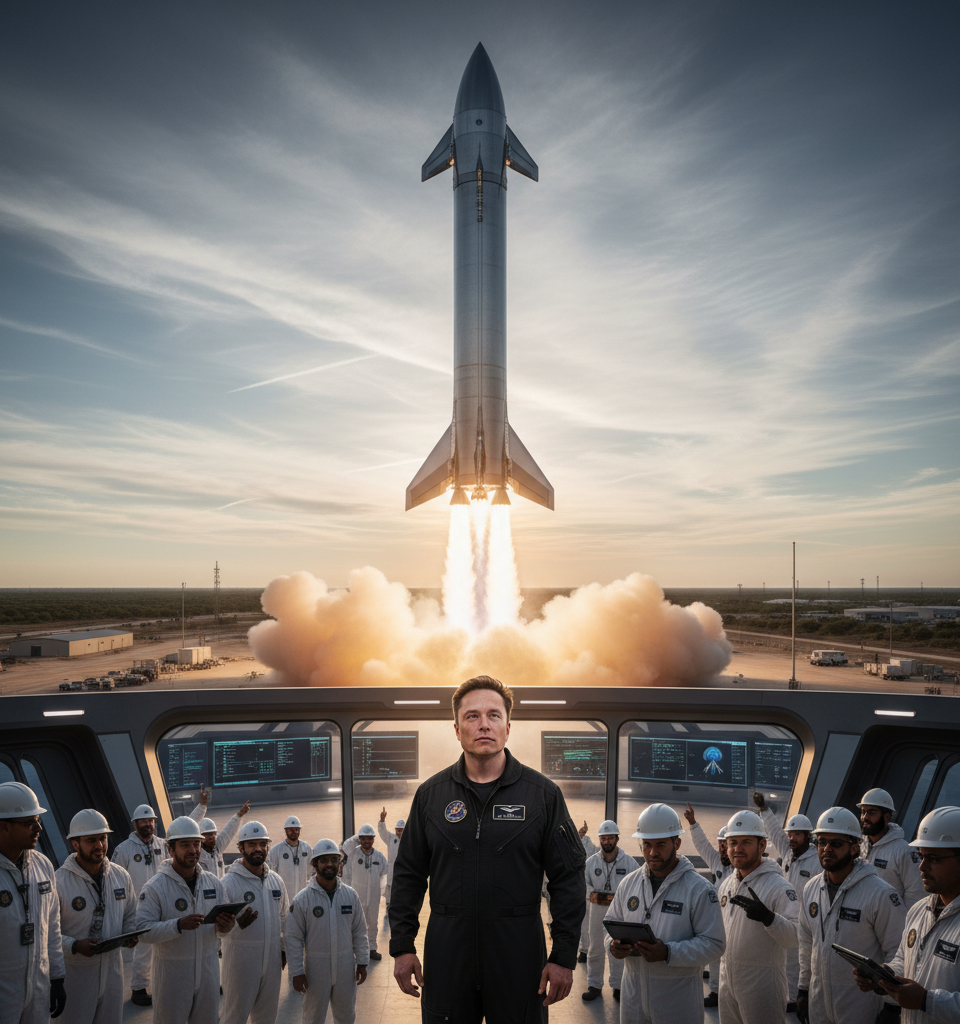
SpaceX has reportedly invested more than $15 billion in the development of its groundbreaking Starship megarocket program. This significant financial commitment, revealed through an exclusive review of the company's confidential pre-initial public offering (pre-IPO) prospectus by Reuters, highlights SpaceX's aggressive push to transform space access. The California-based aerospace manufacturer aims to establish a launch cadence akin to commercial airline operations, a stark departure from traditional government-led space programs.
This disclosure of the cumulative investment quantifies, for the first time, the sheer scale of capital expenditure dedicated to Starship. It underscores SpaceX CEO Elon Musk's long-held ambition to enable human colonization of Mars and create a sustainable, high-frequency space transportation system. Historically, space launch initiatives, particularly those involving heavy-lift vehicles, have been characterized by multi-decade development cycles and exorbitant costs, largely borne by national space agencies. SpaceX's self-funded model and rapid iteration approach represent a paradigm shift in this established industry.
Key Financials and Strategic Imperatives
The $15 billion-plus investment in Starship development positions it as one of the most capital-intensive private aerospace projects ever undertaken. The pre-IPO prospectus likely details these expenditures, providing investors with a clearer picture of the company's financial health and its long-term strategic vision. Achieving an 'airline schedule' of launches implies not only the successful development of Starship but also the creation of robust ground infrastructure, efficient operational procedures, and a high degree of reusability, all designed to dramatically drive down per-launch costs. SpaceX has already demonstrated significant reusability with its Falcon 9 rocket, but Starship aims for full and rapid reusability of both its booster and upper stage.
Reshaping the Space Economy
This colossal investment and audacious goal have profound implications for the commercial space market. If SpaceX succeeds in achieving its envisioned launch frequency and cost reductions, it could unlock entirely new segments of the space economy. Industries ranging from satellite internet constellations (like Starlink) to space tourism, in-orbit manufacturing, and even asteroid mining could become economically viable. The ability to launch hundreds or even thousands of tons to orbit annually, cheaply and reliably, would fundamentally alter the competitive landscape, potentially challenging incumbent launch providers and accelerating global space activities beyond current projections.
Expert Analysis on Viability and Impact
Industry analysts view SpaceX's Starship program with a mix of awe and cautious optimism. While the technical challenges are immense, SpaceX's track record of overcoming seemingly insurmountable obstacles with its Falcon 9 and Dragon programs lends credibility to its ambitions. However, some experts express concerns about the sheer financial outlay, the inherent risks associated with a completely new vehicle architecture, and the regulatory hurdles for such a high-frequency launch system. "The $15 billion figure is staggering, but it reflects the level of investment required to truly redefine space access," noted Dr. Clara Thorne, an aerospace economist. "If they pull it off, it won't just be cheaper to get to space; it will be a fundamentally different way of operating."
The Road Ahead: Testing and Market Integration
The immediate future for Starship involves continued rigorous testing at SpaceX's Starbase facility in Boca Chica, Texas. Numerous test flights, including orbital attempts, are planned to validate the vehicle's design, reusability, and operational efficiency. The company is actively working with NASA on the Artemis program, where a Starship variant is slated to serve as the human landing system for lunar missions, providing a critical early revenue stream and validation point. Beyond NASA, Starship is anticipated to carry large numbers of Starlink satellites, commercial payloads, and eventually, humans to the Moon and Mars, progressively integrating its revolutionary capabilities into the broader space market and, ultimately, human civilization.