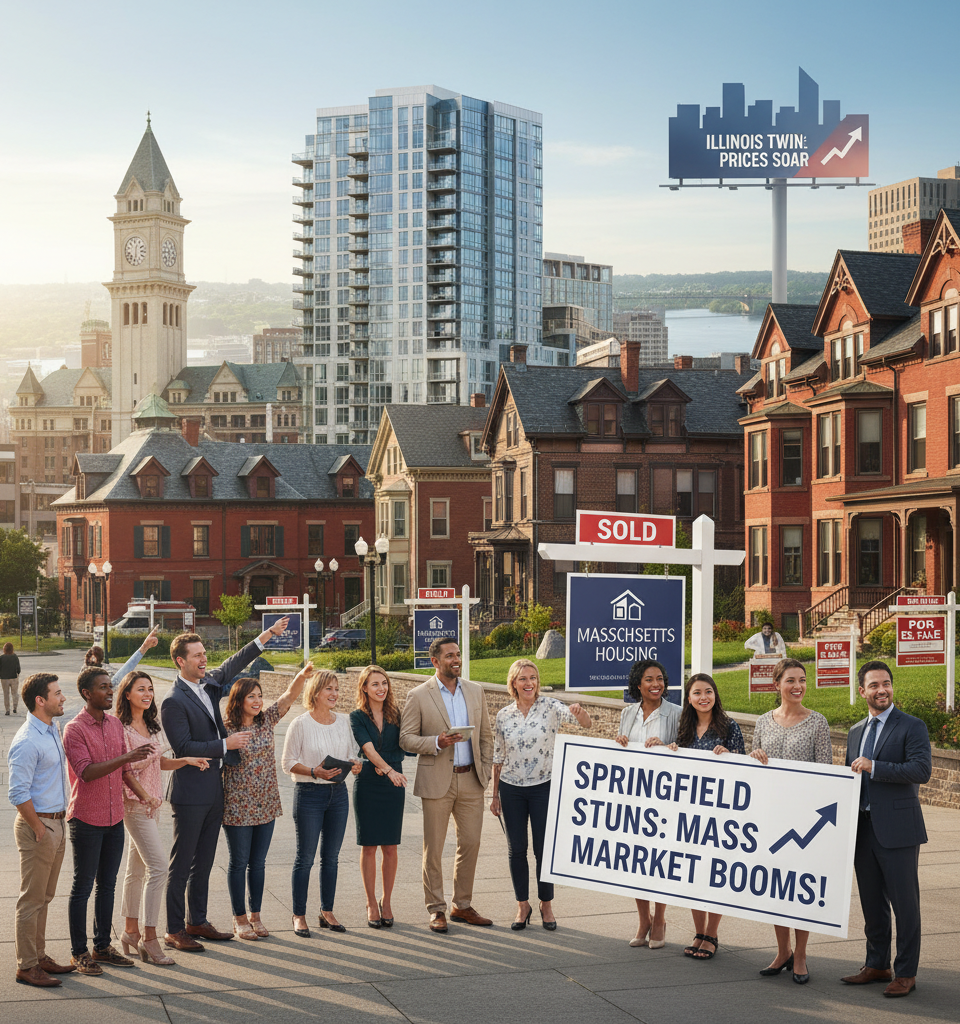
Springfield, Massachusetts, has emerged as the nation's most competitive housing market, according to recent analysis from Realtor.com. This unexpected ascent places the Western Massachusetts hub at the pinnacle of a list where inventory moves swiftly and buyer demand remains exceptionally high. Concurrently, Springfield, Illinois, while not a leader in the same metrics, is experiencing a remarkable appreciation in home prices, underscoring a complex and varied landscape within the current U.S. real estate market.
A Tale of Two Real Estate Realities
This duality in market performance highlights a fascinating trend where affordability and relative value are driving buyer behavior in secondary and tertiary markets. While nationally, the housing market has shown signs of cooling due to elevated interest rates and persistently high prices, these two Springfields illustrate localized resilience and robust demand. The Massachusetts city's market vitality is attributed to a potent combination of relative affordability compared to Boston and a desirable geographic location. Meanwhile, the Illinois capital benefits from its position as a state capital, offering stable employment and a lower cost of living that increasingly appeals to buyers seeking value.
Massachusetts' Market Momentum
In Springfield, MA, homes are moving at an astonishing pace. Data indicates that properties spent an average of just 17 days on the market last month, significantly faster than the national average. Median listing prices in the region have seen a year-over-year increase of 3.5%, reaching approximately $325,000. This strong performance is fueled by an influx of buyers seeking more space or better value than they can find in pricier adjacent metropolitan areas. High demand, coupled with persistently low inventory — a nearly 30% reduction in active listings compared to last year — creates a seller's market characterized by multiple offers and rapid transactions. The city's investment in infrastructure and its growing healthcare and education sectors also bolster its appeal.
Illinois' Affordable Allure
Down in Springfield, IL, the housing narrative is one of significant price appreciation within an ultra-affordable framework. While homes stay on the market slightly longer than their Massachusetts counterpart, averaging around 25 days, the median home price in Springfield, IL, stands at an enticing $180,000. This represents a substantial 12% increase over the past year, indicating a healthy and growing market. The affordability factor draws both local residents and out-of-state buyers, particularly those looking for starter homes or investment properties with strong potential for appreciation. The city's stable government-based employment and lower property taxes contribute to its sustained attractiveness.
Expert Insights on Market Divergence
Real estate analysts point to a "spillover effect" from larger, more expensive urban centers as a primary driver for markets like Springfield, MA. "Buyers are increasingly willing to commute or relocate slightly further to achieve homeownership, especially when facing interest rates above 7%," explains Janelle Penwell, a senior economist at Realtor.com. "Springfield, MA, offers a compelling value proposition within the Northeast Corridor." For Springfield, IL, experts note the sustained demand. "Affordability is paramount in today's market," stated Mark Zandi, chief economist at Moody's Analytics. "Markets like Springfield, IL, with strong local economies and excellent value, are proving highly resilient and attractive to a broad spectrum of buyers, from first-timers to retirees."
Broader Market Implications and Future Outlook
These localized booms in the Springfields offer valuable insights into the broader U.S. housing market's resilience and adaptability. They suggest that while national trends may indicate a slowdown, specific regions — particularly those offering a blend of affordability, strong local economies, and quality of life — can defy general expectations. The demand for accessible housing remains high, and buyers are adapting their strategies to find value wherever it exists. Looking ahead, both cities are expected to maintain their strong market positions, albeit with potential moderation in price appreciation as inventory gradually improves. Urban development projects and continued population shifts toward more affordable regions will likely sustain interest in these vibrant markets for the foreseeable future.