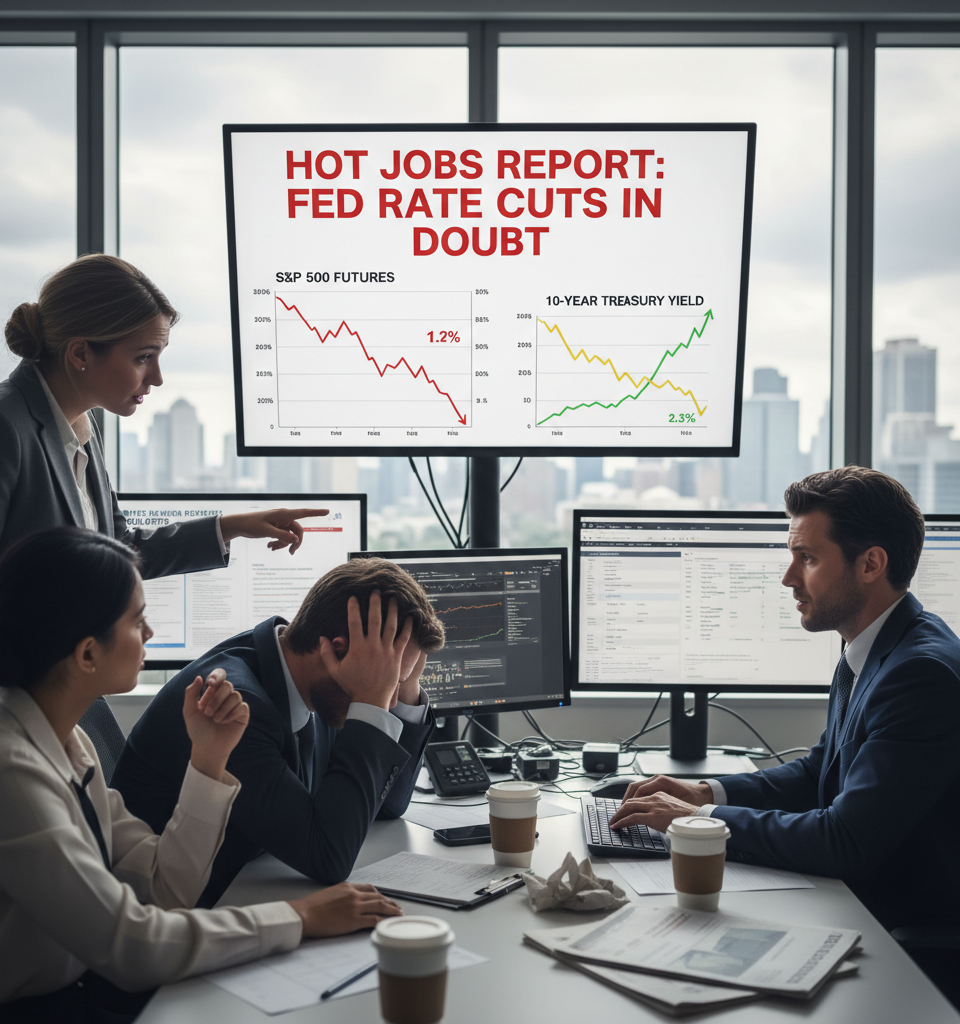
WASHINGTON D.C. – Markets concluded Friday's holiday trading session with notable volatility, as stock futures signaled a weaker opening and Treasury yields pressed higher. This recalibration is directly attributable to the release of a hotter-than-expected jobs report, an economic indicator that has swiftly reignited debate and doubt regarding the Federal Reserve's trajectory for interest rate cuts. The confluence of these factors suggests a reassessment of economic conditions and monetary policy expectations across financial sectors.
The jobs report, whose specific metrics were not detailed but characterized as “hotter-than-expected,” typically reflects robust employment growth and potentially upward pressure on wages. Such indicators can complicate the narrative for a central bank considering easing monetary policy, as strong economic activity may fuel inflationary pressures. For investors and analysts, the report functions as a critical piece of data influencing predictions about the Fed's next moves, particularly in an environment where inflation control remains a paramount concern.
Market Reaction and Economic Outlook
The immediate market reaction saw stock futures universally slip, indicating investor apprehension about potential higher-for-longer interest rates. This sentiment often translates into a de-risking posture, as the cost of borrowing for businesses increases, potentially dampening future earnings growth. Simultaneously, the climb in Treasury yields signifies that bond investors are demanding higher returns for holding government debt, reflecting an expectation of persistent inflation or a belief that the Federal Reserve will maintain a tighter monetary stance for an extended period. Higher yields can also make equities less attractive by offering a competitive, ostensibly safer, return.
The uncertainty surrounding the Federal Reserve's decision-making process is now amplified. Prior to this report, there may have been growing consensus or at least strong expectations for a series of rate cuts in the coming months. A strong jobs report, however, can disrupt this outlook by suggesting the economy is more resilient to higher rates than previously thought, thereby reducing the urgency for the Fed to stimulate growth through cuts. This dynamic forces market participants to re-evaluate their investment strategies and economic forecasts.
Implications for Monetary Policy
The Federal Reserve's mandate involves balancing maximum employment with price stability. A robust jobs market clearly addresses the employment side, but if accompanied by inflationary pressures, it places the Fed in a delicate position regarding its price stability objective. Should the jobs report indicate burgeoning wage growth or excessive demand, it could signal that the economy is not cooling sufficiently to warrant aggressive rate reductions. This scenario could lead to a more hawkish stance from the central bank, contrary to earlier dovish expectations.
The bond market's reaction, with Treasury yields moving upward, directly reflects this recalibration. Yields on government bonds are often seen as a proxy for future interest rate expectations. When they rise, it indicates that investors are either anticipating higher benchmark rates from the Fed or demanding increased compensation for inflation risk. This has cascading effects across the financial system, influencing everything from corporate borrowing costs to mortgage rates, potentially slowing down sectors reliant on consumer credit and business investment.
Looking Ahead: The Fed's Next Move
The coming weeks will undoubtedly see increased scrutiny of economic indicators and speeches from Federal Reserve officials. The market will be keenly watching for any communication that clarifies the Fed's interpretation of this jobs report and its implications for future policy. Analysts will be updating their models and predictions, bracing for a potential shift in the timing and magnitude of any anticipated rate cuts. The path forward for monetary policy appears less certain, injecting a layer of caution into market sentiment.
Investors are now faced with navigating an environment where the prospect of early and numerous rate cuts has diminished. This could lead to continued volatility, as different sectors of the economy react to the new interest rate outlook. Companies with high debt loads or those sensitive to consumer spending may encounter headwinds, while financial institutions could benefit from a steeper yield curve. The market's immediate future will hinge significantly on how the Federal Reserve interprets and responds to the ongoing strength in the labor market.