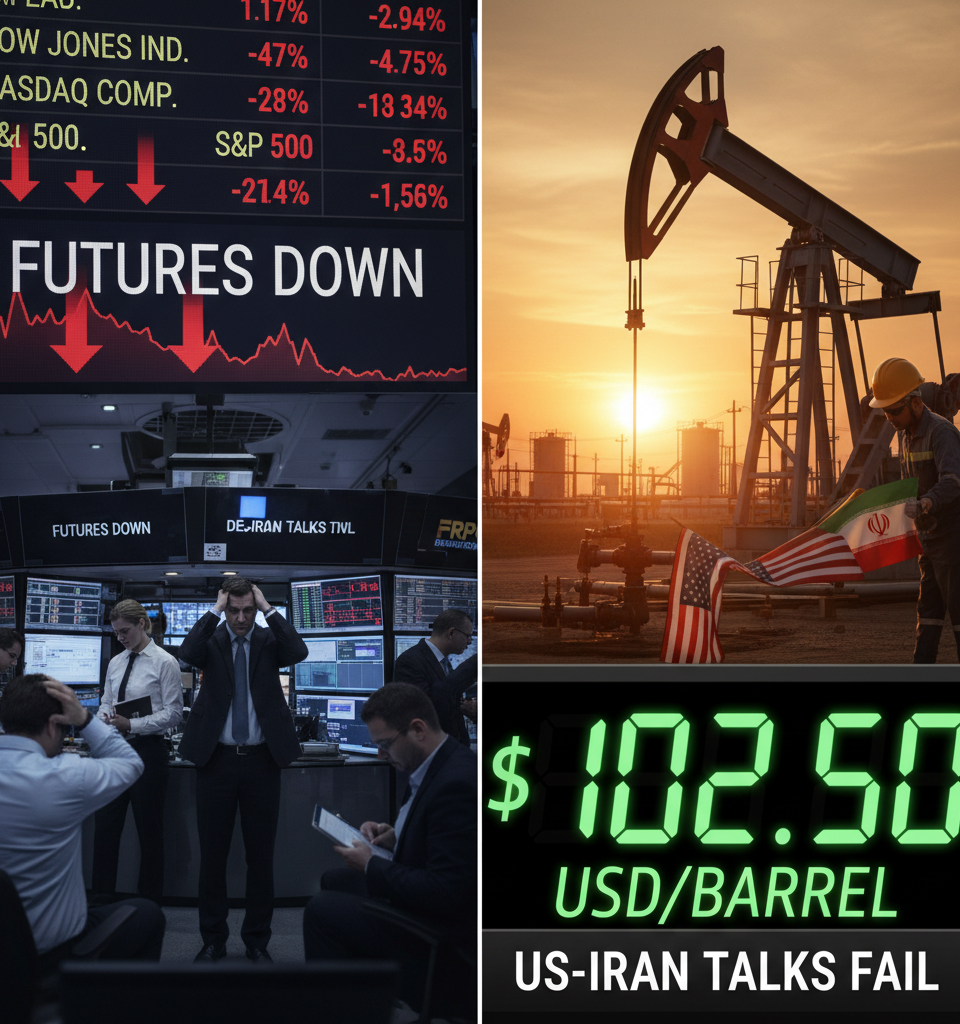
Global financial markets are poised for a tumultuous start to the trading week, with stock-market futures indicating substantial declines after high-stakes diplomatic discussions between the United States and Iran concluded without agreement over the weekend. The primary point of contention, the critical Strait of Hormuz, remains unaddressed, igniting concerns about global energy supplies and geopolitical stability. This diplomatic impasse has immediately translated into economic anxiety, reflected most acutely in the rapid spike in crude oil prices, which have surged back above the critical $100 per barrel mark.
The inability to reach a resolution regarding the Strait of Hormuz carries significant ramifications for international trade and energy markets. The Strait, a narrow sea passage between the Persian Gulf and the Gulf of Oman, is a choke point through which a substantial portion of the world's seaborne oil passes daily. Any disruption or perceived threat to this vital artery directly impacts crude oil prices, as evidenced by the weekend's developments. Investors are now grappling with the potential for increased energy costs to dampen economic growth worldwide and fuel inflationary pressures, particularly in energy-dependent economies.
Geopolitical Tensions Escalate Market Uncertainty
The collapse of these critical talks underscores a deepening rift between Washington and Tehran, potentially signaling an escalation of geopolitical tensions in the already volatile Middle East. While specific details of the negotiations remain undisclosed, their failure to yield even an agreement on the Strait's opening suggests fundamental disagreements that extend beyond immediate maritime security concerns. This backdrop of unresolved diplomatic challenges contributes directly to market uncertainty, as traders account for the increased risk premium associated with regional instability. The immediate market reaction—falling stock futures and rising oil prices—is a direct reflection of this heightened perception of risk.
The broader industry impact extends beyond immediate energy costs. Sectors heavily reliant on stable supply chains and fuel prices, such as transportation, manufacturing, and logistics, are expected to face significant headwinds. Airlines, shipping companies, and freight carriers may see their operating costs surge, potentially leading to higher consumer prices and reduced profit margins. Furthermore, a sustained period of high oil prices traditionally correlates with broader economic slowdowns, as discretionary spending decreases and businesses scale back investments in response to increased input costs.
Analysts Eye Economic Repercussions
Financial analysts are closely monitoring the unfolding situation, with many suggesting that the market's initial reaction could be a precursor to a more sustained period of volatility. The Federal Reserve and other central banks globally may face renewed pressure to balance managing inflationary risks stemming from energy prices with supporting economic growth. While no direct quotes from analysts were available immediately, the sentiment across financial news outlets points to a conservative outlook for equity markets and a bullish one for energy commodities in the near term.
The path forward appears fraught with challenges. Diplomatically, further efforts will likely be required to de-escalate tensions and secure the Strait of Hormuz, though the timeline for such engagements remains unclear. Economically, governments and central banks may need to consider measures to mitigate the impact of higher energy prices on consumers and businesses. Investors, meanwhile, are likely to seek safe-haven assets, which could include government bonds and gold, until there is greater clarity on both the geopolitical and economic fronts.
In the immediate aftermath, equity markets are bracing for noticeable declines upon opening, mirroring the current trajectory of trading in stock futures. The surge in oil prices above $100 per barrel serves as a critical indicator of the deep concern surrounding energy security. The coming days will be crucial in determining the extent of market fallout and whether these diplomatic setbacks lead to a prolonged period of elevated geopolitical and economic uncertainty.