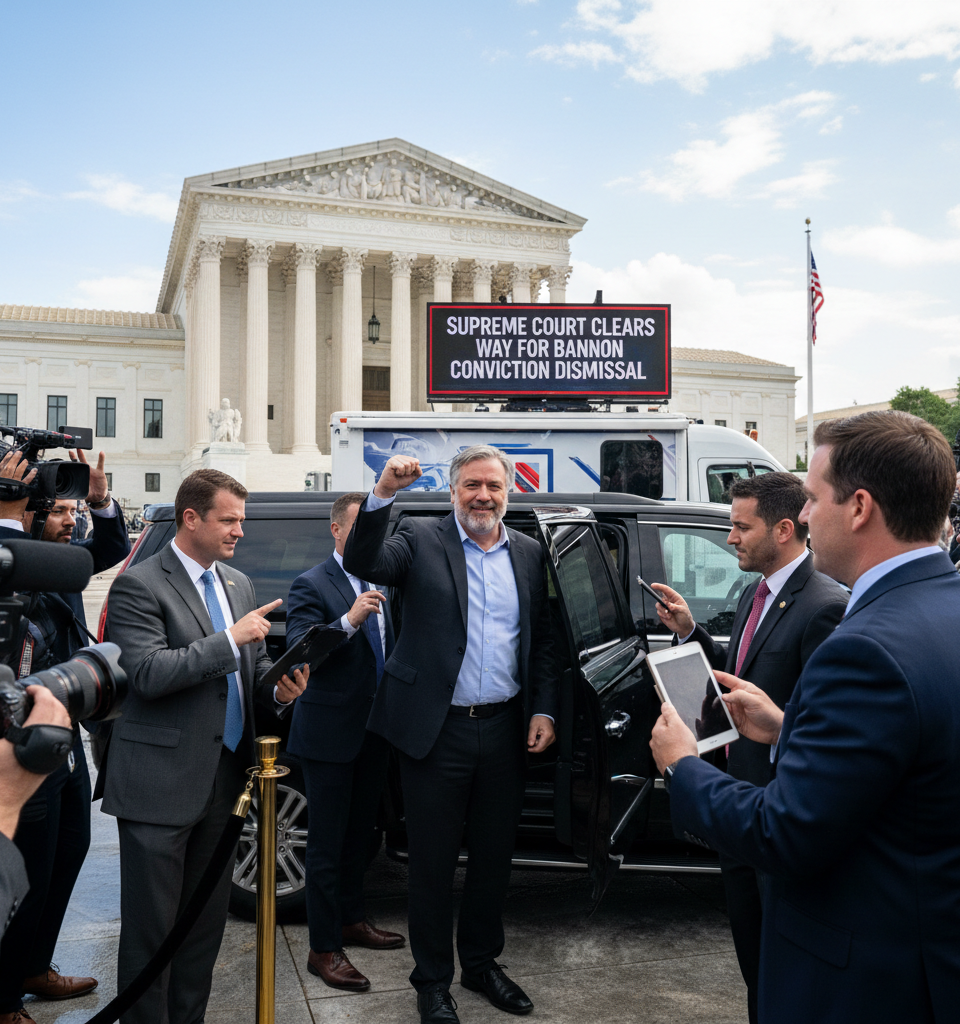
The United States Supreme Court has taken action that clears a path for the potential overturning of the contempt of Congress conviction against Stephen K. Bannon, a prominent former advisor to President Donald Trump. This move by the nation's highest judicial body introduces a new and critical juncture in the ongoing legal saga surrounding Bannon's non-compliance with a congressional subpoena in connection with the investigation into the January 6, 2021, attack on the U.S. Capitol.
Bannon's conviction stemmed from his refusal to provide testimony and documents to the House Select Committee investigating the January 6th events. His legal team had argued that executive privilege protected him from complying with the subpoena, a claim that the lower courts and his subsequent conviction largely rejected. The current Supreme Court development, while not a direct ruling on the merits of his case, represents a procedural step that could lead to a significant re-evaluation of the lower court's decision, potentially benefiting Bannon.
Background of the Conviction
Stephen K. Bannon was found guilty on two counts of contempt of Congress in July 2022. The charges arose from his steadfast refusal to cooperate with the House Select Committee's probe into the January 6th Capitol insurrection. The committee had sought his testimony and various documents, believing he possessed critical information related to the events leading up to and during the attack. Bannon's defense centered on the assertion of executive privilege, a legal doctrine often invoked by presidential advisors to protect confidential communications. However, legal experts widely debated the applicability of executive privilege in Bannon's case, particularly given his status as a private citizen at the time of the subpoena and the nature of the information sought.
Following his conviction, Bannon was sentenced to four months in prison and a $6,500 fine. He remained free pending appeal, meticulously fighting the conviction through various levels of the judicial system. His case has been closely watched by legal scholars and political observers alike, as it tests the boundaries of congressional subpoena power and the assertion of executive privilege, especially in the context of high-profile investigations into matters of national importance. The current Supreme Court action suggests that the legal arguments presented by Bannon's defense – which have thus far been largely unsuccessful – may now receive a renewed and higher-level scrutiny.
Broader Implications for Congressional Oversight
The potential dismissal of Bannon's conviction carries significant implications for the power of congressional oversight. If his conviction is ultimately overturned, questions will inevitably arise regarding the enforceability of congressional subpoenas, particularly when executive privilege claims are made. This could embolden future witnesses to resist similar subpoenas, potentially hindering future legislative investigations into executive branch actions or events of public concern. Conversely, if the conviction is upheld, it reinforces Congress's ability to compel testimony and documents, providing a strong precedent for its investigative role.
This case also intersects with the broader political landscape, given Bannon's close ties to former President Trump and the highly politicized nature of the January 6th investigation. The outcome could be interpreted as either a victory for executive power and a setback for congressional accountability, or vice-versa, depending on the final ruling. The legal community is closely analyzing the procedural elements of the Supreme Court's decision, as its technicalities will dictate the specific avenues available for Bannon's legal team to pursue dismissal, and how other federal courts might interpret similar challenges in the future.
What Lies Ahead
The Supreme Court's recent action is a procedural one, meaning it does not directly overturn Bannon's conviction but rather facilitates a process that could lead to its dismissal. The specifics of this action will now direct the lower courts on how to proceed. It is anticipated that Bannon's legal team will leverage this development to press their arguments more vigorously, likely focusing on the nuances of executive privilege and the separation of powers. This could involve further appeals to the federal circuit courts or direct petitions to the Supreme Court on the substantive legal questions.
The trajectory of this case remains uncertain, with further legal battles expected in the coming months. The ultimate resolution will depend on how the lower courts interpret and apply the Supreme Court's guidance, and whether the initial conviction withstands renewed scrutiny under potentially new legal parameters. The eyes of the nation will be on these proceedings, as the final outcome could reshape the dynamics between legislative oversight, executive power, and judicial review for years to come.