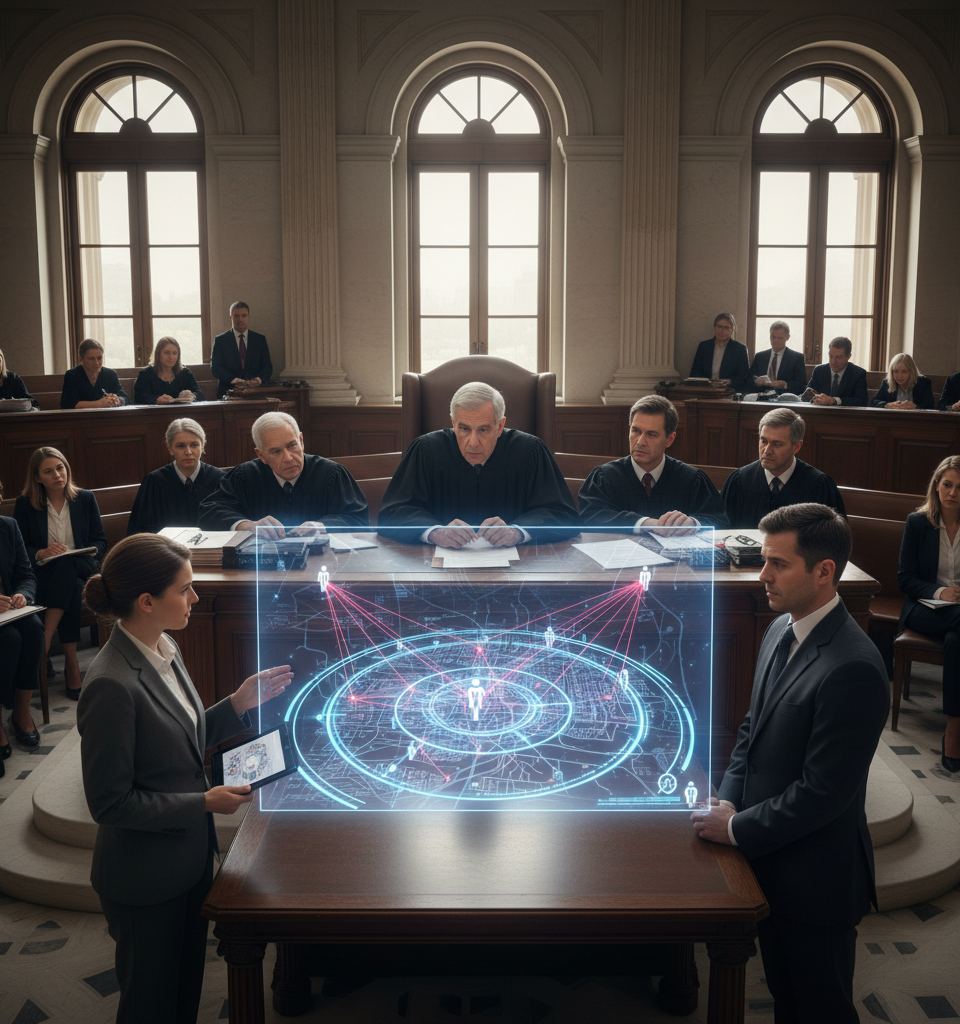
S. Supreme Court heard oral arguments this week in a highly anticipated case that promises to reshape the legal landscape surrounding digital privacy and law enforcement's access to vast stores of personal data. At the heart of the debate is the contentious practice of 'geofence' warrants, which authorize authorities to demand location information from technology companies for potentially hundreds or thousands of individuals within a designated geographic area during a specific timeframe.
The Court appeared sharply divided during deliberations, underscoring the complex interplay between public safety, technological advancement, and constitutional rights. A ruling is expected by the end of the current term, likely in late spring or early summer.
Context and Background
Geofence warrants have emerged as a powerful, yet controversial, tool for law enforcement in recent years, particularly in investigations ranging from petty theft to organized crime and even January 6th Capitol riot cases. Unlike traditional search warrants that target a specific individual or property, geofence warrants operate in reverse. They start with a location and time, then cast a wide net across tech company databases – primarily Google, which stores location history for millions of users who opt-in to its services – to identify all devices present. Critics argue that this dragnet approach represents an profound overreach, effectively turning innocent bystanders into unwitting subjects of suspicion and violating the Fourth Amendment’s prohibition against unreasonable searches and seizures. The practice has drawn comparisons to general warrants, which were a key grievance leading to the American Revolution.
Key Details and Arguments
During oral arguments, justices grappled with the scope of privacy in the digital age. Attorneys for the petitioners, supported by civil liberties groups, argued that geofence warrants are inherently unconstitutional, likening them to searching every home in a neighborhood because a crime occurred nearby. They highlighted the sheer volume of data collected, often encompassing hundreds or thousands of individuals, most of whom are entirely innocent. The government, conversely, contended that these warrants are a vital tool for investigations, allowing law enforcement to narrow down suspect pools when traditional investigative methods prove insufficient. They emphasized the particularity requirement of the Fourth Amendment, arguing that the subsequent filtering of data to identify true suspects adequately addresses privacy concerns. Justice Sonia Sotomayor questioned the scalability of the current warrant system, noting, "This is a massive expansion of the number of individuals whose privacy is being invaded." Meanwhile, Justice Samuel Alito expressed concerns about limiting police capabilities, asking, "Are we going to hobble efforts to investigate serious crimes?"
Industry and Market Impact
The technology industry, particularly large data aggregators like Google, Apple, and other location-based service providers, watches this case closely. A ruling against geofence warrants could significantly alter how these companies process and retain user data, potentially forcing them to implement more stringent privacy safeguards or rethink their data retention policies altogether. Industry giants have largely complied with these warrants under court order, but a definitive Supreme Court ruling could create new legal precedents and compliance burdens. There's a palpable tension between user privacy expectations and the commercial value of location data, which fuels targeted advertising and various services. A restrictive ruling might necessitate substantial investments in new data anonymization techniques or localized processing to minimize the risk of handing over identifiable information.
Expert Perspectives Legal scholars and privacy advocates are sharply divided on the potential outcomes. Ahmed Ghappour, a professor specializing in digital constitutional law, stated,
"This case is a referendum on whether our constitutional protections can keep pace with ubiquitous surveillance technologies. The Court must draw a clear line against dragnet searches." Conversely, John Malcolm, Vice President of the Institute for Constitutional Government at the Heritage Foundation, argued, "While privacy is paramount, the law must not be so rigid as to prevent law enforcement from effectively pursuing justice in a technologically advanced world. There can be a balance." Experts generally agree that a ruling upholding geofence warrants, even with stricter guidelines, could normalize a much broader scale of government surveillance, while a prohibitive ruling could force law enforcement to re-evaluate how they leverage digital evidence in complex cases.
Future Implications and Developments Regardless of the outcome, this ruling will have far-reaching implications for both individual privacy rights and the future of law enforcement investigations. If the
Court strikes down or severely curtails geofence warrants, Congress may be pressured to legislate new frameworks for data access that balance privacy with investigative needs. Conversely, an endorsement of the practice could lead to a proliferation of such warrants, potentially leading to challenges at state levels regarding similar digital privacy protections. The public will be watching closely to see how the highest court in the land interprets Fourth Amendment protections in an era where nearly every individual carries a device that constantly broadcasts their location. The decision will undoubtedly shape the contours of digital freedom for decades to come, influencing future interactions between citizens, technology platforms, and the state's investigative powers.