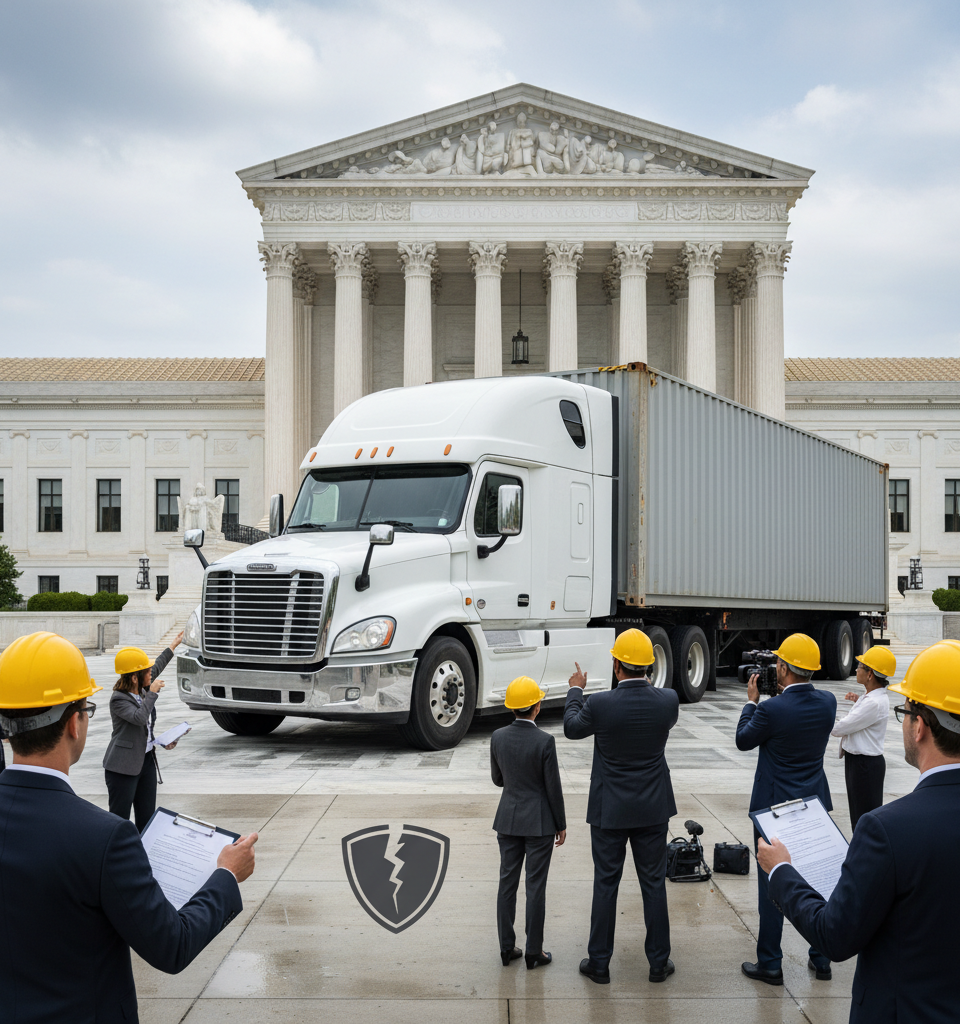
The United States Supreme Court's refusal to hear an appeal in a pivotal case has effectively opened the floodgates for negligent-hiring claims against freight brokers, sending shockwaves through the trucking and logistics industry. This decision, unfolding in recent weeks, marks a significant reinterpretation of federal trucking regulations, removing a key defense brokers previously relied upon under the Federal Aviation Administration Authorization Act of 1994 (FAAAA). For years, brokers operated under the assumption that the FAAAA preempted state-level negligence claims, shielding them from liability for incidents involving carriers they hired.
The Supreme Court's inaction on the Miller v. H. Robinson Worldwide case validates the Ninth Circuit Court of Appeals' earlier ruling, asserting that the FAAAA does not preclude state common-law personal injury claims against brokers.
This development fundamentally alters the risk landscape for an industry that facilitates trillions of dollars in goods movement annually.
Historical Context and Regulatory Gaps
Historically, the regulatory framework for freight brokers, primarily centered around the Moving Ahead for Progress in the 21st Century Act (MAP-21), mandated a $75,000 surety bond. This bond's explicit purpose was to ensure that carriers and owner-operators were paid for their services, not to provide a financial backstop for personal injury or wrongful death claims arising from accidents. The original intent of the FAAAA was to prevent states from enacting laws that could impede the free flow of interstate commerce by regulating prices, routes, or services.
Brokers often argued that allowing state negligence claims would amount to de facto regulation of their services through judicial means. However, the Miller case's journey through the judicial system, culminating in the Supreme Court's tacit approval, dismantled this long-standing interpretation, exposing a profound disconnect between the industry's existing financial safeguards and its newfound liabilities.
Core Details of the Ruling and Its Precedents
The case at the heart of this shift, Miller v. H. Robinson Worldwide, involved a catastrophic tractor-trailer accident that resulted in severe injuries.
H. Robinson, a major freight broker, was negligent in its selection of the motor carrier, which reportedly had a history of safety violations. The Ninth Circuit's ruling, now affirmed by the Supreme Court's denial of certiorari, found that negligent-hiring claims against brokers do not fall under the FAAAA's preemption clause.
This means that brokers can now be held directly liable if it's proven they failed to exercise due diligence in vetting the motor carriers they contract. The existing $75,000 surety bond, while a significant amount for ensuring carrier payments, is woefully inadequate to cover multi-million dollar judgments that can arise from severe personal injury or wrongful death lawsuits, which routinely reach eight or even nine figures.
Impact on the Logistics and Freight Industry
The implications for the freight brokerage industry are substantial and far-reaching., a number that has grown significantly in recent years. This ruling forces every single one of them to re-evaluate their risk management strategies and insurance coverage.
Many brokers currently operate with general liability insurance that may not explicitly cover negligent-hiring claims to the extent now required. The potential for increased litigation and substantial financial payouts will undoubtedly lead to a sharp rise in insurance premiums across the sector. Smaller brokers, in particular, may struggle to absorb these increased costs, potentially leading to consolidation or even closures.
Furthermore, the focus on carrier vetting will intensify, potentially leading to fewer available carriers for high-risk routes or specialized loads, and increased operational complexities for brokers.
Expert Analysis and Industry Response
Legal experts and industry analysts are unanimous in their assessment that this ruling constitutes a game-changer. "This is not a theoretical problem; the insurance gap is now real and immediate," stated one prominent transportation attorney, who requested anonymity due to ongoing client discussions. " Insurance providers are already signaling significant adjustments to their offerings.
Some anticipate new, specialized insurance products designed to cover negligent-hiring liability, while others foresee a general hardening of the market for broker-specific insurance. The ruling also places a greater onus on brokers to conduct exhaustive due diligence on their contracted carriers, moving beyond basic FMCSA safety ratings to include detailed accident histories, maintenance records, and driver qualification files.
What's Next: Future Implications and Legislative Potential
The immediate future will likely see a surge in litigation as plaintiffs' attorneys capitalize on this new legal avenue. Brokers will be forced to adapt quickly, with many expected to invest heavily in enhanced vetting technologies and processes. Discussions are already emerging within industry associations, such as the Transportation Intermediaries Association (TIA), regarding potential legislative remedies.
There's a strong possibility that industry stakeholders will lobby Congress to clarify or amend the FAAAA to reinstate some level of preemption or to mandate a more robust financial responsibility requirement tailored to personal injury claims. Without such intervention, the cost of doing business for freight brokers will undoubtedly climb, potentially affecting the efficiency and pricing of the entire supply chain. The coming months will be critical in determining how the industry, the courts, and potentially legislators, respond to this pivotal Supreme Court decision.