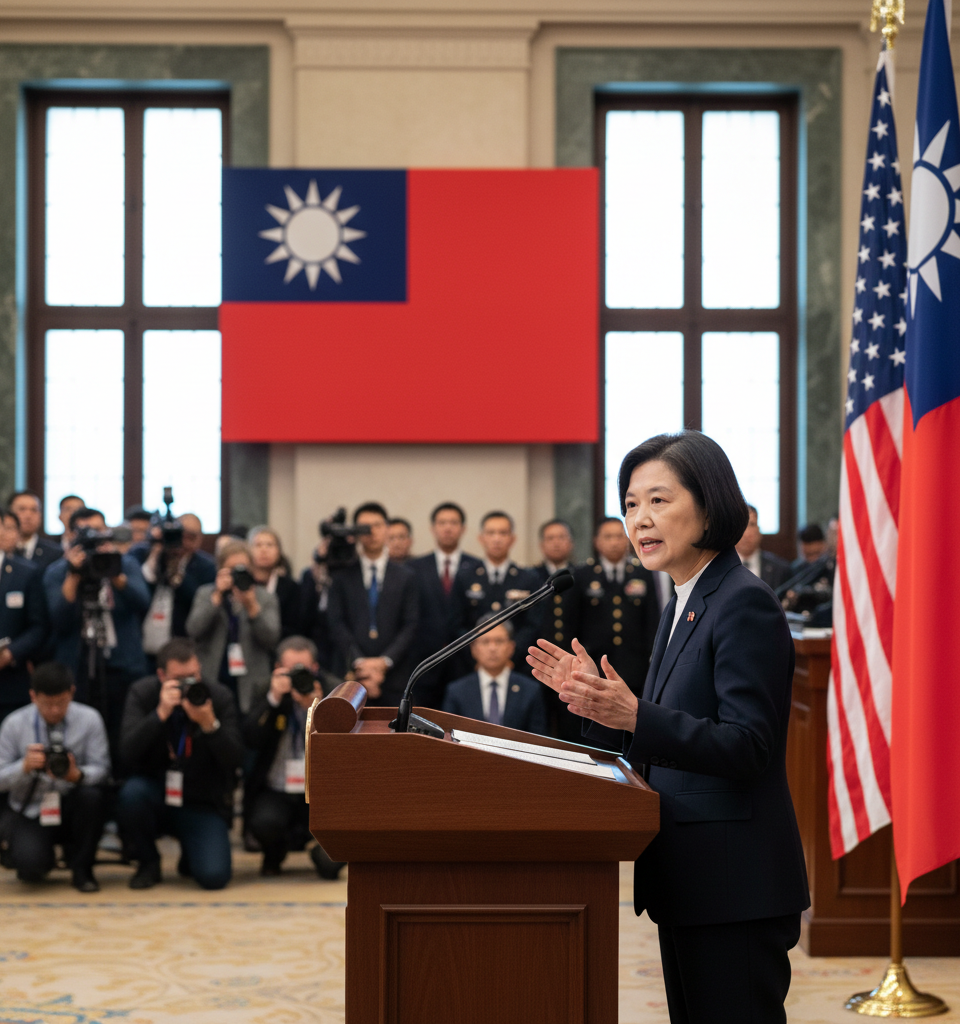
Taipei, Taiwan — In a significant declaration that underscores the delicate balance of power in the Indo-Pacific, Taiwan's President recently characterized U.S. arms sales as "the most important deterrent" against regional conflict. This statement directly addresses earlier remarks by former U.S. President Donald Trump, who had controversially framed these defense provisions as leverage in negotiations with Beijing. The president's comments highlight Taiwan's reliance on foreign military assistance to bolster its defense capabilities amidst persistent threats from mainland China.
Context and Background
The strategic importance of Taiwan, a self-governing democracy of roughly 24 million people, has intensified in recent years, drawing increased international scrutiny and positioning the island as a potential flashpoint for global conflict. China views Taiwan as a renegade province that must be reunified with the mainland, by force if necessary, a stance that has long fueled regional instability. The United States, while adhering to its "One China" policy, maintains unofficial relations with Taiwan and, crucially, provides it with defensive weaponry under the Taiwan Relations Act of 1979. This latest pronouncement from Taiwan’s leadership reaffirms the urgency with which Taipei perceives its defense needs and the critical role American military support plays in its national security strategy.
Key Details and Specifics
The declaration follows a landmark $11 billion arms package approved in December. This extensive procurement includes a diverse array of advanced military hardware and software, designed to significantly enhance Taiwan's asymmetric warfare capabilities. Specific items reportedly include precision-guided missiles, advanced drone systems, state-of-the-art artillery platforms, and sophisticated military software intended to improve command, control, and communication networks. This particular package was one of the largest in recent history, signaling a robust commitment from Washington to Taipei's defense, even as it navigates its complex relationship with Beijing. The acquisition aims to deter a potential invasion by making the cost of such an action prohibitively high for any aggressor.
Industry and Market Impact
The continuous flow of U.S. arms to Taiwan has significant implications for the global defense industry. Major American defense contractors, including Lockheed Martin, Raytheon Technologies, and Northrop Grumman, are key beneficiaries of these multi-billion-dollar deals. These sales not only inject substantial revenue into these corporations but also drive innovation in defense technology, particularly in areas relevant to countering sophisticated naval and air threats. Furthermore, the deals contribute to maintaining a robust U.S. defense industrial base, indirectly supporting American jobs and technological leadership. Globally, the transactions influence arms trade dynamics, with other nations in the Indo-Pacific potentially recalibrating their own defense procurements in response to perceived threats and regional power shifts.
Expert Perspective
Defense analysts and geopolitical experts largely agree with Taiwan’s president on the deterrent effect of these arms sales. Dr. Evelyn Goh, an expert in Asian security affairs, noted recently that "while military aid alone cannot guarantee Taiwan's security, it significantly raises the strategic calculus for Beijing, complicating any potential military adventurism." Other analysts point to the shift towards asymmetric defense strategies, where Taiwan aims to inflict substantial costs on an invading force through advanced, agile, and often smaller-scale systems, rather than attempting to match China’s larger military might. These experts emphasize that the psychological impact of visible U.S. support, alongside tangible military hardware, is a critical component of Taiwan's deterrence.
What's Next?
S. arms sales to Taiwan is expected to remain consistent, driven by bipartisan support in Washington and Taiwan's ongoing need for defense modernization. Future packages are likely to focus on further enhancing Taiwan's ability to resist a blockade or invasion, with an emphasis on anti-ship missiles, air defense systems, and intelligence, surveillance, and reconnaissance (ISR) capabilities.
The geopolitical implications extend beyond immediate defense. S. support is interpreted by many as a signal of Washington's enduring commitment to a free and open Indo-Pacific, potentially influencing other regional actors like Japan, South Korea, and the Philippines to strengthen their own defense postures and regional alliances.
The ongoing strategic dialogue between Washington, Taipei, and Beijing will undoubtedly continue to shape the future of cross-strait relations and regional stability for years to come.