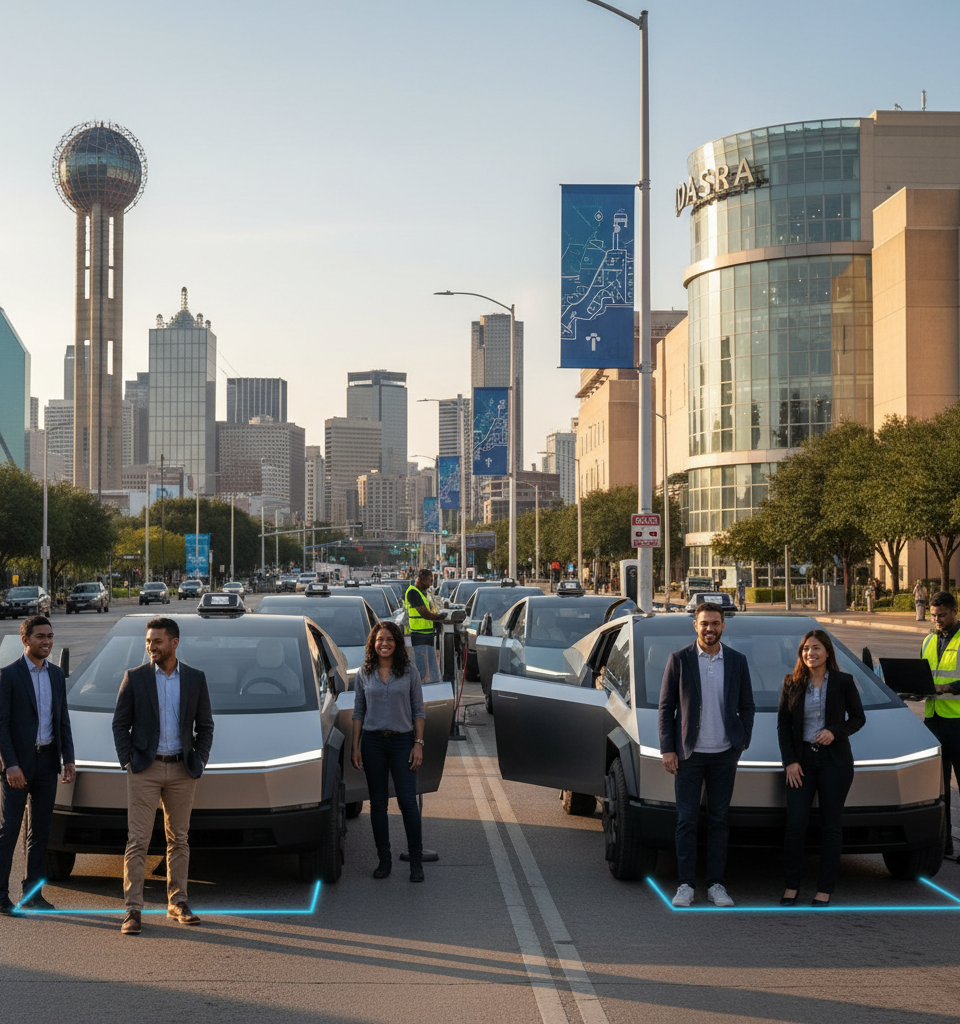
Tesla officially commenced the rollout of its robotaxi service in Dallas and Houston, Texas, as confirmed by a brief social media announcement from the company. This expansion marks a pivotal moment in Tesla's ambitious pursuit of fully autonomous ride-hailing, bringing its self-driving technology to more diverse and bustling urban environments.
Strategic Expansion in Key Markets
The move into two of Texas's largest metropolitan areas underscores Tesla’s strategic focus on proving the viability and scalability of its Full Self-Driving (FSD) software in complex operating conditions. Dallas and Houston, with their extensive road networks, varied traffic patterns, and high population densities, offer ideal proving grounds for further development and data collection crucial for advancing autonomous vehicle capabilities. This expansion also aligns with Tesla's long-held vision of transforming individual car ownership into a network of revenue-generating robotaxis.
While specific operational details regarding fleet size, pricing, or immediate availability to the general public were not disclosed in the initial announcement, the deployment is expected to initially involve a limited number of vehicles operating under closely monitored conditions. These early phases are critical for gathering real-world data, identifying edge cases, and fine-tuning the system's performance and safety protocols. The company’s past deployments of FSD Beta have typically started with small user groups before broader release.
Broader Industry Implications
This latest development has significant implications for the broader autonomous vehicle industry. Tesla, unlike many competitors, relies on a camera-only vision system for its FSD technology, eschewing lidar and radar arrays commonly used by other self-driving developers like Waymo and Cruise. This approach has been a point of contention and innovation within the sector. Successfully scaling robotaxi services with a vision-only system in new, challenging cities would lend considerable weight to Tesla's technological philosophy.
The entry into Dallas and Houston intensifies the competition in the nascent robotaxi market. While Waymo, a subsidiary of Alphabet, and GM's Cruise have been expanding their operations in cities like Phoenix, San Francisco, and Austin, Tesla's massive existing fleet of FSD-capable vehicles provides a unique scaling advantage once the technology achieves regulatory and public acceptance. The competition is not just about technology but also about regulatory navigation and public trust.
Expert Perspectives on Tesla's Auto-Pilot
Industry analysts view this expansion as both an audacious step and a necessary one for Tesla to meet its long-term objectives. "Tesla's expansion into Dallas and Houston is a crucial test of their FSD system's robustness," noted Dr. Eleanor Vance, an autonomous vehicle researcher at the Institute for Future Mobility. "Moving beyond the beta phase with individual drivers to a genuine ride-hailing service in complex cities demands an even higher degree of safety and reliability. They're collecting invaluable data, but the path to widespread commercial viability is still long and fraught with technical and regulatory hurdles."
Executives within the autonomous driving sector, often speaking anonymously due to competitive sensitivities, acknowledge Tesla's ability to rapidly deploy software updates across its fleet. However, concerns persist regarding the regulatory frameworks needed for truly driverless commercial operations. The safety record of these early deployments will be paramount in shaping public perception and legislative action.
The Road Ahead for Robotaxi Services
Looking ahead, the immediate focus for Tesla will be on refining the performance and safety of its robotaxi service in these new markets, likely through incremental increases in operational hours and geographical coverage. Regulatory approvals will remain a significant determinant of the pace of expansion, as state and local governments grapple with the complexities of autonomous vehicle integration. Public acceptance, often swayed by perceived safety and convenience, will also play a critical role in the long-term success of the robotaxi initiative.
Further down the line, if successful, Tesla's robotaxi service promises to transform urban transportation, offering new opportunities for vehicle utilization and potentially reducing traffic congestion and emissions. However, the journey from limited deployment to a comprehensive, fully autonomous ride-hailing network across major cities will require continuous innovation, rigorous testing, and a robust regulatory environment. The Dallas and Houston launches are just the latest chapter in this ongoing, high-stakes technological evolution.