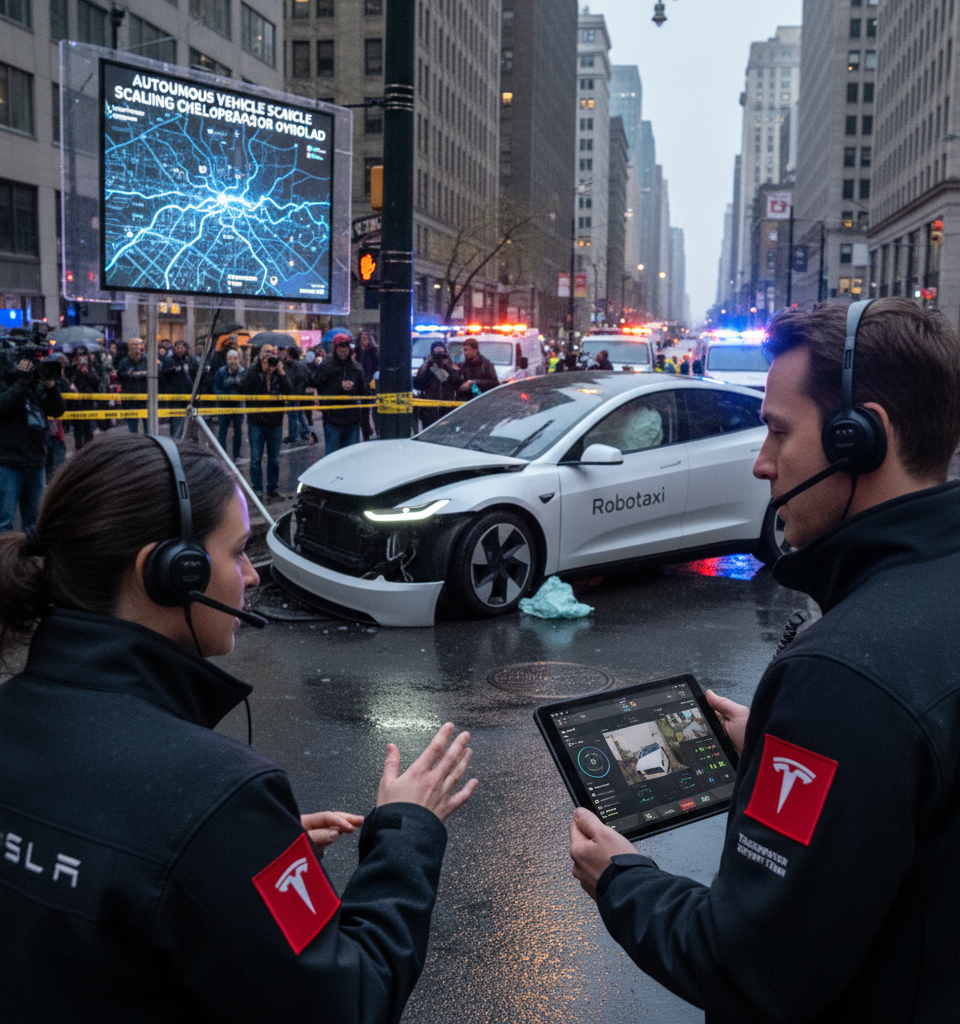
Newly uncovered crash reports reveal that two collisions involving Tesla's nascent robotaxi fleet necessitated immediate intervention from human teleoperators, exposing critical insights into the company's efforts to expand its autonomous driving capabilities. The incidents, detailed in previously redacted National Highway Traffic Safety Administration (NHTSA) documents, occurred as Tesla actively pushes to deploy its self-driving technology more broadly, highlighting the substantial reliance on human oversight within its otherwise autonomous vision.
Context and Background
Tesla, under the leadership of Elon Musk, has long championed a future of fully autonomous robotaxis, promising a revolutionary transportation model. For years, the company has been developing its 'Full Self-Driving' (FSD) software, with Musk frequently predicting its imminent perfection. However, the path to true Level 5 autonomy has proven more arduous than anticipated, marked by regulatory scrutiny, public skepticism, and a series of high-profile incidents. These newly revealed crashes underscore the inherent difficulties in transitioning from advanced driver-assistance systems to truly unsupervised autonomous operations, even for a company as technologically front-leaning as Tesla.
Key Details of the Incidents
The unredacted reports delineate two distinct minor collisions. In one instance, a Tesla vehicle operating in autonomous mode experienced a low-speed impact, prompting a teleoperator to take remote control to navigate the vehicle safely. The second incident involved a similar scenario, where human intervention was required after a minor fender-bender. While no severe injuries were reported in either case, the necessity of teleoperator intervention for seemingly minor issues speaks volumes about the current limitations of the FSD system in managing real-world, unpredictable urban environments. These incidents confirm a greater reliance on remote human assistance than Tesla's public rhetoric often suggests, particularly as it seeks to scale its robotaxi services.
Industry and Market Impact
The revelations come at a pivotal time for the autonomous vehicle (AV) industry, which has seen both significant advancements and recent setbacks. Competitors like Waymo and Cruise have also grappled with public acceptance and regulatory hurdles, resulting in tightened operational restrictions or pauses in service in some areas. Tesla's incidents, while not severe, contribute to a broader narrative questioning the current readiness of purely autonomous systems for widespread deployment without substantial human fallback. This could impact investor confidence in the immediate prospects of robotaxi profitability and potentially slow regulatory approvals for autonomous operations across the sector, emphasizing the need for robust safety protocols and transparent reporting.
Expert Perspective
Industry analysts emphasize that while these incidents are not catastrophic, they highlight the complex engineering and ethical challenges inherent in autonomous driving development. "The need for teleoperators, even for minor incidents, suggests that self-driving systems are still navigating the 'long tail' of edge cases – those infrequent, unpredictable situations that are incredibly difficult to program for," notes Samuel Jenkins, an automotive technology expert. "It reinforces the idea that achieving truly driverless operation, especially in complex urban environments, is a multi-decade endeavor, not a short-term sprint." Jenkins added that the transparency, even if forced by unredaction, is crucial for building public trust and refining the technology.
Future Implications and Developments
Moving forward, these incidents will likely intensify scrutiny from regulators like NHTSA on Tesla's FSD system and its robotaxi deployment strategy. Tesla will face ongoing pressure to demonstrate how it plans to reduce the dependency on teleoperators as it scales its operations. The company's strategy may involve more sophisticated AI training to handle a wider array of scenarios or, conversely, a more integrated and transparent role for human monitoring within its operational framework. The lessons learned from these incidents will undoubtedly shape the future development and deployment timelines for autonomous vehicles across the entire industry, pushing for even more rigorous testing and validation before widespread commercialization.
These disclosures also pose questions about the public's perception of fully autonomous vehicles and the trust required for their adoption. As companies like Tesla continue to push boundaries, clear communication about the capabilities and limitations of their technology, including the role of human oversight, will be paramount for gaining public acceptance and ensuring safe, reliable autonomous transportation systems.