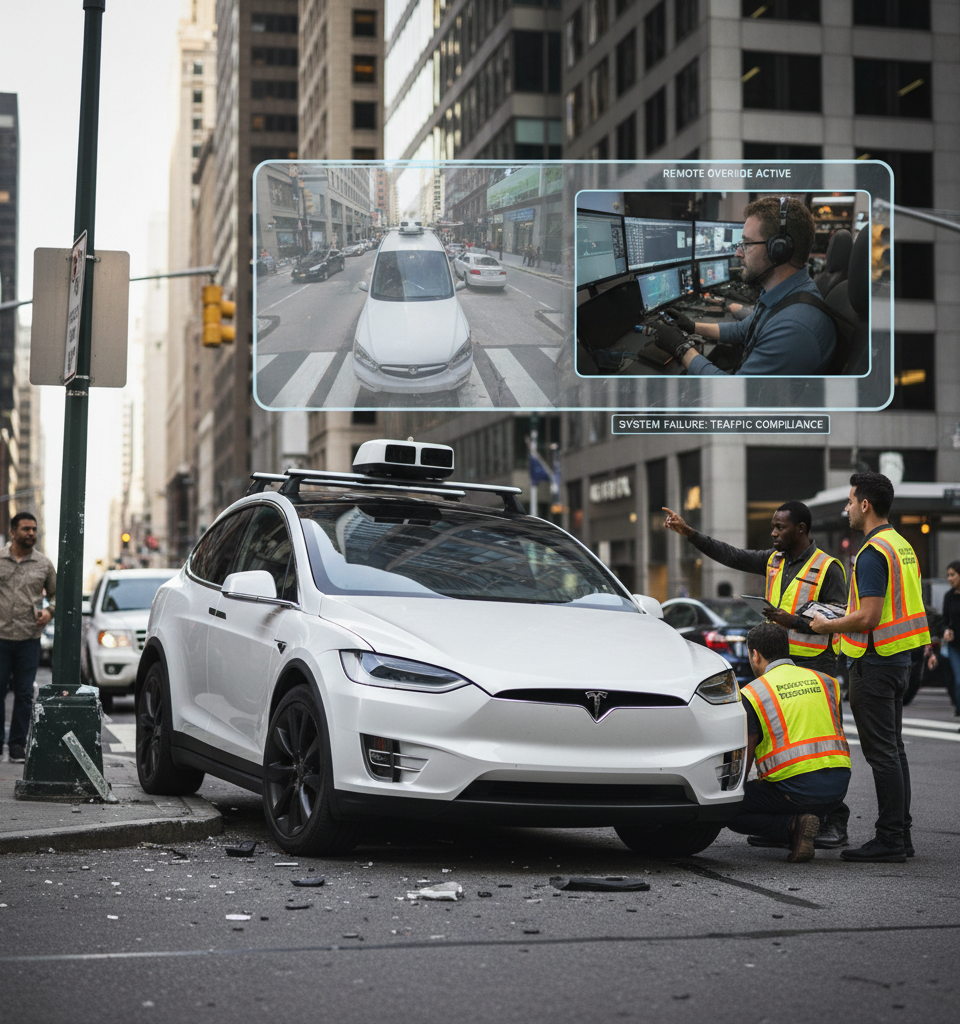
Newly released accident reports indicate that Tesla's robotaxi program, a cornerstone of CEO Elon Musk's long-term vision, continues to grapple with significant operational hurdles. Two separate incidents occurring since July 2025 involved Tesla vehicles designated for autonomous operation, where human remote operators were reportedly overriding or actively driving the vehicles at the time of collision. This development casts a spotlight on the incremental, and often sluggish, progress towards fully self-driving capabilities, challenging the narrative of rapid advancement previously projected by the electric vehicle giant.
Context and Industry Landscape
Tesla’s pronouncements regarding a vast network of autonomous robotaxis have been a consistent feature of its investor calls and public statements for several years. CEO Elon Musk famously predicted millions of robotaxis by 2020, a goal that has continually been pushed back. The recent crash data comes at a critical juncture for the autonomous vehicle (AV) industry, which has seen both significant investment and increasing scrutiny. Competitors like Waymo and Cruise have deployed limited driverless services in select cities, often after years of rigorous testing and regulatory navigation. The reliance on remote operators in these latest Tesla incidents highlights a fundamental gap between fully autonomous aspirations and current operational realities, suggesting that the industry's 'safety driver' equivalent is merely shifting from an in-car presence to a remote one, at least for now.
Key Details and Operational Specifics
The two reported crashes, specifically occurring since July 2025, involved Tesla vehicles equipped with the company's 'Full Self-Driving' (FSD) software suite. While details of the specific incidents remain under investigation by relevant authorities, the common thread is the intervention or direct control by a human remote operator. This implies that the vehicles were not operating in a truly autonomous mode at the time of the accidents, even if intended for such deployment.
This operational model - where remote human oversight is either a fallback or a primary mode of control - fundamentally differs from the pure L4 or L5 autonomy that Tesla has frequently promoted. The financial implications of these incidents, including potential insurance claims and repair costs, are yet to be fully disclosed. These events occurred amidst increased public and regulatory attention on AV safety, particularly following other high-profile incidents involving autonomous or assisted driving systems from various manufacturers.
Industry and Market Impact
The implications for the broader autonomous vehicle market are significant. While not directly comparable to incidents involving fully driverless vehicles without any remote oversight, these crashes contribute to a general perception of slow progress and persistent safety concerns within the AV sector. Investors and consumers are becoming increasingly discerning, distinguishing between advanced driver-assistance systems (ADAS) and true Level 4 or Level 5 autonomy. This differentiation is crucial for market valuation and public adoption. For market leaders and aspirants in the AV space, including Waymo (Alphabet), Cruise (General Motors), and others, these events underscore the immense technical and regulatory challenges. They also reinforce the argument for a phased, highly regulated approach to AV deployment, rather than an expedited, technology-first rollout.
Expert Perspectives
Industry analysts have weighed in, suggesting that these incidents are indicative of the inherent complexities of achieving robust full autonomy. Dr. Anya Sharma, a leading expert in robotics and AI safety at the Institute for Autonomous Systems Research, commented, "The fact that remote operators are still heavily involved, even in designated robotaxi deployments years after original projections, shows the incredible difficulty of handling edge cases in uncontrolled environments.
" Another analyst from a major financial institution, speaking anonymously, stated, "These setbacks, while perhaps minor in isolation, collectively erode confidence.
What's Next: Future Implications and Developments
Looking ahead, these incidents could prompt further scrutiny from regulatory bodies such as the National Highway Traffic Safety Administration (NHTSA) and state departments of motor vehicles. Future robotaxi deployments, not just for Tesla but across the industry, may face more stringent testing requirements and longer operational prove-out periods before receiving full approval for driverless service in new areas. For Tesla, this likely means a continued, albeit slower, expansion of its FSD beta program, with an ongoing emphasis on data collection and system refinement.
The pivot to broader, genuinely driverless robotaxi services will probably remain an incremental journey, punctuated by regulatory milestones and continuous safety validation. The industry as a whole will continue to grapple with public perception, technical challenges, and the ethical considerations of deploying decision-making AI on public roads, with each incident serving as a costly lesson in the path toward mainstream autonomous transportation.