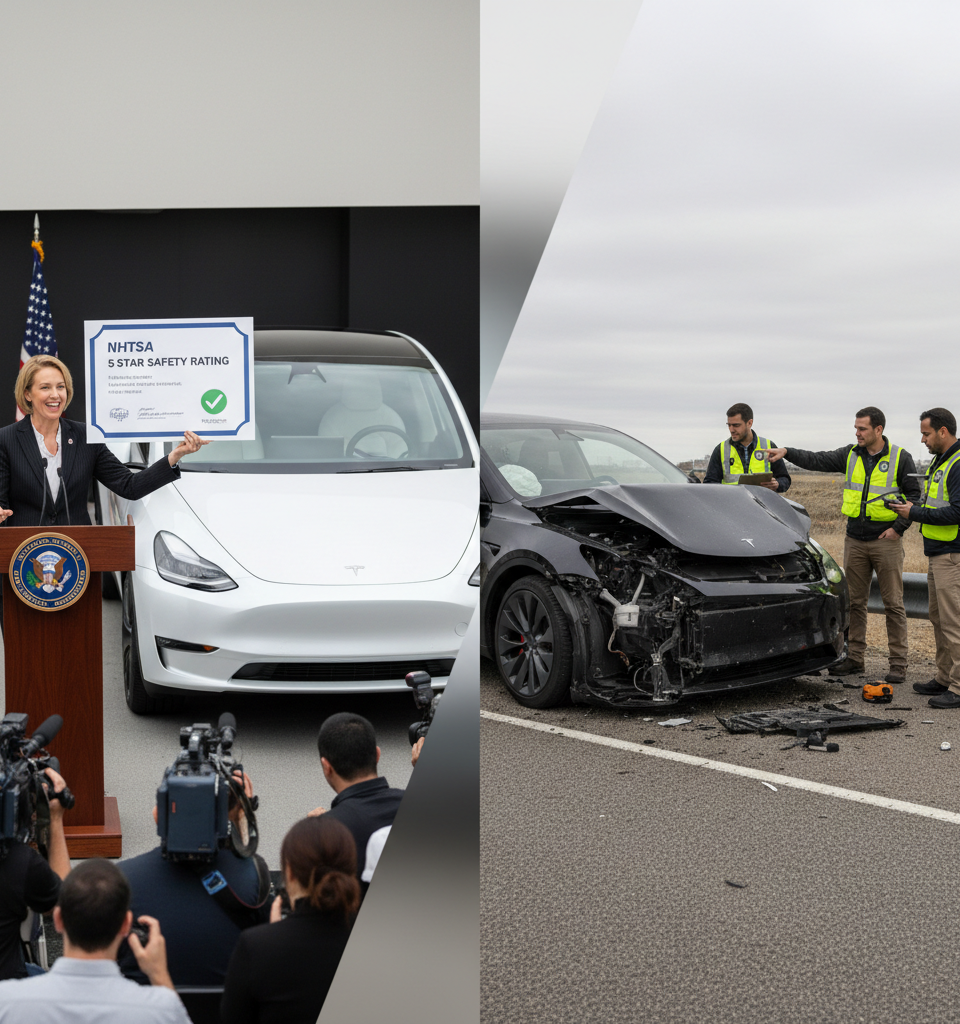
The National Highway Traffic Safety Administration (NHTSA) this week announced that the Tesla Model Y has become the first vehicle to successfully navigate its newly implemented advanced driver assistance system (ADAS) safety tests. This landmark achievement for Tesla, however, arrives incongruously as the very same agency is deep into an escalating investigation concerning 3.2 million Tesla vehicles attributed to a series of crashes potentially involving the company's advanced self-driving features, often marketed as Autopilot or Full Self-Driving (FSD). The simultaneous announcements underscore the multifaceted scrutiny facing Tesla's technological innovations and safety record.
This duality brings into sharp focus the divergent aspects of automotive safety: passive protection systems, which are evaluated by NHTSA's traditional crash tests and new ADAS assessments, and the active, software-driven capabilities that define modern autonomous driving systems. While the Model Y's success in the new ADAS tests acknowledges its robust preventative measures against certain collisions, the ongoing investigation into millions of its vehicles points to critical concerns regarding the real-world deployment and human interaction with its more sophisticated driving assistance technologies. The contrast has sparked considerable debate within industry circles regarding the regulatory framework for emerging automotive technologies.
Key details from NHTSA indicate that the Model Y performed exceptionally well across various scenarios designed to assess ADAS functionality, including automatic emergency braking, lane keeping assist, and blind-spot detection. These new tests are part of a broader effort by NHTSA to keep pace with rapid technological advancements in the automotive sector, moving beyond conventional crashworthiness to evaluate features intended to prevent crashes altogether. However, the separate investigation, initiated in response to a growing number of incidents, scrutinizes Tesla's Autopilot and FSD systems, particularly their ability to detect and respond to emergency vehicles and stationary objects. Reports suggest that at least 16 fatal crashes and hundreds of non-fatal incidents are under review, some involving vehicles reportedly operating with these advanced systems engaged.
From an industry perspective, this situation casts a long shadow over the entire autonomous vehicle (AV) sector. While Tesla has long been a frontrunner and disruptor, these regulatory actions could prompt a more cautious approach from competitors and stricter oversight across the board. Automakers investing heavily in AV technology, such as General Motors (with its Cruise unit) and Waymo, are watching closely, aware that public perception and regulatory trust are paramount for widespread adoption. The incidents involving Tesla vehicles have already fueled debates about the appropriate balance between innovation and public safety, potentially shaping future legislation and certification processes for all AV developers.
Experts and industry analysts offer varied perspectives. Many commend NHTSA for developing more comprehensive ADAS testing protocols, acknowledging the critical role these systems play in modern vehicle safety. "The Model Y's performance in these new tests is a testament to Tesla's engineering capabilities in traditional safety metrics," stated Dr.
Elena Petrova, an automotive safety expert at the University of Michigan.
Looking ahead, the outcomes of NHTSA's investigation will be critical. It could lead to substantial recalls, civil penalties, and potentially the imposition of new, more stringent operational design domain (ODD) limitations for Tesla's advanced driver-assistance systems. Furthermore, this dynamic situation is poised to catalyze a broader re-evaluation of how ADAS and autonomous driving features are regulated globally. Policymakers may accelerate the development of clearer legal frameworks, robust data sharing requirements, and standardized testing methods to ensure that technological progress does not outpace public safety. The coming months will likely see continued public discourse and potential legislative action aimed at defining the future of autonomy on our roads.