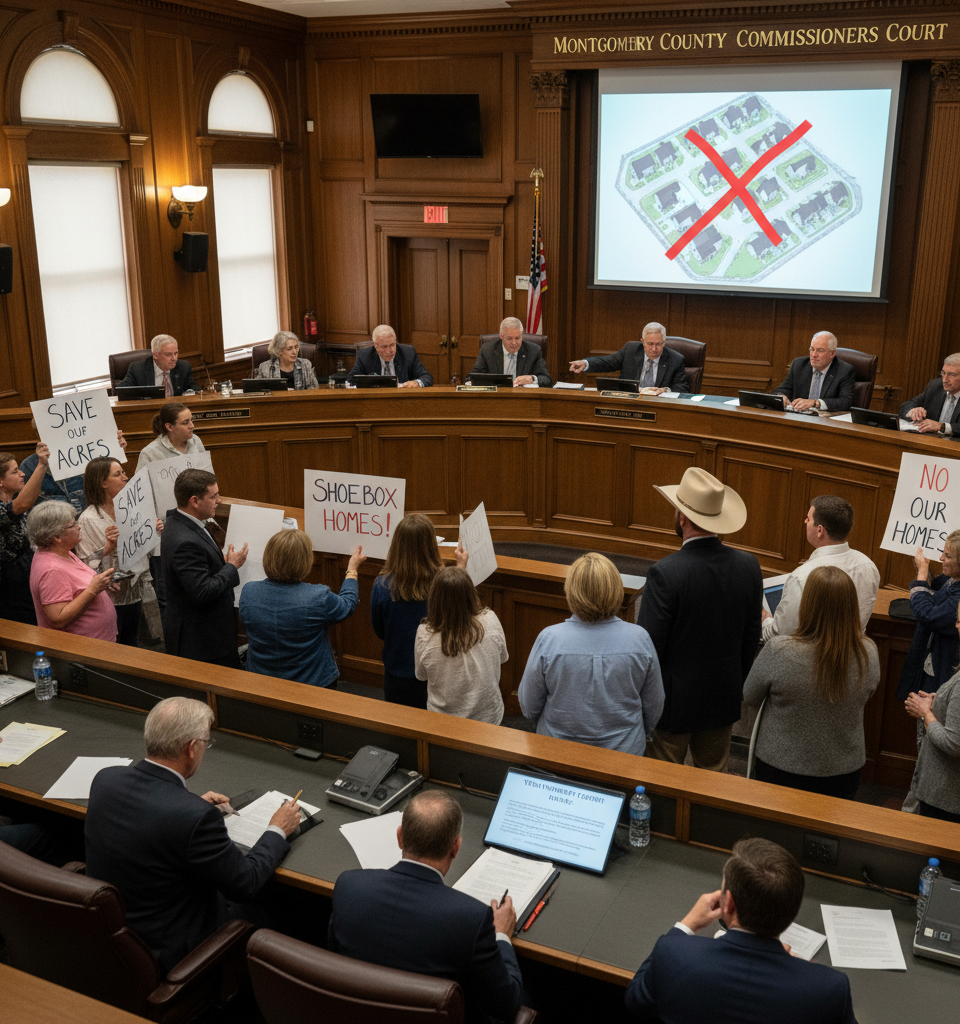
MONTGOMERY COUNTY, TX – November 19, 2023 – A legislative tug-of-war over residential development standards has ignited in Montgomery County, Texas, as local authorities attempt to significantly increase minimum residential lot sizes, setting the stage for a direct confrontation with a recently enacted state law. This local initiative, following a prior attempt earlier this year, aims to address what county officials perceive as unchecked growth and infrastructure strain, even as a statewide measure championed by Governor Greg Abbott seeks to reduce development hurdles in the state's largest urban centers. The controversy underscores a deepening divide between state-level market-oriented policies and local land-use control, with Montgomery County, a rapidly expanding exurb of Houston, at the epicenter.
Contextualizing the Texas Lot Size Debate
This dispute didn't emerge in a vacuum. It gained significant traction after Governor Abbott signed Senate Bill 14 (SB 14) into law last year, which primarily aimed to reduce minimum residential lot sizes in Texas's five largest cities: Houston, San Antonio, Dallas, Austin, and Fort Worth. The stated intent of SB 14 was to combat rising housing costs and increase affordability by facilitating denser development. However, the law's scope deliberately excluded surrounding counties, creating a patchwork regulatory landscape. Montgomery County, experiencing a population boom that rivals some of the state's largest cities, views this exemption as an opportunity – or perhaps a necessity – to reassert local control over its development trajectory, moving to increase its minimum lot sizes from a current average of 5,000 square feet to potentially 7,500 or even 10,000 square feet, depending on zoning classifications.
Key Details and Local Motivations
Montgomery County's planning department first proposed an increase in minimum lot sizes in March of this year, citing concerns over infrastructure capacity, traffic congestion, and the preservation of the county's suburban character. "We’re seeing unprecedented growth," stated County Commissioner James Noack during a recent public hearing, "and our roads, our schools, our utility systems are struggling to keep up. Tying large homes to smaller lots isn't sustainable." Developers, however, argue that larger lot sizes directly translate to higher housing costs, exacerbating affordability issues even within more suburban areas. Sources within the planning department indicate that the current proposal seeks to establish tiered minimums, potentially ranging from 7,500 square feet in less dense areas to smaller, but still increased, minimums in areas closer to existing infrastructure. The median home price in Montgomery County has surged by over 20% in the last two years, reaching approximately $380,000, correlating with a tight housing supply and rapid population influx.
Broader Industry and Market Impact
The ripple effects of Montgomery County's potential ordinance extend beyond its borders, influencing the broader Texas real estate and construction industries. Developers, many operating across numerous Texas municipalities, face increasing regulatory fragmentation. The Texas Association of Builders (TAB) has expressed significant concerns, with a spokesperson noting, "Inconsistent regulations across neighboring counties create uncertainty, increase development costs, and ultimately restrict housing options for Texans." If Montgomery County succeeds, it could embolden other rapidly growing peri-urban counties to follow suit, potentially undermining the state's broader objective of increasing housing supply and affordability. This battle represents a critical test case for the balance between local autonomy in land-use planning and state-level directives aimed at economic and housing market efficiency.
Expert Perspectives on the Regulatory Tug-of-War
Real estate economists and urban planning experts are closely watching the situation. Dr. Karen Smith, a professor of urban planning at the University of Texas, commented, "This isn't just about lot sizes; it's about the fundamental tension between local control and state preemption. While SB 14 aimed for density in core cities, the rationale for similar flexibility extends to rapidly developing exurbs like Montgomery County, which often bear the brunt of urban overflow. Larger lot sizes inherently constrain supply and can push up per-unit infrastructure costs, which are then passed on to homebuyers." Conversely, local governance advocates argue that counties possess superior knowledge of their specific environmental, infrastructural, and social needs, making them better equipped to dictate development standards. The outcome in Montgomery County could set a precedent for how much legislative muscle counties can flex against state mandates in the booming Texas growth corridor.
What Lies Ahead: Potential Legal Challenges and Policy Shifts
The immediate future holds a series of public hearings and likely fierce lobbying from various stakeholders. If Montgomery County's commissioners approve the new, larger minimum lot sizes, it could trigger legal challenges from pro-development groups, potentially leading to a protracted court battle over the interpretation and limits of SB 14 and local land-use authority. Furthermore, the situation could prompt state legislators to revisit SB 14 or consider new legislation during upcoming sessions, potentially extending similar lot size restrictions to fast-growing counties or, conversely, explicitly affirming local control. The economic implications for developers include revised project timelines, increased land acquisition costs, and potentially reduced project feasibility, shifting investment patterns away from the county. For prospective homebuyers, the ordinance could accelerate the already upward trend in housing prices, further limiting access to affordable housing options in a desirable, growing region.