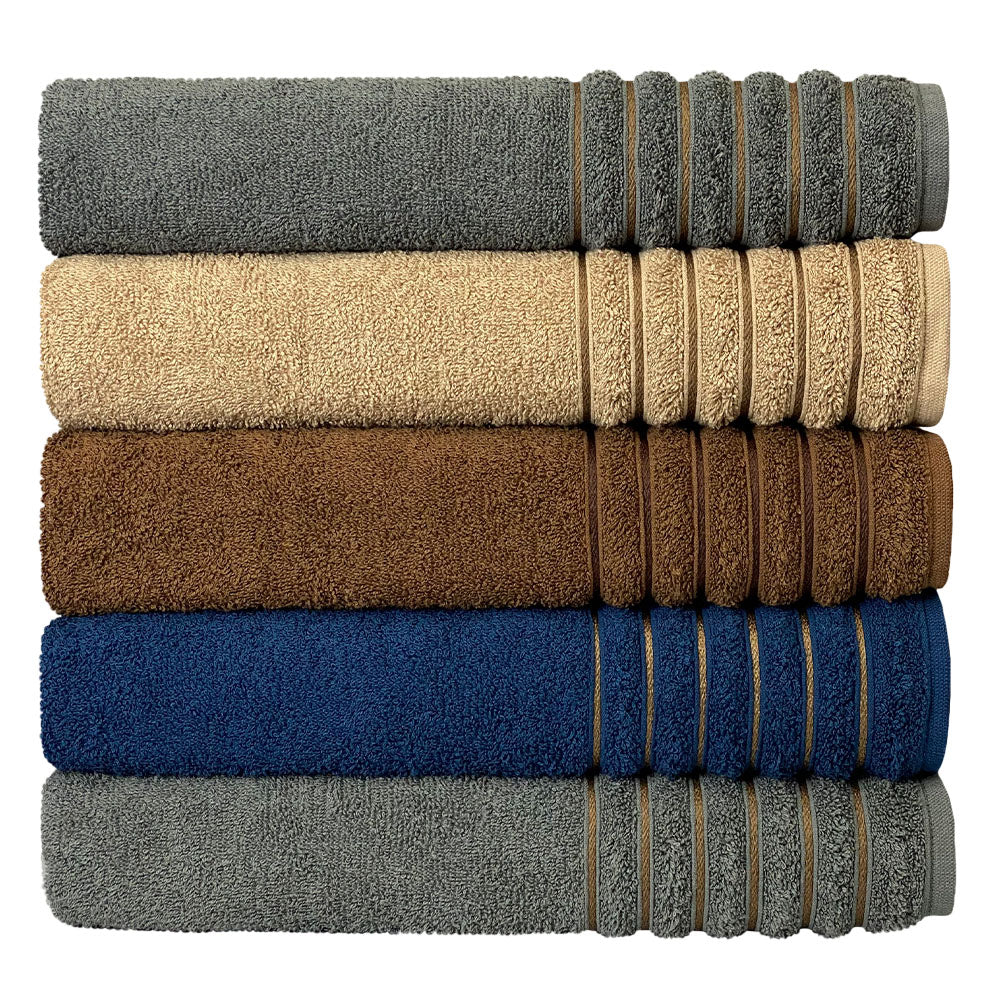
In Brazil, 89.7 per cent of our bath category revenue arrives in five-piece sets and kits. Single towels account for 9.7 per cent. The average order is 332.13 Brazilian reais. Those three numbers, drawn from 21,546 orders placed between January and July 2026, are what a retailer or a fulfilment operator can plan around, and they are the part most export plans skip in favour of a unit price.
The figures come from the Annual Study of the Brazilian Towel Market 2026, published in August by Casa da Toalha, the online retailer I founded in Brusque, Santa Catarina. The aggregated table behind every number is open, so anything below can be checked.
What a Basket That Size Changes
A market where almost nine in ten revenue units leave as a coordinated set is a different operation from one where they leave as singles, even when the annual volume is identical.
Colour has to hold across five pieces in three different sizes. Dye lots have to match between the bath, face and hand pieces, because the customer will see them side by side on the same rail within a week of delivery. Packaging is designed once, for the set, not for the piece. Pick and pack is one line instead of five, which is cheaper, but a single missing piece fails the whole order rather than part of it.
For a supplier, that is the uncomfortable part. An excellent single towel with a slight colour drift between sizes is not a small defect in this market. It is a returned order.
Shipping Is an Objection. Price Is Not.
We asked 502 shoppers at checkout what had worried them most before finishing the purchase. Shipping cost came third, at 16.1 per cent, according to the Annual Study of the Brazilian Towel Market 2026. Quality and softness came first at 22.3 per cent, and being new to the shop was second at 17.3 per cent. High price was named by 2.2 per cent.
Read that against the basket size and the operational brief changes shape. The freight line on a 332 real order is visible enough to be argued about, while the price of the goods inside it is not. Anyone optimising for a lower landed unit cost, at the expense of a slower or more expensive last mile, is fixing the objection nobody raised.
The Map Is Flatter Than the Trade Assumes
The 21,546 orders in the study came from all 27 Brazilian federal units. Sao Paulo took 35.2 per cent, Rio de Janeiro 13.8, Minas Gerais 11.4, the three southern states together 14.7 and the northeast 12.5.
Brazilian textile manufacturing is concentrated in the south and southeast, and for most of its history the good cloth stayed near where it was woven. That distribution says the online channel has already dissolved a fair part of that. Two thirds of demand sits outside Sao Paulo, and it is not clustered tightly enough for a single warehouse to serve it well on time.
November, Not December
Across the whole measured series, from October 2022 onwards, November was the peak month in every single year: 3,251 transactions in November 2022, 3,968 in 2023, 5,736 in 2024 and 4,271 in 2025. The second wave is the southern hemisphere winter, June to August. December to February is the trough.
Inbound lead time counts backwards from November here, not from Christmas. In Brazil the towel is a cold weather purchase and a discount season purchase. It is not a gift, and a container timed for a northern hemisphere holiday calendar lands a month late.
The annual line is worth one note of caution for anyone sizing this from a single good year. Transactions went from 20,703 in 2023 to 35,195 in 2024, a rise of 70 per cent, then fell to 30,758 in 2025, down 12.6 per cent but still well above 2023. The first seven months of 2026 ran 6.3 per cent ahead of the same period in 2025.
What We Could Not Measure
For years we registered each colour as a separate product instead of treating colour as a structured attribute. When we sat down with the history, roughly three quarters of order lines had no usable colour value, so there is no colour preference breakdown in this edition. That is very probably the number a manufacturer would have found most useful, and we do not have it.
The other limits are stated openly on the study page. The base is the customer of one shop, not a probabilistic sample of the country. The 226 answer survey used elsewhere in the study covers one week and is treated as a signal. The transaction series starts in October 2022.
The practical lesson, for us at least, was that the operational shape of a market shows up in the basket long before it shows up in a price list. We had the data for years. We had not structured it well enough to read.