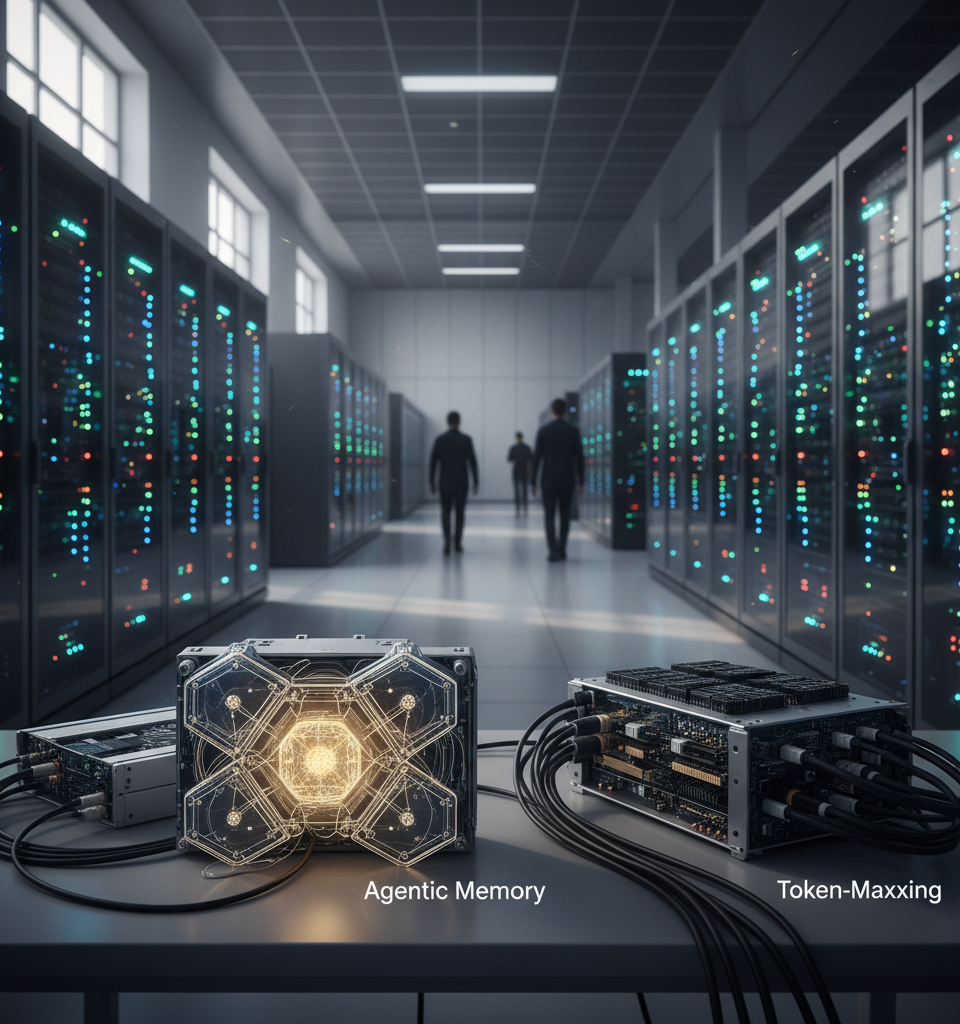
The efficiency and effectiveness of global sales operations often hinge on the underlying technological infrastructure, particularly in AI-driven automation for customer service, supply chain optimization, and market intelligence. A forthcoming paradigm shift in AI development, moving from raw computational scale to more nuanced, context-aware 'agentic memory,' could redefine the operational costs and competitive advantages for multinational enterprises, influencing investment decisions in AI platforms and staffing for global market penetration.
A New Era for AI Development
The artificial intelligence industry is on the cusp of a fundamental re-evaluation of its core development methodologies. Industry observers and researchers are anticipating a strategic pivot from what has been termed 'token-maxxing' to 'agentic memory,' signaling the next major frontier in AI evolution. This shift is not merely an incremental update but a profound redirection, acknowledging the foundational, nascent stage of current AI agent capabilities and paving the way for more sophisticated, context-aware systems.
The Limitations of 'Token-Maxxing'
For a significant period, the dominant paradigm in AI development, particularly within large language models (LLMs), has been 'token-maxxing.' This approach primarily focuses on increasing the sheer volume of data tokens processed and the scale of computational power applied to training models. While this strategy has led to remarkable advancements in generating human-like text and performing complex linguistic tasks, it inherently carries limitations. These limitations often manifest as a lack of persistent memory, coherent long-term reasoning, and true understanding of context beyond immediate input windows. Models trained through token-maxxing can struggle with tasks requiring multi-step planning, adaptation to changing environments, or remembering information across extended interactions, making them less robust for dynamic, real-world applications.
The Promise of 'Agentic Memory'
The anticipated transition to 'agentic memory' represents a move towards building AI systems that can retain and leverage information over extended periods, akin to human memory. This involves developing architectures that allow AI agents to store, retrieve, and reason about past experiences and learned knowledge, enabling more sophisticated decision-making and adaptive behavior. Instead of relying solely on the input provided in the current prompt (the 'context window'), agents equipped with agentic memory would have access to a dynamically updated, persistent knowledge base. This would allow them to maintain conversational threads, learn from interactions, and plan complex actions over time, significantly enhancing their utility and reliability in complex operational settings.
Industry Impact and Evolution
This strategic pivot is expected to have far-reaching implications across the AI landscape. For developers, it means a shift in focus from purely scaling model size to innovating in memory architectures, knowledge representation, and reasoning mechanisms. For businesses deploying AI, it promises more capable and trustworthy AI agents that can handle more intricate tasks, such as managing long-term customer relationships, orchestrating complex supply chains, or performing detailed research over extended periods. The evolution of AI agents with true agentic memory could unlock entirely new applications and efficiencies, moving beyond current generative capabilities to truly autonomous and intelligent systems capable of sustained, goal-oriented behavior.
The Road Ahead
The transition to agentic memory is expected to be a multi-faceted challenge, requiring significant research and development. It will likely involve advancements in various sub-fields of AI, including knowledge graphs, persistent state management, reinforcement learning, and neuroscience-inspired memory models. The industry is currently in the nascent stages of this evolution, with initial experiments and conceptual frameworks beginning to emerge. The coming years will likely see intense competition and collaboration as companies vie to develop the most effective and scalable agentic memory solutions, ultimately shaping the future trajectory of AI and its integration into global industries. This shift underscores a broader recognition that intelligence is not merely about processing vast amounts of data at high speed, but also about the ability to learn, remember, and adapt over time.