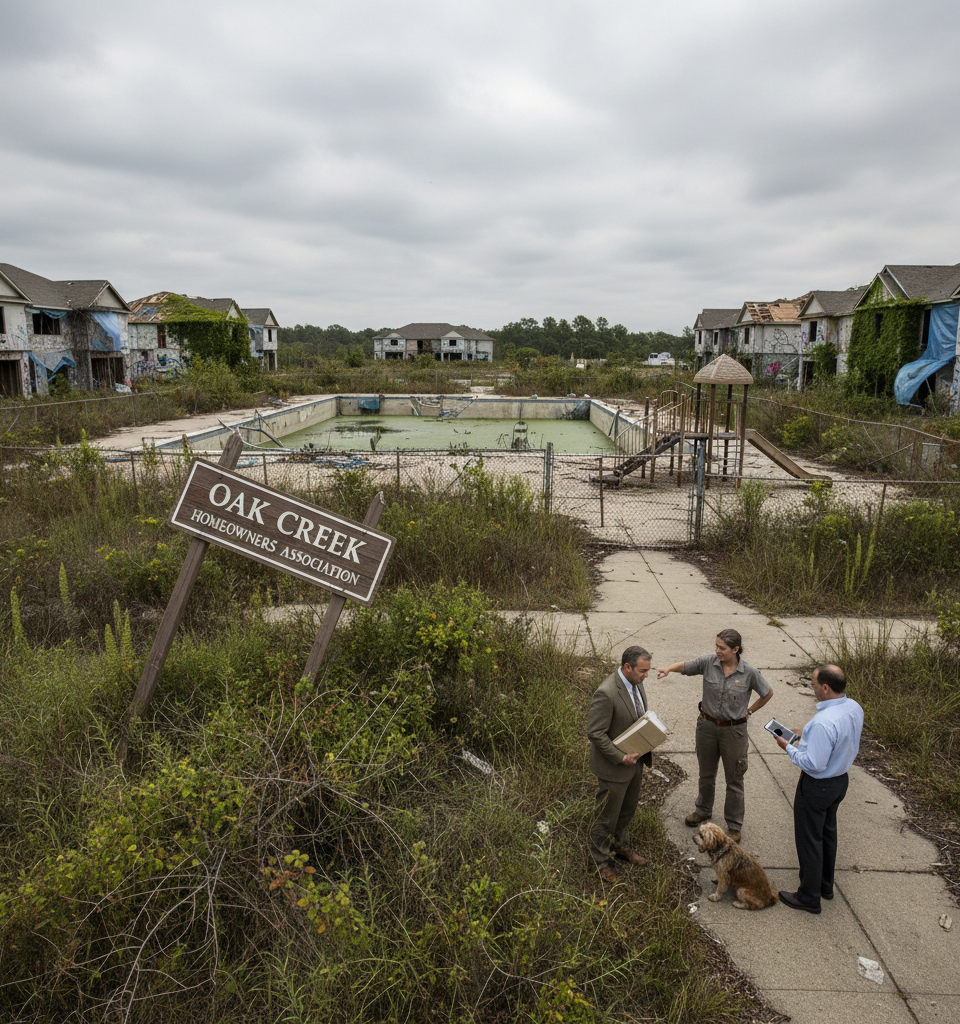
Across the United States, homeowners are increasingly finding themselves ensnared in a frustrating and often costly legal quagmire due to developers failing to properly hand over control of homeowners associations (HOAs) to residents. This critical lapse in the developer turnover process transforms once-promising communities into what legal professionals term 'Zombie HOAs,' where properties languish without proper governance, maintenance, or financial oversight. The issue, more pervasive than commonly acknowledged, underscores a significant vulnerability in the homeowner association model, affecting thousands of properties and potentially billions of dollars in resident assets.
The Unfolding Crisis of Developer Negligence
This phenomenon isn't merely an administrative hiccup; it represents a fundamental breakdown in the contractual obligations between developers and homebuyers. The developer turnover process is designed to ensure a smooth transition of power, financial records, and operational control from the developing entity to the elected homeowner board. However, when developers either intentionally or negligently sidestep this responsibility—often after selling most units but before a community is fully established—homeowners are left with no legal recourse to manage their own properties effectively. This dereliction creates a void: amenities fall into disrepair, crucial financial records are absent, and the community's legal standing becomes tenuous, hindering everything from securing loans to collective decision-making.
Disturbing Trends and Key Indicators According to legal experts specializing in
HOA law, developer non-compliance is rampant, significantly more common than the public or even some housing industry insiders realize. "It's not just a few bad apples; it's a systemic issue in certain markets," states a prominent attorney who spoke with Realtor.com, highlighting that the problem often emerges in rapidly developing areas or projects where the developer's entity is specifically created for a single community and then dissolved. Key indicators of a 'Zombie HOA' include a lack of transparent financial statements, absence of resident-elected boards, and deferred maintenance on common areas, which can lead to significant structural and aesthetic decline. While precise national statistics are hard to pin down due to the decentralized nature of HOA governance, anecdotal evidence suggests thousands of communities could be impacted, representing hundreds of thousands of individual homeowners.
Broadening Impact on the Housing Market
The ripple effects of these 'Zombie HOAs' extend far beyond the immediate residents. They pose a significant threat to property values within affected communities, as potential buyers are deterred by the lack of clear governance and potential liabilities. Lenders become wary of financing properties in HOAs without transparent financial reporting or active resident control, complicating resales and refinances. This uncertainty can lead to a depressed market for these properties, shrinking the pool of interested buyers and ultimately eroding the wealth of current homeowners. Furthermore, the inability of these HOAs to enforce covenants or collect dues can lead to neglected common areas and depreciating property values across the entire development, impacting local tax bases.
Expert Calls for Greater Oversight
Housing industry experts and legal scholars are increasingly calling for stronger regulatory oversight and stricter enforcement mechanisms. They advocate for mandatory third-party audits of developer-controlled HOAs prior to turnover, clearer legal frameworks for establishing resident control, and more accessible legal avenues for homeowners to compel developer compliance. "Many states have guidelines, but enforcement is often weak or non-existent," notes one real estate analyst, emphasizing the need for robust state-level legislation that includes penalties for developers who fail to uphold their responsibilities. There's also a push for better homeowner education, empowering residents to identify red flags and initiate legal action much earlier in the process.
Navigating the Path Forward
For homeowners currently trapped in a 'Zombie HOA,' the path to rectification is arduous but not impossible. It typically involves organizing fellow residents, pooling resources to secure legal counsel, and diligently piecing together fragmented community records. Attorneys specializing in HOA law often advise forming an ad-hoc resident committee and formally demanding financial and operational documents from the developer. In more severe cases, litigation may be necessary to compel the developer to fulfill their handover obligations and compensate the community for damages incurred due to neglect. Looking ahead, state legislatures are being pressured to introduce and strengthen laws that protect homeowners from such developer malfeasance. The creation of a national registry or watchdog organization for HOAs is also being discussed as a potential long-term solution to bring greater transparency and accountability to this rapidly expanding segment of the housing market. As the U.S. continues to expand its suburban and exurban landscapes with master-planned communities, the issue of developer accountability in HOA transitions will only grow in prominence. The stakes are substantial, impacting not just individual homeowners' investments but the very fabric of community governance and property market integrity.