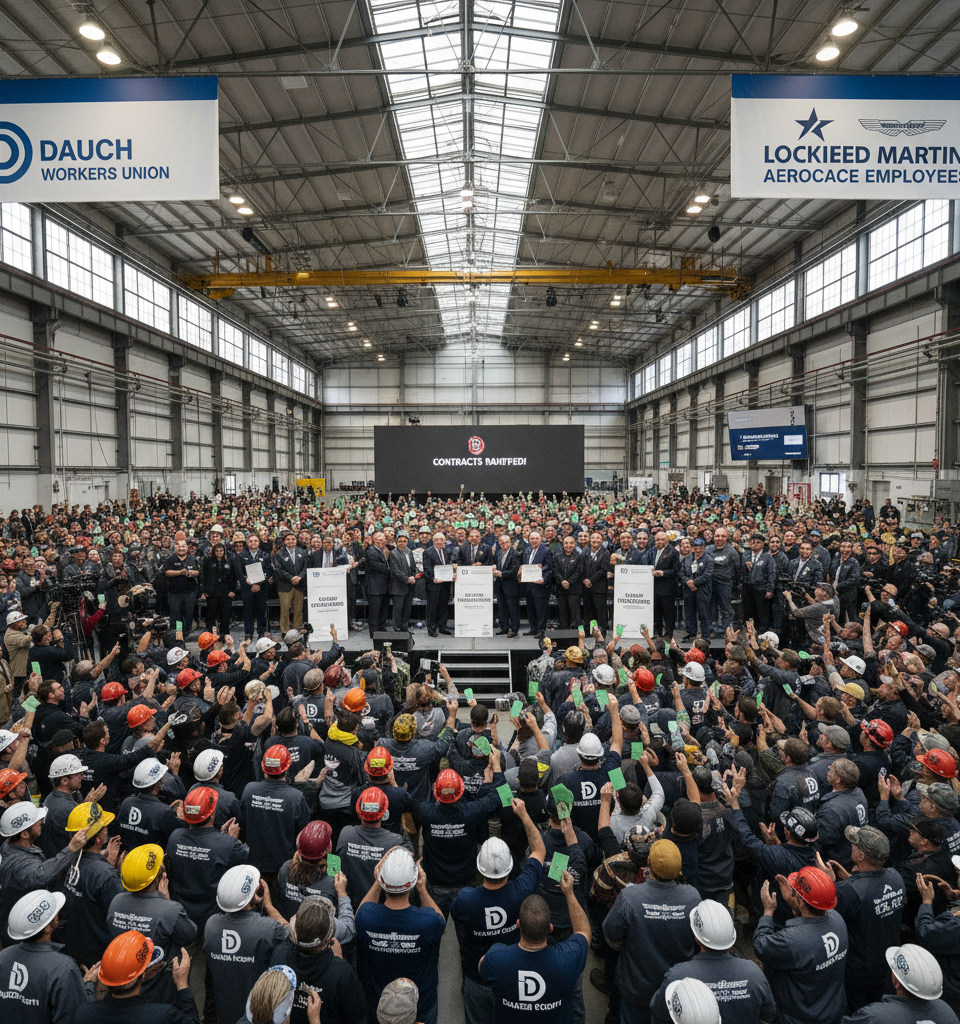
Thousands of unionized employees across two major industrial sectors – automotive supply and aerospace defense – voted over the weekend to ratify new labor contracts, signaling significant developments for both their respective companies and the broader American labor landscape. At Dauch, a key General Motors supplier, nearly 1,000 United Auto Workers (UAW) represented employees concluded a two-week strike by approving their new agreement. Concurrently, approximately 5,000 International Association of Machinists and Aerospace Workers (IAM) members at Lockheed Martin also cast their ballots in favor of a new deal.
Context and Significance
The ratification at Dauch is particularly impactful for the automotive supply chain. The two-week strike at the Michigan plant had undoubtedly created disruptions for General Motors, highlighting the critical role that tier-one suppliers play in the integrated manufacturing process. For the UAW, securing this new agreement reinforces its ongoing efforts to achieve favorable terms for its members amidst evolving industry dynamics, particularly as the automotive sector navigates transitions towards electric vehicles and increased automation.
The simultaneous agreement at Lockheed Martin, a behemoth in the defense industry, underscores the continued influence of organized labor in sectors vital to national security and technological advancement. These dual ratifications provide a snapshot of current labor relations, demonstrating that unions retain significant bargaining power in strategic industries.
Key Contract Details
While specific granular details of both contracts were not immediately made public beyond their ratification, the approval by such a large number of workers suggests that they contain provisions deemed satisfactory by the union memberships. At Dauch, the ending of the two-week work stoppage indicates that the new contract addressed the core grievances or demands that led to the strike, likely encompassing wages, benefits, and working conditions. For the IAM workers at Lockheed Martin, the smooth passage of their vote without a reported strike suggests a more amicable negotiation process, with a deal that likely reflects competitive compensation and benefits packages common within the defense industry, designed to retain highly skilled labor critical for complex aerospace projects.
Industry Impact and Broader Implications
The resolution of these labor disputes offers stability for the affected companies. For Dauch, the resumption of full production at its Michigan plant is crucial for meeting commitments to GM and avoiding further penalties or production lags. For Lockheed Martin, a ratified contract ensures continuity in its defense projects, many of which involve long-term government contracts and require consistent staffing. More broadly, these agreements contribute to a narrative of active union engagement across crucial sectors of the U.S. economy. They may also set precedents or influence future negotiations for other companies within the automotive supply chain and the aerospace industry, as unions often leverage successful agreements in one company as a benchmark for others.
The Role of Organized Labor
The successful ratification by both the UAW and IAM members underscores the persistent and vital role of organized labor in advocating for workers' rights and securing improved terms of employment. In a period marked by fluctuating economic conditions and technological shifts, unions continue to act as a significant counterbalance to corporate power, ensuring that employees have a voice in decisions that affect their livelihoods. The high turnout and approval rates for these contracts suggest a strong sense of solidarity and trust in their respective union leadership to deliver tangible benefits.
Looking Ahead
With these contracts now ratified, both Dauch and Lockheed Martin can focus on their operational objectives with greater certainty regarding their labor forces. For Dauch, the immediate priority will be to scale up production to catch up on any backlogs created by the strike. For Lockheed Martin, the new agreement provides a stable foundation for ongoing and future defense projects. These developments will be watched closely by other companies and unions as they navigate their own labor discussions, potentially influencing the landscape of worker expectations and corporate negotiation strategies in the coming months and years.