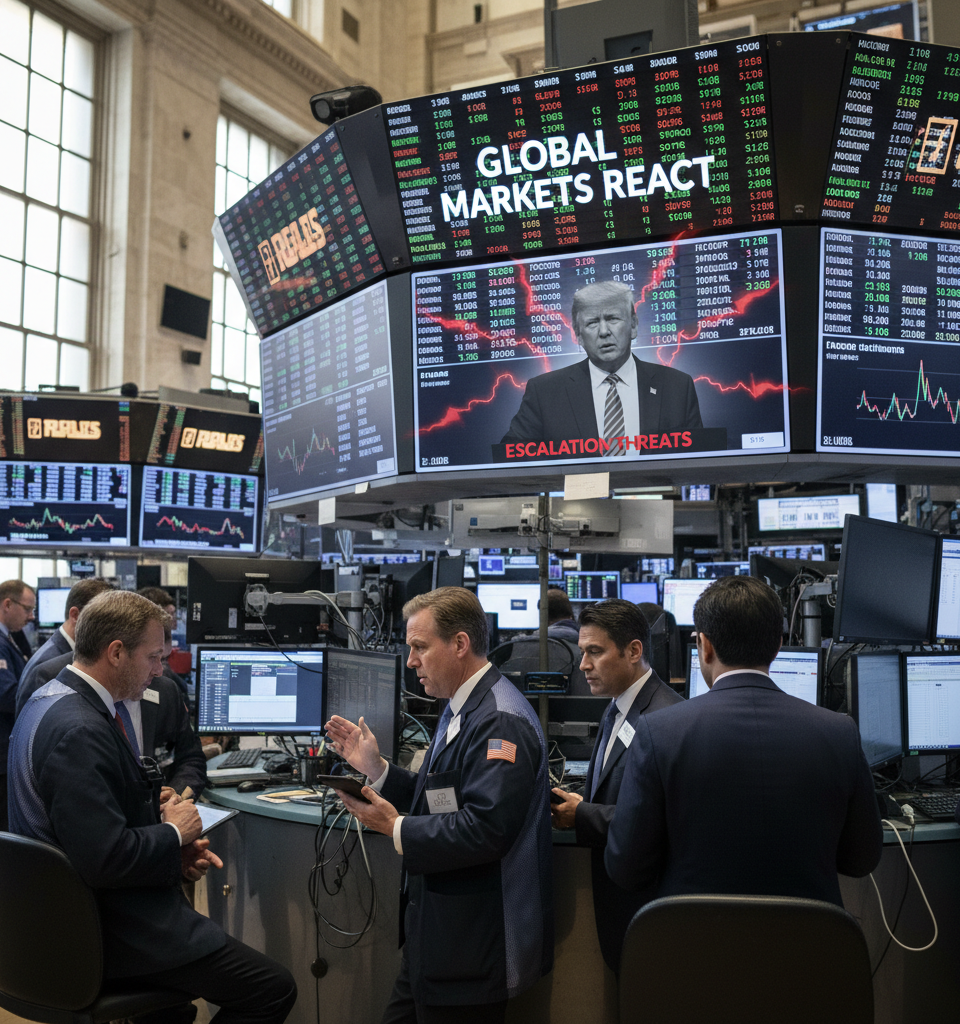
Global financial markets are opening today amid considerable uncertainty, directly influenced by recent statements from US President Donald Trump indicating a possible significant escalation of military action in Iran. This development is particularly concerning for investors and economists, as it threatens to intensify an existing energy-price shock, which is already having a profound impact on the global economic landscape.
Geopolitical Tensions and Economic Fallout
The specter of a widened conflict in the Middle East introduces a critical layer of risk to an already fragile international economy. Geopolitical instability in a major oil-producing region invariably translates into heightened volatility in energy markets. The current energy-price shock, which has been steadily building, now faces the possibility of being dramatically worsened, potentially sending crude oil prices soaring to levels that could trigger a global recession. The interconnectedness of global economies means that any significant disruption to the supply or pricing of such a fundamental commodity has ripple effects across all sectors, from manufacturing and transportation to consumer spending and inflation.
President Trump's statements, delivered with the characteristic weight of his office, have immediately become a primary driver of market sentiment. Traders and analysts are now meticulously assessing the likelihood and potential severity of such an escalation, attempting to price in the complex mosaic of political, military, and economic consequences. The rhetoric itself, even without immediate action, creates an environment of apprehension, leading to risk aversion among investors and prompting shifts towards perceived safe-haven assets.
The Impact on Energy Markets
An escalation in Iran would almost certainly lead to disruptions in oil supply, particularly if key shipping lanes in the Persian Gulf, such as the Strait of Hormuz, were to become compromised or perceived as unsafe. Even a modest reduction in supply from this vital region can have an outsized effect on global prices, given the tight balance between supply and demand that often characterizes the oil market. Furthermore, the premium for geopolitical risk – an additional cost built into oil prices to account for potential disruptions – would undoubtedly surge, adding further upward pressure.
Analysts are already modeling various scenarios, considering not only the direct impact on Iranian oil exports but also the broader regional ramifications that could affect other major producers. The immediate effect on the global economy would be a sharp increase in business costs and a reduction in consumer purchasing power, as higher fuel prices translate to increased expenditure on transportation, heating, and goods. This, in turn, could dampen economic growth and fuel inflationary pressures, complicating the policy decisions of central banks worldwide.
Broader Market Implications
Beyond crude oil, the ripple effects are expected to be widespread. Equity markets could experience significant sell-offs as corporate profits are squeezed by higher energy costs and reduced consumer demand. Sectors particularly vulnerable include airlines, logistics, and automotive industries. Conversely, defense stocks might see an uplift, while firms offering alternative energy solutions could also draw increased attention, albeit likely on a longer-term horizon.
Bond markets are also bracing for impact. In times of heightened global uncertainty, there is often a flight to quality, driving demand for government bonds from stable economies, particularly the US Treasury. This could push bond yields lower in the short term, but persistent inflation fueled by energy prices could eventually lead central banks to tighten monetary policy, creating upward pressure on yields later on. Currency markets would also react sharply, with the US dollar potentially strengthening as a safe haven, while currencies of commodity-importing nations could weaken.
Navigating an Unpredictable Landscape
For businesses, the threats of escalation necessitate a re-evaluation of supply chains, energy hedging strategies, and contingency plans. Companies with significant exposure to the Middle East or high energy consumption are particularly vulnerable. Investors, meanwhile, are likely to adopt a more cautious stance, prioritizing capital preservation over aggressive growth strategies until a clearer picture of the geopolitical situation emerges.
Looking ahead, the immediate focus will remain on any further statements or actions from the US administration and Iranian leadership. The coming days and weeks will be crucial in determining whether these threats remain rhetoric or translate into concrete military maneuvers. The global economy, already grappling with post-pandemic recovery and ongoing inflationary pressures, now faces another formidable challenge, underscoring the delicate balance between geopolitical stability and economic prosperity. Until the situation in the Persian Gulf stabilizes, volatility is likely to be the prevailing theme across all financial markets.