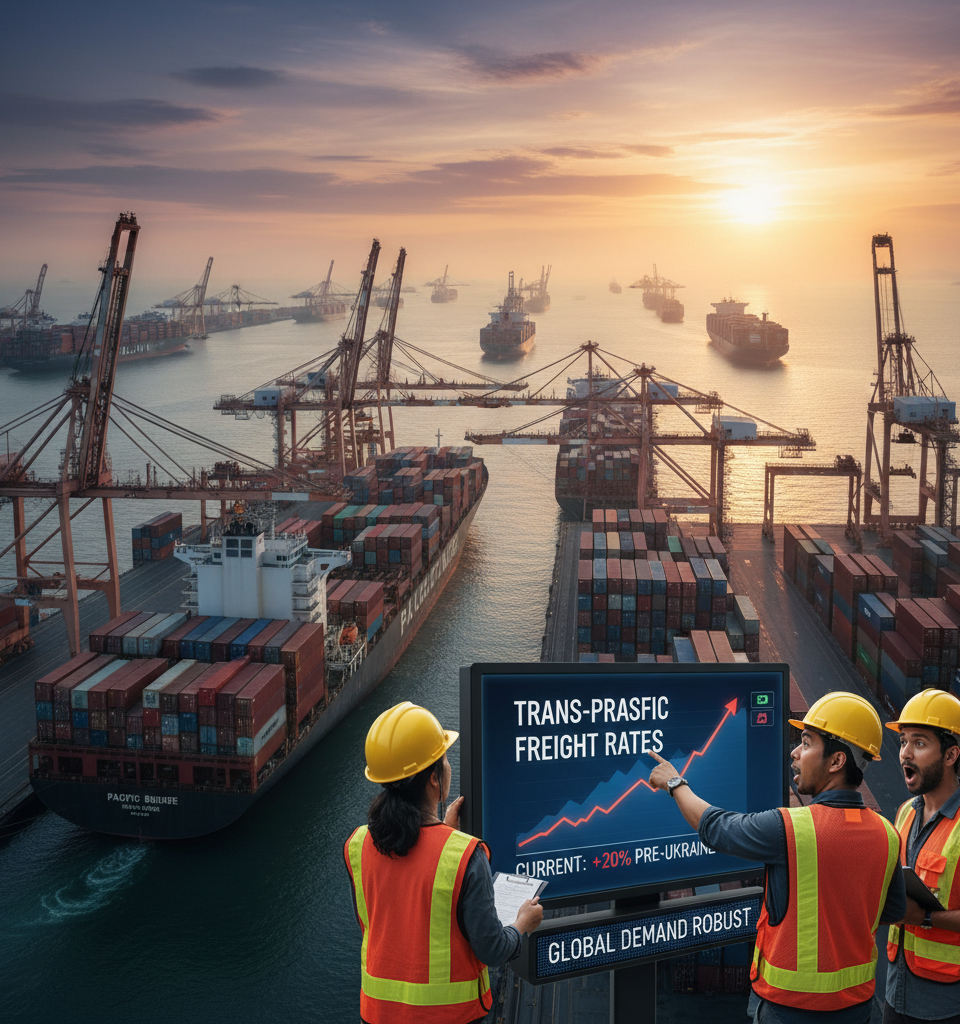
Trans-Pacific ocean freight rates, a crucial barometer for global trade and consumer demand, are currently sustaining levels significantly higher than those observed prior to Russia's invasion of Ukraine in February 2022. This persistent elevation in pricing stands in stark contrast to the subdued expectations from retailers regarding peak season performance, challenging conventional supply and demand forecasting models. The incongruity highlights ongoing complexities within the global shipping landscape, influencing everything from inventory management to inflation for consumers.
Historical Context and Market Disconnect
The current rate stability, or rather, elevated baseline, represents a significant shift from the volatility experienced during the pandemic-induced supply chain chaos. During 2020 and 2021, trans-Pacific spot rates skyrocketed to unprecedented highs, often exceeding $20,000 per 40-foot equivalent unit (FEU) on key routes. While these dizzying peaks have long receded, current rates, even with a general downtrend over the past year, consistently sit above the $3,000-$4,000 per FEU range that characterized the pre-2022 market. This sustained floor indicates a recalibration of pricing power, despite forecasts of only tepid gains for the upcoming peak shipping season, traditionally a period of heightened activity and premium rates.
Retailer Caution and Demand Signals
Retailers are voicing significant caution, with many warning of a less robust peak season than typical. High inflation, elevated interest rates, and shifting consumer spending habits away from goods and towards services are primary drivers of this subdued outlook. Major retailers have reported accumulating inventories in some categories, leading to a more conservative ordering strategy. This reduced demand signal from the retail sector would ordinarily translate to downward pressure on freight rates. However, factors such as persistent Red Sea diversions, a cautious approach to capacity management by shipping lines, and perhaps an underlying increase in operational costs continue to underpin the higher rate structure.
Industry Impact and Operational Challenges
For importers and exporters, these sustained high rates eat into profit margins and contribute to higher landed costs for goods. This can, in turn, be passed on to consumers, hindering efforts to control inflation. Shipping lines, while benefiting from higher rates, are also contending with their own set of challenges, including fluctuating fuel prices – exacerbated by geopolitical events – and the ongoing rerouting of vessels around the Cape of Good Hope, which adds significant transit time and expense. The operational pivot required by these diversions effectively reduces available vessel capacity on some routes, subtly tightening the market even amidst softer demand.
Expert Perspectives on Market Dynamics
Maritime analysts point to a confluence of factors maintaining the rate floor. "While demand has undoubtedly softened from pandemic highs, carriers have become much more disciplined in managing capacity," notes one leading freight market analyst. "Blank sailings and slow steaming are now commonplace strategies to prevent rates from collapsing entirely." Others highlight the geopolitical premium embedded in current pricing, particularly related to the Red Sea situation. "The cost and time associated with rerouting are significant, and that inevitably translates into higher freight charges," commented an economist specializing in logistics. This suggests that current rates aren't purely a function of fundamental supply and demand on the trans-Pacific, but also reflect a broader risk premium across global shipping lanes.
Future Implications and Key Developments
The immediate future of trans-Pacific rates hinges on a delicate balance between retailer demand, carrier capacity discipline, and geopolitical stability. Key developments to watch include inventory levels at major retailers, consumer spending trends for goods, and any resolution or escalation of tensions in the Red Sea region. Should consumer demand surprisingly rebound during the peak season, the currently elevated rates could see further upward pressure. Conversely, a continued slump in goods consumption, coupled with robust new vessel deliveries entering the market in late 2024 and 2025, could eventually push rates downwards. For now, businesses navigating the trans-Pacific must brace for a 'new normal' where freight costs remain a significant, and elevated, component of their supply chain calculus.
Regulators are also increasingly scrutinizing carrier behavior and market concentration, which could introduce new dynamics into pricing mechanisms. The continued evolution of carrier alliances and strategic partnerships will further shape capacity deployment and pricing strategies, making the coming months critical for understanding the long-term trajectory of these vital trade routes.