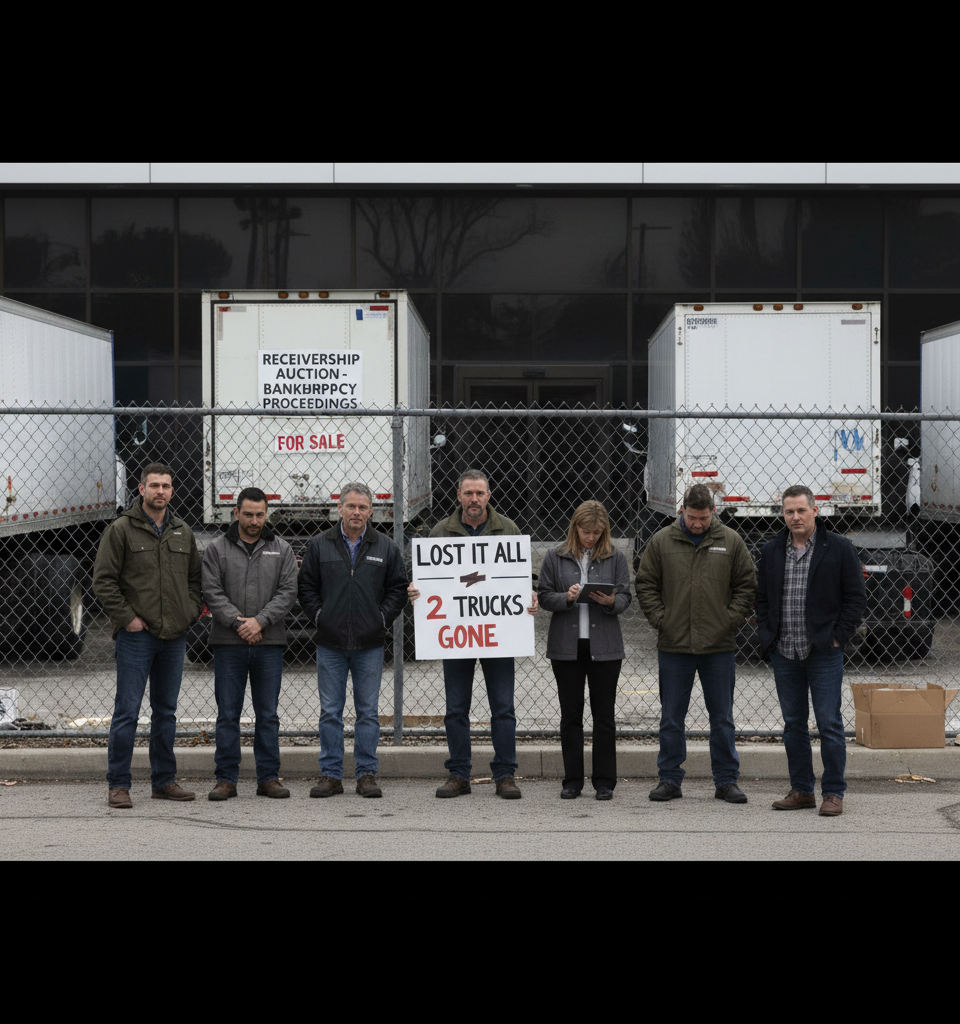
A dozen small trucking carriers and logistics firms declared bankruptcy in April, according to recent industry analyses, marking a significant escalation in financial distress within the highly fragmented U.S. freight market. This wave of failures, predominantly affecting companies with fewer than 50 trucks and non-asset-based brokerages, highlights the continued pressure on the supply chain ecosystem amidst softening demand, overcapacity, and intense pricing competition. The bankruptcies underscore a challenging period for the industry, particularly for its most vulnerable participants.
Context and Background
This recent surge in bankruptcies is not an isolated event but rather a continuation of a challenging period that began in late 2022. The U.S. trucking industry, often seen as a bellwether for economic activity, experienced a robust boom during the pandemic, driven by soaring consumer demand for goods. However, the subsequent normalization of consumer spending patterns, coupled with an influx of new carriers entering the market, created an oversupply of trucking capacity. This imbalance has driven down freight rates to unsustainable levels for many, especially smaller operations that lack the economies of scale or strong balance sheets of larger, more diversified logistics companies. This period mirrors previous downturns, such as those seen in 2016-2017 and 2019, where market corrections disproportionately affected smaller firms.
Key Details and Figures
The twelve bankruptcies recorded in April represent a significant jump, with half of these filings attributed to carriers operating fewer than 20 trucks. Another four were logistics providers or freight brokers, indicating a broad-based struggle beyond just asset-owning carriers. This brings the total number of trucking bankruptcies for the first four months of the year to over 50, a substantial increase compared to the same period in 2023. Industry experts point to several contributing factors, including the National Average Spot Rate for dry van freight which has hovered around $1.80-$2.00 per mile (all-in) for much of the past year, significantly below the $2.50-$3.00 per mile many small carriers require to operate profitably, especially when factoring in rising insurance premiums, maintenance costs, and fuel price volatility. Cash flow remains a critical issue, with many brokers extending payment terms, further squeezing the liquidity of smaller trucking companies.
Industry and Market Impact
The ongoing consolidation through bankruptcies is reshaping the competitive landscape of the freight industry. While larger carriers with established contracts and diverse service offerings are better positioned to weather the storm, the erosion of smaller players reduces overall market capacity and diversity. This eventually could lead to increased rates when demand inevitably picks up, but in the short term, it intensifies competition for the remaining freight. The brokerage sector is also experiencing significant pressure, with some non-asset brokers finding it increasingly difficult to compete on price against direct carrier-shipper relationships or the sophisticated technological platforms of larger logistics firms. This impacts shippers through potential service disruptions and eventually fewer options, but for now, it means they still largely benefit from lower rates.
Expert Perspective “We are witnessing natural market mechanisms at play, albeit with painful consequences for many small business owners,” states Dr. Emily Chen, a logistics economist at FreightPulse Analytics.
“The industry expanded rapidly, perhaps too rapidly, during the pandemic. Now, the market is correcting for that oversupply. Small carriers, particularly those heavily reliant on the volatile spot market, are simply unable to cover their operating costs. Brokers, too, are facing thinner margins as capacity outstrips demand, making it harder to find profitable loads and manage cash flow.” She added that a significant chunk of the newer entrants that joined the market between 2020 and 2022 are now facing their ultimate test, with many lacking sufficient capital reserves to endure prolonged downturns.
What's Next? Analysts predict that the trend of bankruptcies is likely to continue for the remainder of 2024, possibly extending into early 2025, until a more balanced supply-demand ratio is achieved.
Key indicators to watch include the Cass Freight Index, which tracks shipment volumes and expenditures, and the spot-to-contract rate differential. A sustained increase in demand, perhaps spurred by a stronger manufacturing sector or a significant shift in consumer spending, would be necessary to absorb the current excess capacity. Consolidation among brokers is also expected to accelerate, as larger firms acquire distressed assets or smaller entities simply cease operations. For the surviving players, this challenging period could ultimately lead to a more resilient and efficient industry, albeit one with fewer independent operators. Trucking companies and logistics firms that are managing to navigate this downturn are often those that have diversified their service offerings, invested in efficient technologies, and maintained strong relationships with shippers, securing contract freight rather than relying predominantly on the spot market. Innovation in operational efficiency and strategic financial planning will be paramount for survival in the months ahead.