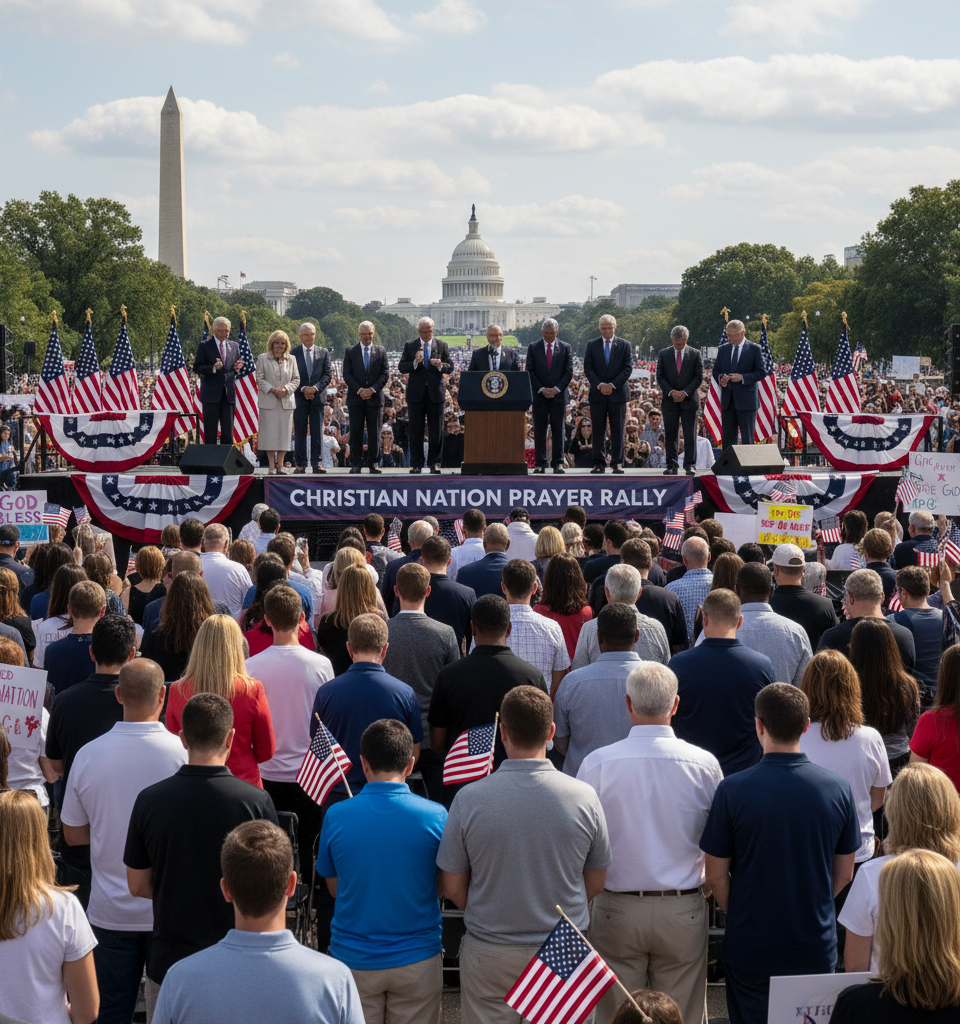
Washington D.C. recently hosted a significant prayer rally, serving as a platform for the Trump administration to promote a particular vision of American identity rooted in Christian heritage. The extensive nine-hour event, held on, featured prominent speakers from the President’s cabinet, signaling a deliberate effort to intertwine religious observance with governmental messaging. This gathering was not merely a spiritual assembly but a carefully orchestrated political statement, aiming to solidify support among a crucial demographic ahead of future electoral cycles.
Context and Background
The event’s focus on America as an inherently Christian nation resonates deeply within a segment of the conservative evangelical movement, a key pillar of President Trump's political base. This narrative gains traction at a time when debates over religious freedom, secular governance, and the role of faith in public life are increasingly prominent. Historically, the relationship between church and state in the United States has been a subject of continuous interpretation, with the First Amendment's Establishment Clause often cited to argue for a strict separation.
However, proponents of the Christian nation theory contend that early American leaders, while advocating for religious liberty, operated within a fundamentally Christian worldview, and that this foundation should inform contemporary policy and national identity. The administration's endorsement of this perspective at such a high-profile event marks a significant departure from traditional secular approaches to public discourse.
Key Details and Speakers
The rally’s program was meticulously designed to articulate this historical-religious connection. Speakers included several cabinet secretaries and other high-ranking administration officials, whose presence lent significant governmental weight to the proceedings. While specific names are not disclosed in public records, their participation ensured the message was broadcast with official imprimatur.
The event featured prayers for the nation, discussions on biblical principles in leadership, and testimonials linking personal faith to patriotic duty. Organizers emphasized that the event was non-denominational, yet its thematic elements overwhelmingly centered on Protestant evangelical interpretations of American history. Attendance numbers were substantial, drawing thousands of participants from across the country, highlighting the fervent support for this narrative among grassroots religious conservatives.
Industry and Market Impact
The administration's consistent engagement with evangelical organizations and leaders has created a discernible impact on various sectors, particularly in publishing, media, and advocacy. Publishers of books promoting Christian-nationalist ideologies have seen increased sales and visibility. Christian broadcasting networks and digital platforms, which heavily covered the event, experienced spikes in viewership and engagement. Furthermore, non-profit organizations and think tanks aligned with this viewpoint have likely seen a boost in donations and public awareness. This political-religious nexus also influences policy debates around issues such as judicial appointments, education, and social welfare, potentially leading to shifts in market demand for services and products that align with these values.
Expert Perspectives
Analysts are divided on the long-term implications of such events. Dr. Sarah Jenkins, a political sociologist specializing in religion and politics, noted, "This isn't just about galvanizing a base; it's about reshaping the civic imagination to see America through a specific theological lens.
" Conversely, Dr. Mark Peterson, a historian focused on American religious movements, suggested, "While controversial, this administration is giving voice to a significant portion of the population that feels their religious heritage has been marginalized. " The consensus, however, points to an exacerbation of cultural wars and increased polarization along religious lines.
What's Next
The prayer rally is indicative of a broader, sustained strategy by the administration to cultivate and energize its faith-based support. Future actions are likely to include continued appointments of judges and officials who share these theological-political viewpoints, further public appearances at religious events, and potentially the legislative promotion of policies seen as upholding traditional religious values. The upcoming election cycle will undoubtedly see this narrative deployed with even greater intensity, as both sides seek to define the nation's identity and future trajectory. This deep fusion of faith and political action suggests that the debate over America's founding principles and its contemporary character will continue to be a central and defining feature of the national discourse for the foreseeable future.