Trump Administration Clashes with States Over AI Regulation as Preemptive Efforts Intensify
Ana Maria Constantin•April 19, 2026•4 min read
Key Takeaways
Read this first — then go as deep as you need.
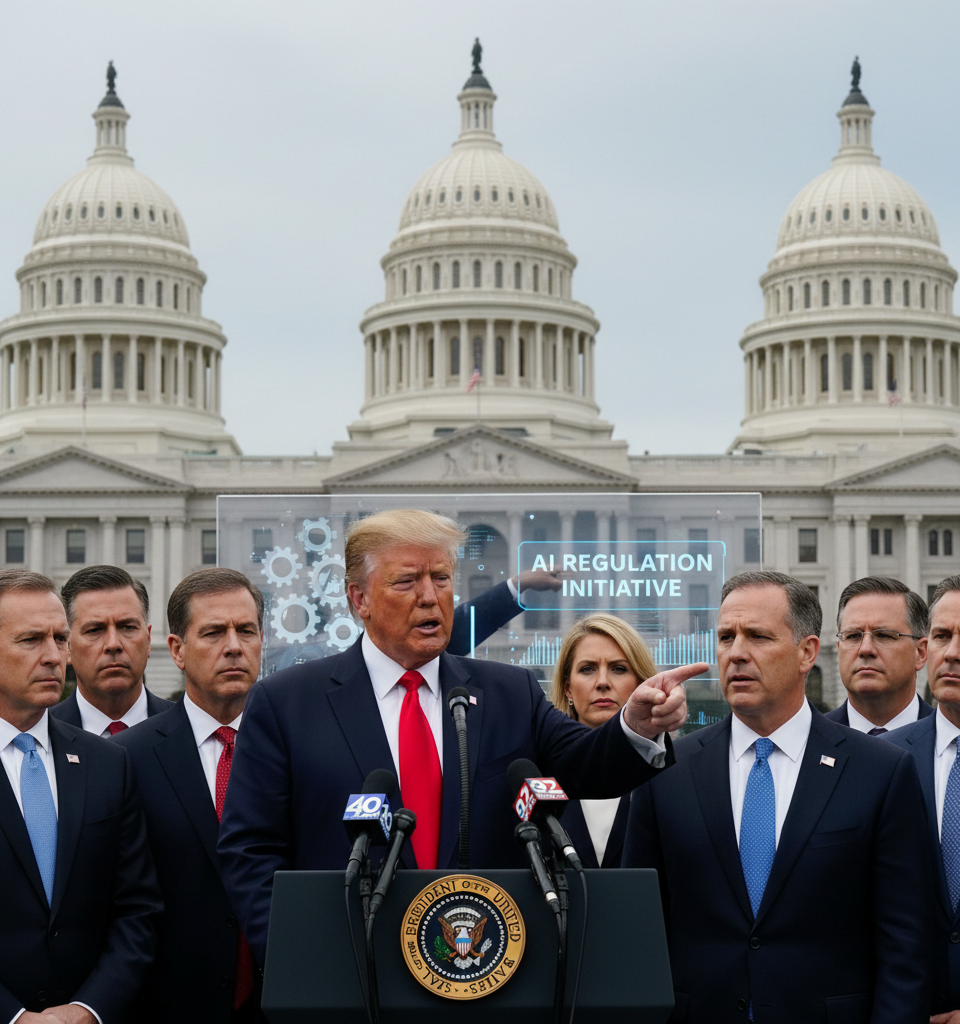
Federal vs. State: The Escalating Battle for AI Regulatory Control WASHINGTON D.C. — The Trump administration is engaged in an aggressive, multi-pronged campaign to assert federal preemption over artificial intelligence (AI) regulation, directly challenging the burgeoning legislative efforts of individual states. This strategic push, spearheaded by the Department of Justice (DOJ) through a specialized litigation task force and supported by Commerce Department evaluations of potentially “burdensome” state laws, aims to establish a “minimally burdensome national standard.” Yet, paradoxically, states are accelerating their own independent regulatory initiatives, creating a significant jurisdictional impasse with profound implications for the rapidly evolving AI industry. This unfolding conflict represents a crucial inflection point in the governance of advanced technologies. The administration's argument centers on fostering innovation and preventing a fragmented regulatory landscape that could hinder technological progress and economic competitiveness. They contend that a patchwork of state-level rules could stifle startups, burden established tech giants with compliance complexities, and ultimately cede global AI leadership to nations with more unified approaches. Critics of federal preemption, however, argue that states are better positioned to address unique local concerns and consumer protection needs that might be overlooked by a broad national standard. Key details of the administration’s strategy include a legislative framework presented to Congress, urging lawmakers to enact preemptive federal legislation. This framework explicitly seeks to nullify state-level attempts at AI regulation deemed antithetical to innovation or national policy goals. Concurrently, the Commerce Department is tasked with identifying and assessing state laws that could impede technological development, signaling potential federal intervention or challenges. Despite these formidable federal efforts, states have demonstrated an unprecedented surge in AI-related legislative activity, with 1,208 bills, resolutions, and executive orders introduced across various jurisdictions in recent years, illustrating a robust and decentralized response to the technology's rapid advancement. The implications for the broader technology landscape are substantial. While Silicon Valley giants might welcome a harmonized national standard that simplifies compliance, smaller AI developers and startups could face significant challenges if even a “minimally burdensome” federal standard proves too costly to implement. Furthermore, the ability of states to experiment with different regulatory approaches – often referred to as “laboratories of democracy” – could be curtailed, potentially stifling novel solutions to ethical AI development, data privacy, and algorithmic bias. The dispute also raises fundamental questions about federalism and the appropriate balance of power in an era of rapid technological change. "The administration's stance is understandable from a competitiveness perspective, aiming to avoid a '50 states, 50 rules' scenario," commented Dr. Eleanor Vance, a technology policy expert at the American Enterprise Institute. "However, the states are responding to tangible public concerns around privacy, bias, and accountability. The challenge lies in finding a common ground that protects consumers without stifling innovation. A complete federal preemption risks alienating states and overlooking nascent issues that haven't yet reached national prominence." Other analysts suggest that a purely top-down approach might fail to adequately address the nuanced socio-technical challenges presented by AI at local levels. Looking ahead, the clash is expected to intensify. The Trump administration will likely continue to lobby Congress for preemptive legislation and could employ the DOJ's litigation task force to challenge specific state laws in court, setting legal precedents. States, in turn, are unlikely to concede their regulatory authority lightly, particularly given the increasing public and political focus on AI ethics and governance. The outcome of this power struggle will ultimately shape the future of AI development and deployment in the United States, determining whether innovation will be guided by a singular federal vision or a more diverse, state-driven regulatory ecosystem. Both sides are preparing for a protracted and potentially litigious dispute, with the tech industry watching closely.
Discussion
Join the discussion
Sign in to leave a comment on this article.
Loading comments...
Enjoying this article?
Get more like it delivered to your inbox — free.
This article was compiled by GlobalSell News from publicly available reporting and has been edited for clarity and length. For full details, read the original source.