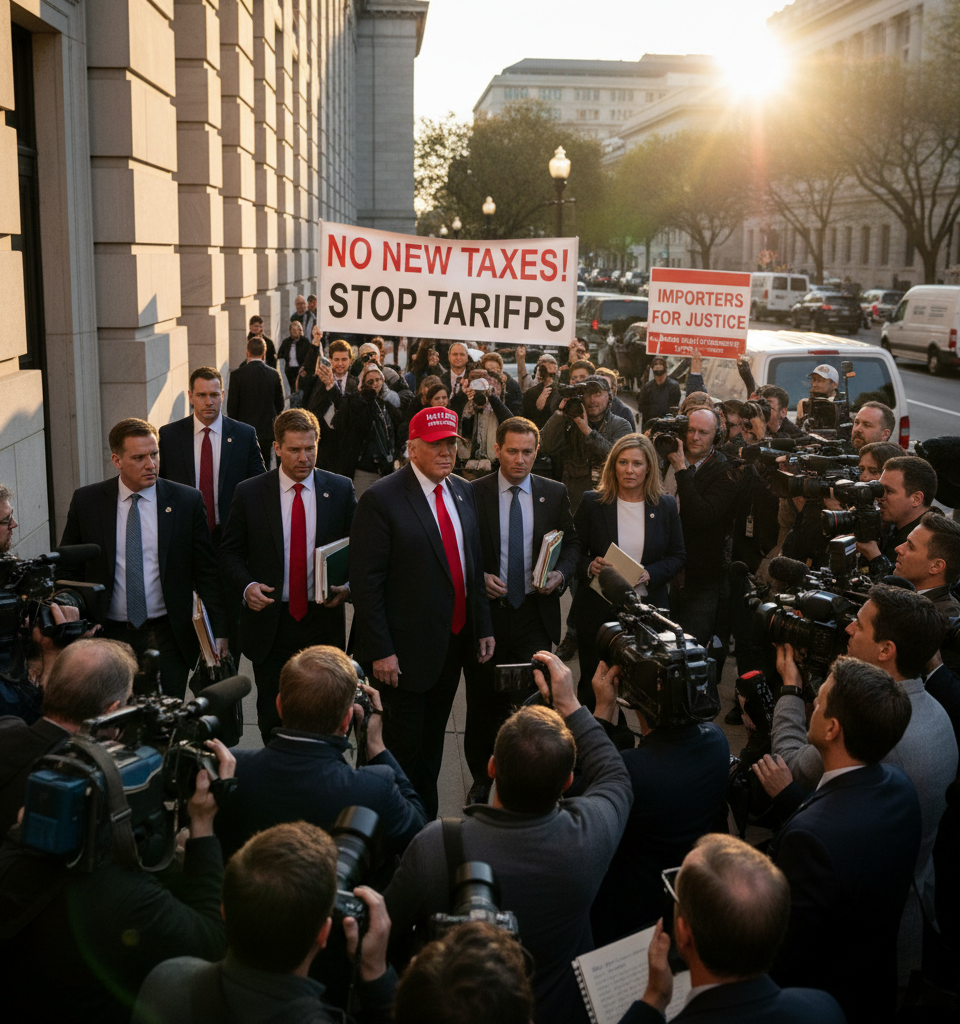
WASHINGTON D.C. – The Trump administration finds itself embroiled in a familiar legal confrontation, as a coalition of U.S. states and small businesses has filed a new lawsuit challenging the legality of a 10% tariff imposed on a wide array of imported goods. This latest judicial foray, initiated in a federal court in Washington D.C. this week, aims to dismantle the White House's revised trade strategy, which emerged after the Supreme Court previously invalidated an earlier set of presidential tariffs. The plaintiffs argue that the new duties, mirroring their predecessors in economic impact, represent an overreach of executive power and inflict undue financial hardship on American consumers and enterprises.
Renewed Battle Over Executive Trade Authority
This legal challenge is more than just a dispute over economic policy; it's a fundamental test of the executive branch's constitutional authority regarding international trade. The initial wave of Trump-era tariffs, particularly those targeting steel and aluminum, faced significant opposition and culminated in a Supreme Court ruling that severely curtailed the President's ability to unilaterally impose such taxes without explicit congressional approval. The administration's subsequent pivot to a 10% blanket tariff on a broader basket of imports was widely seen as an attempt to navigate around that judicial constraint. The current lawsuit directly confronts this legal maneuvering, asserting that the new tariffs are merely a thinly disguised reincarnation of the previously struck-down policy, thus circumventing the spirit, if not the letter, of the Supreme Court's decision.
Key Arguments: Economic Strain and Constitutional Overreach
At the heart of the plaintiffs' argument are two main pillars: the economic detriment inflicted by the tariffs and the alleged constitutional overreach. Small businesses, particularly those reliant on imported components or finished goods, claim the 10% tax significantly erodes their profit margins and raises operational costs, often forcing them to absorb the increases or pass them on to consumers. One plaintiff, a Michigan-based electronics distributor, stated, “We’ve seen our input costs jump by an average of 8-12% since these tariffs were re-imposed. That’s not a sustainable model for a small business operating on tight margins.” States, meanwhile, argue that the tariffs stifle economic growth within their borders by reducing consumer spending and hindering investment. Legal experts aligned with the plaintiffs contend that the administration is misinterpreting Section 232 of the Trade Expansion Act of 1962, a provision intended for national security concerns, to implement broad economic policy without congressional consent.
Widespread Industry Disruption and Market Volatility
The re-introduction and subsequent legal challenge of these tariffs have created a palpable sense of uncertainty across numerous sectors of the U.S. economy. Industries from automotive manufacturing and electronics to retail and agriculture are bracing for potential disruptions. Manufacturers relying on imported raw materials, for instance, face increased supply chain costs and pressure to relocate production or absorb higher expenses. Retailers are contemplating price increases, which could dampen consumer demand, especially heading into peak shopping seasons. The stock market has historically reacted negatively to trade war escalations, with analysts predicting renewed volatility if this legal battle prolongs without clear resolution. The S&P 500 notably dipped by 0.7% on news of the initial filing, reflecting investor anxiety.
Legal Experts Weigh In: A Narrow Path for the Administration
Legal scholars and trade policy experts are closely watching the proceedings. Professor Eleanor Vance, a constitutional law expert at Georgetown University, commented, “The administration faces a steep uphill climb. The Supreme Court decisively narrowed the scope of executive authority on tariffs. To succeed in this new challenge, the government will need to present a compelling and distinct legal justification for these 10% tariffs that clearly differentiates them from the previously invalidated ones. That’s a very narrow path.” Other analysts suggest this case could finally force Congress to reassert its constitutional role in trade policy, potentially leading to legislative action that clarifies the balance of power.
The Road Ahead: Potential Appeals and Congressional Action
The immediate future of the 10% tariffs now hinges on the federal court's initial ruling, anticipated in the coming months. Regardless of the outcome, appeals to higher courts, including potentially the Supreme Court once again, are highly probable. This multi-year legal saga suggests prolonged uncertainty for businesses and consumers. Beyond the courtroom, there's a growing call for congressional intervention. Lawmakers from both sides of the aisle, though often disagreeing on specific trade policies, are increasingly expressing concern over the executive branch's expansive interpretation of its powers. This lawsuit could serve as a catalyst for new legislation aimed at clearly defining the President's tariff authority, an outcome that would have lasting implications for U.S. trade policy and international relations for decades to come.
Economic Indicators and Consumer Sentiment
Initial analyses suggest that the 10% tariff, if sustained, could shave an estimated 0.1-0.2% off U.S. GDP growth annually. Consumer sentiment surveys released this quarter indicate a slight dip, with concerns over rising prices and economic stability being cited by respondents. Businesses, particularly those with global supply chains, have reported increased administrative burdens and compliance costs associated with navigating the complex tariff landscape. The National Retail Federation recently projected that if these tariffs remain in effect, American households could see an average increase of $400-$500 in annual spending due to higher import costs, underscoring the broad-based economic impact at stake in this renewed legal battle.