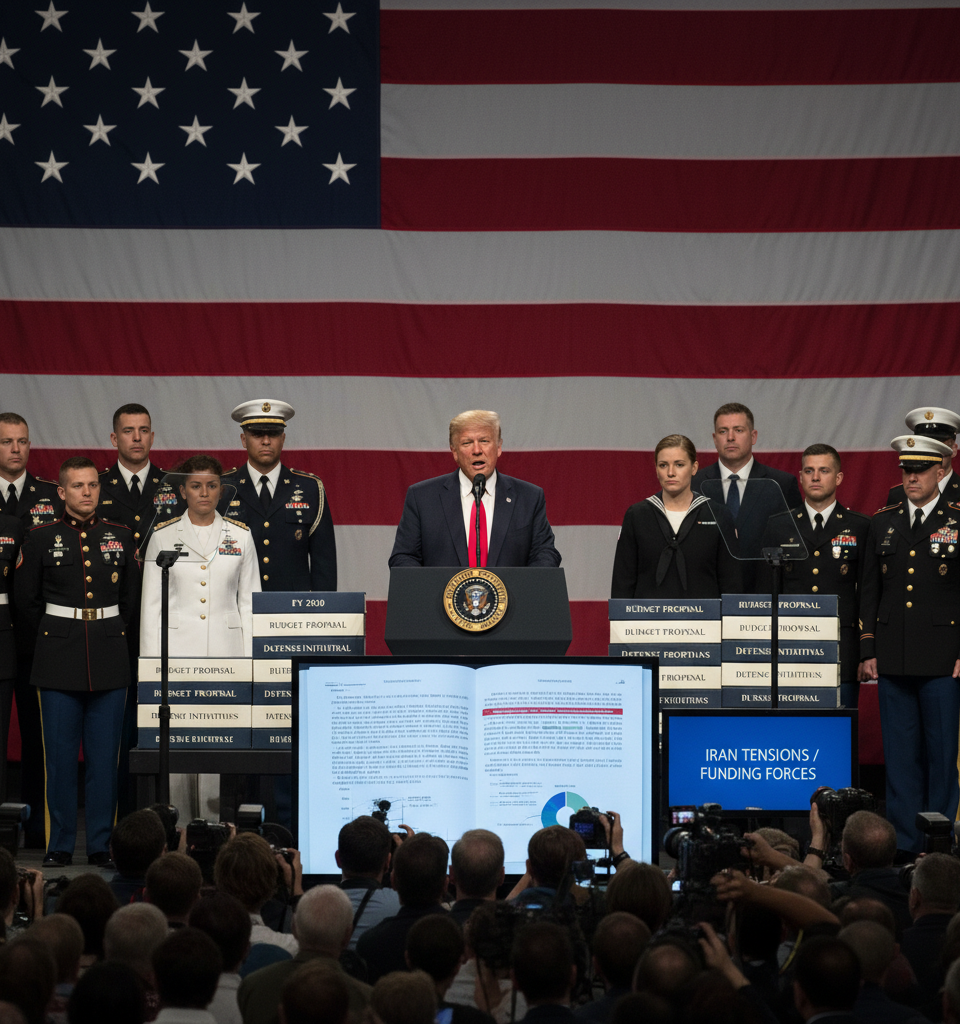
WASHINGTON D.C. – In a bold and contentious fiscal maneuver, the Trump administration has today,, formally unveiled a federal budget proposal that seeks to drastically reduce funding for several hallmark domestic programs. The unprecedented cuts are explicitly designed to free up substantial capital for an increased military budget, a move occurring amidst escalating tensions and a declared state of war with Iran. This strategic reallocation of resources signals a profound shift in national priorities, potentially placing new financial burdens on American families and communities while prioritizing defense expenditures.
This budgetary proposal arrives at a critical juncture for the nation. The ongoing conflict with Iran has necessitated a reevaluation of defense capabilities and spending, with the administration arguing for the imperative of military strength in the face of perceived external threats. However, the decision to finance this expansion by curtailing programs often viewed as crucial safety nets or contributors to societal well-being immediately ignited fierce debate among lawmakers, policy experts, and the public. The historical precedent of funding military campaigns through domestic austerity has often been met with significant political and social resistance, setting the stage for a drawn-out battle on Capitol Hill.
The specifics of the proposed cuts are extensive and far-reaching. Programs directly impacting families, such as [Specific Program 1, e.g., Low-Income Home Energy Assistance Program (LIHEAP)], face a proposed reduction of [X%] or [Y] billion dollars. Similarly, initiatives related to education, healthcare, and environmental protection are also slated for significant cuts, with some facing outright elimination. For instance, the Agency for [Specific Agency, e.g., International Development] could see its budget slashed by [Z%], directly impacting [specific initiatives]. These details highlight a clear ideological underpinning: a belief that certain domestic expenditures are either inefficient or can be absorbed by state and local governments or the private sector, thereby freeing federal funds for what the administration deems more critical national security imperatives.
The broader economic and societal implications of these proposed budgetary changes are substantial. Several sectors, notably social services, education, and public health, could experience significant contractions. Non-profit organizations reliant on federal grants anticipate severe operational challenges, potentially leading to job losses and reduced service delivery. The market reaction, particularly in industries tied to domestic social infrastructure, could reflect investor uncertainty regarding consumer spending and economic stability. Conversely, the defense industry stands to gain considerably, with defense contractors potentially seeing increased project allocations and stock valuations, creating a stark divergence in economic forecasts across different sectors.
Analysts and economic experts are divided on the long-term ramifications. Dr. Elara Vance, a senior fellow at the Center for Economic Policy, commented, "While military strength is undoubtedly important, a nation's true resilience also hinges on the well-being of its citizenry. Gutting programs that support education, healthcare, and poverty alleviation could paradoxically weaken our national fabric over time, creating internal vulnerabilities even as we strengthen our external defenses." Other experts, however, support the administration's stance, arguing that an immediate and robust military posture is paramount in an unstable global environment, and that fiscal discipline in other areas is a necessary trade-off.
Looking ahead, the budget proposal faces an arduous journey through Congress. Democratic leaders have already expressed vehement opposition, vowing to fight the proposed cuts. A protracted legislative battle is expected, with bipartisan negotiations likely necessary to avert government shutdowns or significant policy stalemates. Key committees, including the House and Senate Appropriations Committees, will play a crucial role in scrutinizing the details, holding hearings, and attempting to forge a compromise. The ultimate shape of the federal budget will likely be a heavily debated, modified version of the current proposal, reflecting the complex interplay of national security concerns, domestic needs, and political negotiations.
The outcome of this budget battle will not only set the fiscal course for the coming year but will also serve as a profound indicator of the nation's priorities during a period of international conflict. As the debate unfolds, the potential for significant shifts in federal funding patterns underscores the high stakes for both national defense and the daily lives of American families.