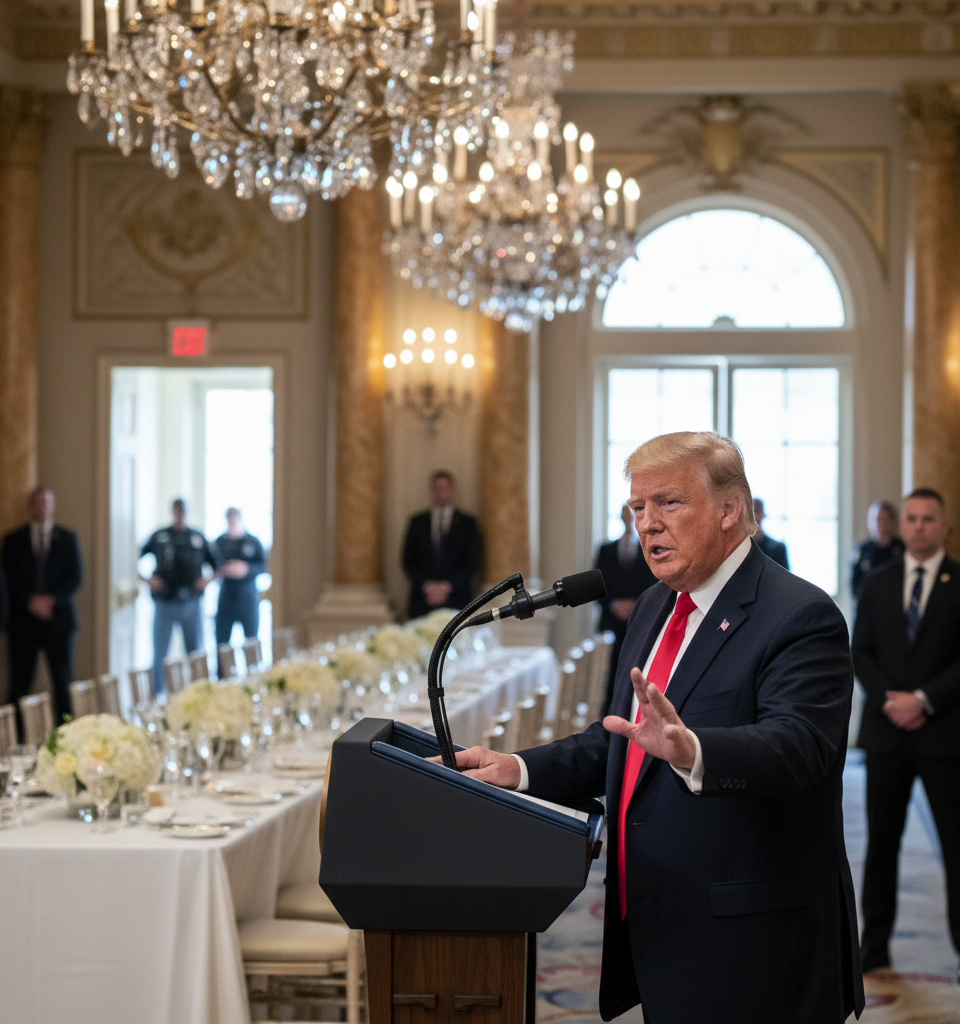
Former President Donald Trump has reignited his campaign for a dedicated ballroom at the White House, citing a recent shooting involving a 'would-be assassin' as critical justification. Speaking publicly, Trump emphasized the need for enhanced, controlled environments for official events, suggesting the current infrastructure falls short in guaranteeing the safety of high-profile individuals. This assertion comes as security arrangements for various political gatherings, including the recent Correspondents' Dinner, face intense scrutiny following the incident.
Trump’s insistence on a White House ballroom is not new, tracing back to his previous administration where similar proposals were floated. The argument pivots on the premise that such a facility would centralize and secure large-scale events, reducing reliance on external venues that may present greater security challenges. This renewed push for a permanent, highly fortified event space underscores a persistent concern within high-echelon political circles regarding the evolving nature of threats and the imperative to protect national leaders and dignitaries.
The incident referenced by Trump, though details remain sparse in his public comments, serves as a poignant, albeit unverified, anecdotal fulcrum for his argument.
The Ballroom Proposition: A Recurring Theme
During his time in office, President Trump had frequently expressed a desire for a capacious ballroom within the White House complex, envisioning it as a more fitting and secure venue for state dinners, press conferences, and other significant gatherings. His administration had even explored preliminary designs and cost estimates, which reportedly ran into the tens of millions of dollars. Proponents of the idea often highlight logistical advantages, such as reduced travel times for official motorcades and the ability to implement stringent, consistent security protocols within a controlled federal perimeter. Opponents, however, have historically raised concerns about the cost, potential disruption to the historic White House grounds, and the perception of extravagance.
Security Scrutiny and Public Events
The recent incident, which Trump broadly described as involving a 'would-be assassin' and is now being cited as a prime example of why greater security is needed, has amplified existing concerns about public and semi-public events involving political figures. While specific details of the alleged assassination attempt remain speculative in Trump’s public remarks, the broader context points to a heightened sensitivity around vulnerabilities at events like the annual Correspondents' Dinner. Security experts often grapple with the balance between public accessibility and comprehensive protection, especially in an era of polarized political discourse and increased threats. The challenge lies in creating an environment that fosters engagement while mitigating risks from lone actors or organized groups.
Expert Perspectives on Executive Protection
Industry experts in executive protection and national security generally concur that permanent, purpose-built facilities offer superior security advantages over temporary or external venues. Dr. Evelyn Reed, a counter-terrorism analyst, noted, “A dedicated, hardened facility allows for layered security measures – from controlled access points and ballistic protection to advanced surveillance systems – that are difficult to replicate on a temporary basis or in a multi-use commercial space.” However, she also cautioned that “no venue is entirely impervious, and the most effective security strategies combine physical fortifications with robust intelligence gathering and highly trained personnel.” The cost-benefit analysis of such a project, particularly its drain on taxpayer funds versus the potential increase in safety, remains a subject of ongoing debate among policymakers and the public.
Future Implications and Political Discourse
Trump's renewed advocacy for a White House ballroom, particularly his framing of the argument around a specific security incident, is likely to inject itself into the ongoing political discourse, especially as the 2024 election cycle intensifies. While specific legislative action on a White House ballroom may not be imminent depending on the political landscape, the discussion serves to highlight broader questions about presidential security, the allocation of federal funds, and the symbolic importance of the White House as both a residence and a seat of power. The incident he references, regardless of its verified details, undoubtedly fuels the narrative around the need for enhanced protective measures for America's leaders, potentially influencing future policy decisions regarding executive security protocols and event planning both domestically and internationally.