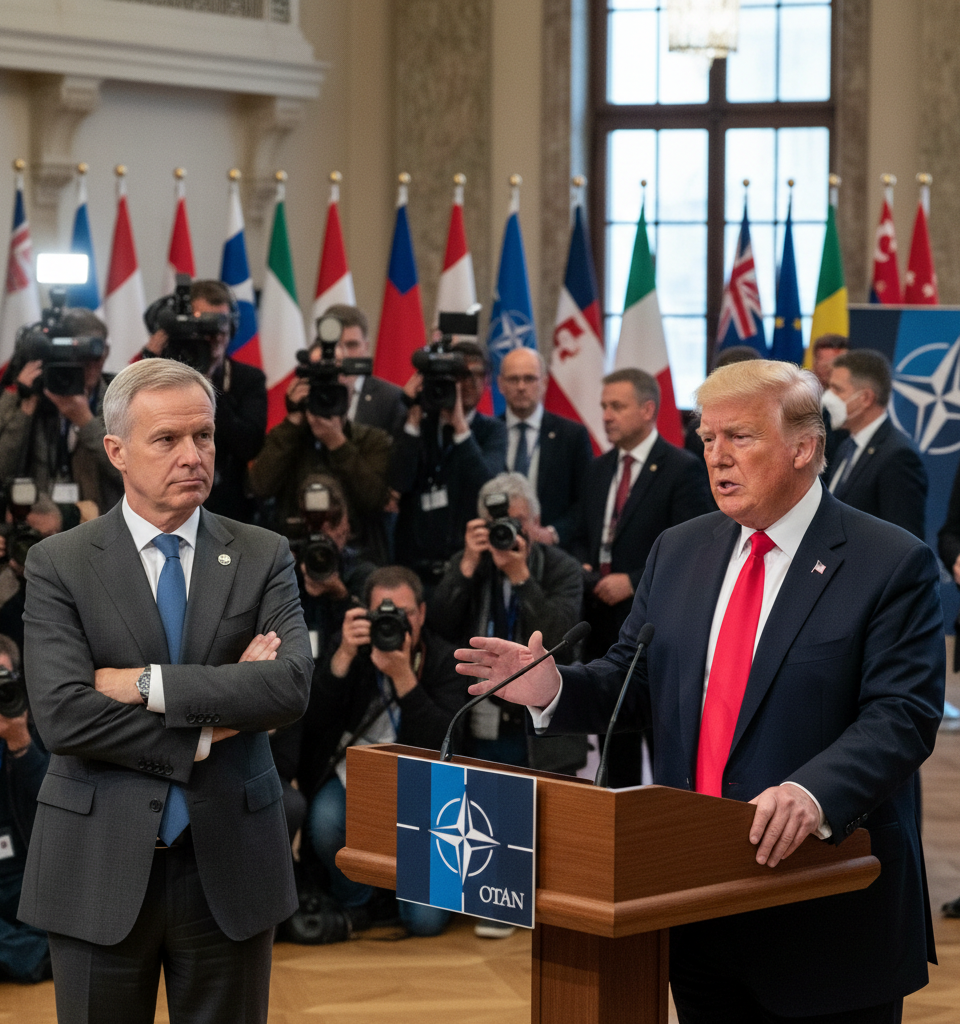
Former President Donald Trump delivered a contentious rebuke of the North Atlantic Treaty Organization (NATO) today, claiming the alliance was conspicuously absent during a critical juncture he referred to as the 'Iran war.' His fiery remarks emerged following a meeting with NATO Secretary General Jens Stoltenberg, who characterized the discussions as 'very frank' — diplomatic parlance often signaling significant disagreement. Trump's renewed criticism underscores persistent anxieties within the alliance about his potential return to office and the future of transatlantic security cooperation.
A History of Discord: Trump's Contentious Relationship with NATO
Trump's latest condemnation is not an isolated incident but rather a continuation of his consistent skepticism regarding NATO's value and burden-sharing among member states. Throughout his 2017-2021 presidency, he frequently accused European allies of failing to meet their defense spending commitments, threatening at various points to withdraw the United States from the alliance. These perennial criticisms have sowed deep unease among European leaders, who view NATO as the cornerstone of continental security, particularly in the face of escalating geopolitical tensions in Eastern Europe and the Middle East.
Unpacking the 'Iran War' Claim and Stoltenberg's Response
The specific context of Trump's 'Iran war' reference remains somewhat ambiguous. While the United States has engaged in numerous military and diplomatic confrontations with Iran over decades, no large-scale, declared 'Iran war' involving direct NATO military intervention has occurred. It is plausible Trump was referencing periods of heightened tension or specific instances of US military action in the Middle East where he felt NATO allies did not offer sufficient support or participation. Stoltenberg, seeking to maintain alliance solidarity, emphasized NATO's unity and its ongoing efforts to adapt to contemporary security challenges, including a greater focus on counter-terrorism and cyber defense, without directly refuting Trump's historical claims. He reiterated the importance of the transatlantic bond, highlighting that "NATO is stronger with the United States."
Geopolitical Ripples: Impact on Global Alliances and Defense Spending
Trump's assertions send significant ripples through the global geopolitical landscape. His stance, if he were to return to the presidency, could precipitate a fundamental re-evaluation of defense strategies across Europe and beyond. Many European nations have already begun to accelerate their defense spending, partly driven by the war in Ukraine and partly in anticipation of a less reliable American security guarantee. Data from NATO indicates that in 2023, 11 of the 31 allies were projected to meet the 2% of GDP defense spending target, up from just 3 in 2014. Trump's comments could further catalyze this trend, potentially leading to increased European military autonomy but also greater fragmentation in global security architecture.
Expert Insights: A Test for Transatlantic Unity
Security analysts view Trump's latest remarks as a critical test for transatlantic unity. Dr. Fiona Hill, a former Senior Director for European and Russian Affairs on the National Security Council, noted, "Trump's rhetoric creates an existential crisis for NATO, forcing allies to confront the possibility of American disengagement." Other experts point out that while Trump's criticisms often focus on burden-sharing, his broader objections speak to a transactional view of alliances that diverges sharply from the collective security principles enshrined in NATO's Artikel 5. "European leaders must prepare for a future where they shoulder a significantly larger share of the defense burden, regardless of who occupies the White House," said Dr. Max Bergmann, Director of the Europe Program at the Center for Strategic and International Studies.
The Road Ahead: Navigating Uncertainty and Summit Preparations
The immediate future will see NATO officials intensify efforts to present a united front, particularly as the alliance prepares for crucial summits. Stoltenberg's task is immense: to reassure member states of NATO's enduring purpose while navigating the unpredictable political currents emanating from Washington. Discussions are expected to focus on further enhancing deterrence and defense, bolstering support for Ukraine, and addressing new threats ranging from hybrid warfare to climate change's impact on security. The specter of a potential second Trump presidency looms large, making the alliance's ability to demonstrate its indispensable value more critical than ever before. The coming months will be instrumental in shaping the alliance's trajectory and its role in a rapidly evolving global order.
Trump's consistent questioning of NATO's structure and operational relevance necessitates a robust internal dialogue within the alliance. Member states are likely to continue to shore up their individual and collective defense capabilities, recalibrating their expectations for U.S. leadership. The perceived urgency of these actions is underscored by ongoing conflicts and rising state-on-state competition, making any weakening of NATO a potentially destabilizing factor on the world stage.