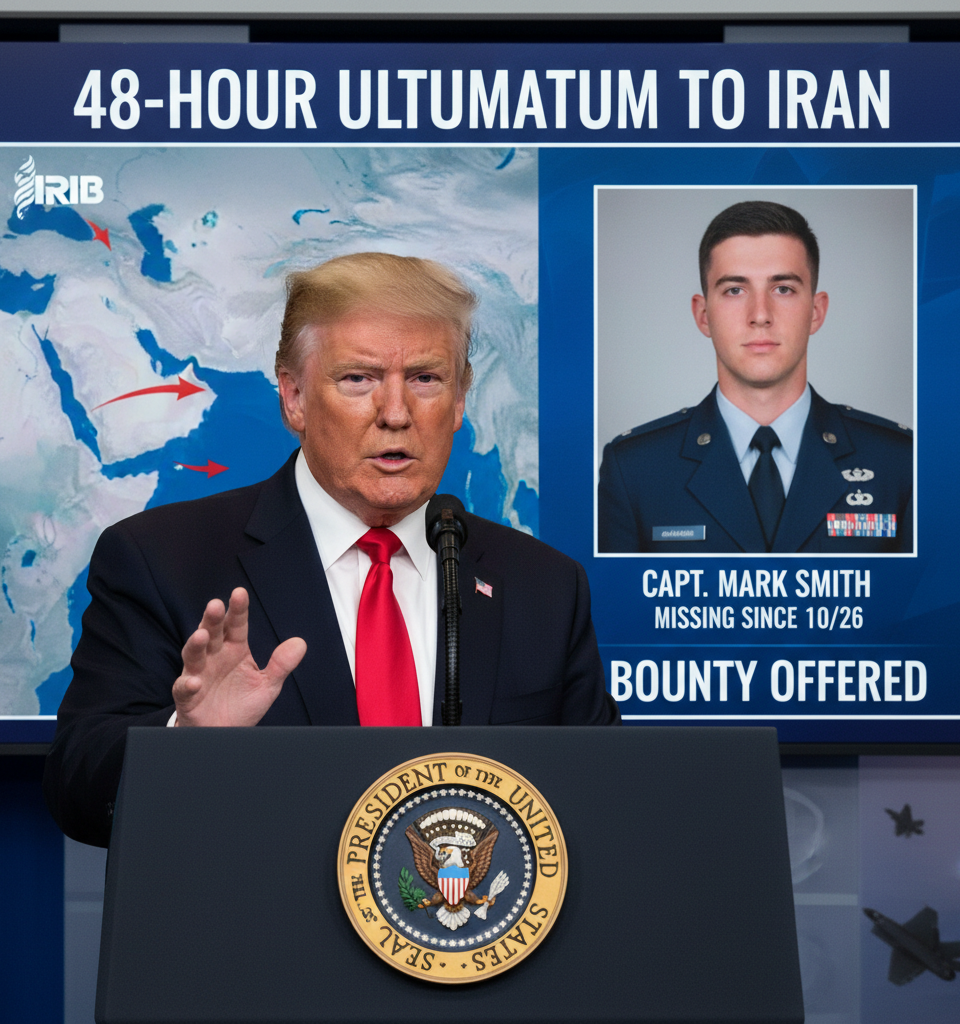
Washington D.C. / Tehran – Geopolitical tensions between the United States and Iran have reached a perilous new peak following President Donald Trump's issuance of a 48-hour ultimatum directed at Tehran, starkly coinciding with the ongoing disappearance of a U.S. airman. The explicit warning from the White House signals an unyielding stance, demanding immediate action from the Islamic Republic. Simultaneously, Iranian state media has disseminated a provocative offer: a 2.8 billion Iranian Rials (approximately $66,000 USD) bounty for individuals who successfully capture the airman alive, an act widely condemned as exacerbating an already fragile situation and an egregious violation of international norms concerning the treatment of military personnel.
This latest development is a critical juncture in the long-strained relationship between Washington and Tehran, marked by years of sanctions, proxy conflicts, and rhetorical provocations. The roots of this particular crisis can be traced back to the U.S. withdrawal from the Joint Comprehensive Plan of Action (JCPOA) in 2018, followed by the re-imposition of crippling sanctions aimed at Iran's oil exports and financial sector. Subsequent incidents, including attacks on oil tankers in the Persian Gulf and the downing of a U.S. surveillance drone, have systematically ratcheted up the pressure, transforming the region into a geopolitical powder keg. The current standoff is not merely about a missing individual; it is a test of wills that carries profound implications for global energy markets and regional stability.
The precise circumstances surrounding the airman's disappearance remain shrouded in uncertainty, with conflicting reports emerging from both sides. While U.S. authorities have been tight-lipped about specific details, citing operational security and the ongoing investigation, President Trump's direct and public ultimatum underscores the gravity of the situation as perceived by the White House. The publicly stated bounty, disseminated across Iranian media platforms, is a stark act of defiance, not only attempting to monetize the capture of a foreign service member but also directly challenging international conventions on the treatment of prisoners of war and missing persons. This move by Tehran is seen by many analysts as a cynical attempt to exploit a crisis for propaganda purposes and further entrench its adversarial position against the U.S.
The volatile situation has sent ripple effects throughout global financial and energy markets. Oil prices, already subject to fluctuations due to supply concerns and geopolitical instability, saw an immediate uptick of nearly 2% following President Trump's announcement, with Brent crude briefly touching $72 per barrel. Shipping companies operating in the Strait of Hormuz, a crucial chokepoint for global oil transit, have reportedly increased their insurance premiums by as much as 15-20% in recent days, reflecting heightened risk assessment. The economic ramifications extend beyond crude, with investors eyeing safe-haven assets such as gold, which experienced a 0.5% rise, and the Japanese Yen.
Defense and foreign policy experts are vocal in their assessments, with many expressing deep concern over the escalating rhetoric and the potential for miscalculation. Dr. Eleanor Vance, a senior fellow at the Council on Foreign Relations, stated, "This 48-hour deadline compresses the diplomatic window significantly and raises the stakes exponentially. The bounty offer from Iran is not just provocative; it's an unprecedented challenge to the norms of international engagement, effectively incentivizing the capture of foreign military personnel. This could spiral out of control very quickly if not managed with extreme caution." Other analysts point to the domestic political pressures influencing both leaders, suggesting that neither side can afford to appear weak or irresolute.
As the 48-hour deadline looms, the international community watches with bated breath. Diplomatic backchannels are reportedly being activated, though details remain scarce. The immediate focus will be on the safety and whereabouts of the missing airman, which remains the most pressing humanitarian and security concern. Beyond the short-term crisis, the episode underscores the urgent need for de-escalation mechanisms and a clear communication strategy between Washington and Tehran to prevent an inadvertent slide into a broader regional conflict. Future developments will likely involve intense diplomatic maneuvers, potential economic retaliation, and perhaps even a multinational intervention to address maritime security in the Persian Gulf, depending on the outcome of the ultimatum and the fate of the missing U.S. airman.