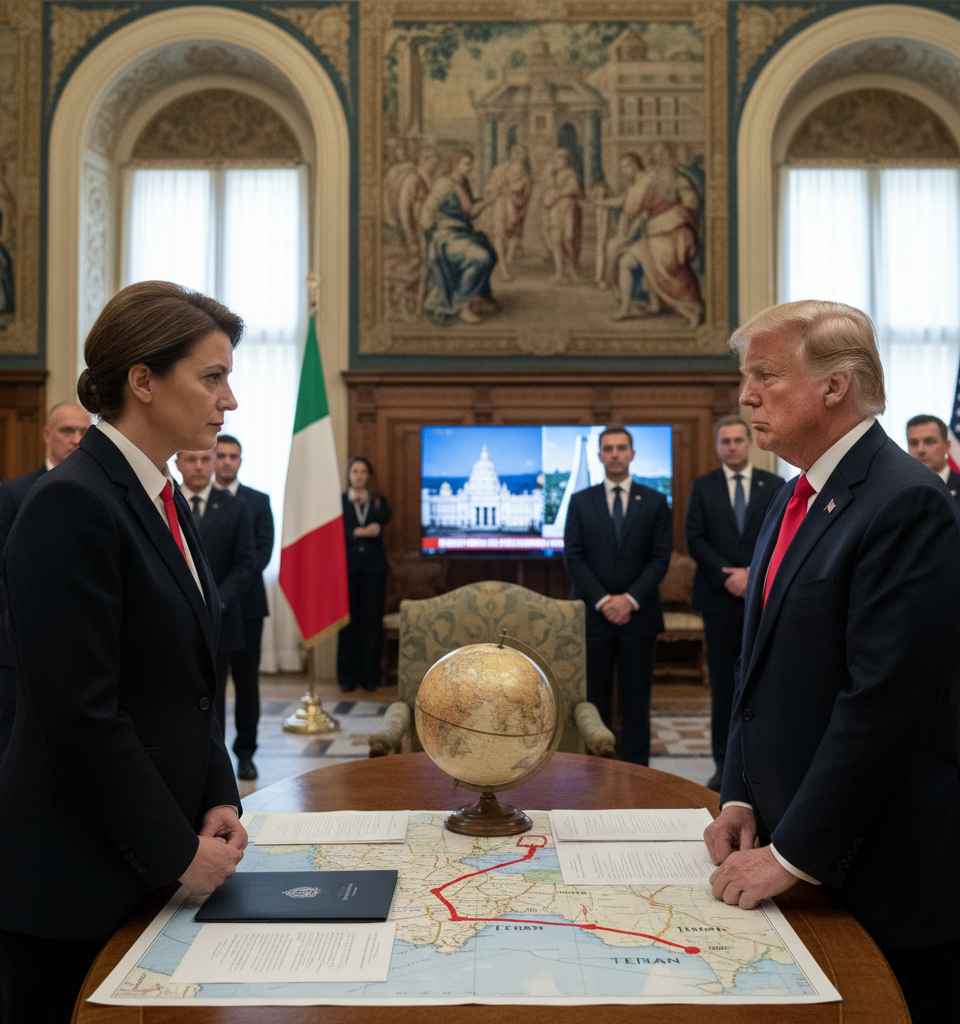
ROME/MAR-A-LAGO – The seemingly robust political alliance between former U.S. President Donald Trump and Italian Prime Minister Giorgia Meloni has reportedly fractured, with sources close to both leaders indicating a growing estrangement over recent diplomatic disagreements concerning the Vatican and Iran. The rift marks a significant turn in transatlantic conservative politics, where Meloni was once considered one of Trump's most steadfast European allies. This emerging division signals a potential recalibration of conservative international relations, particularly as both leaders navigate complex geopolitical landscapes.
This breakdown in relations carries substantial weight, given the historical alignment between Trump's "America First" ideology and Meloni's Brothers of Italy party, a nationalist-conservative force that has ascended rapidly in Italian politics. Their past camaraderie was built on shared anti-globalist sentiments, skepticism towards established international institutions, and a focus on national sovereignty. The current discord threatens to undermine a perceived bedrock of future conservative cooperation, especially if Trump were to return to the White House. The implications extend beyond personal rapport, potentially impacting future transatlantic policy coordination on critical issues.
Key to the growing schism are specific disagreements that have apparently reached a breaking point. Sources familiar with both camps point to differing approaches on the diplomatic handling of the Vatican, particularly concerning its engagement in global affairs, and divergent strategies regarding Iran's nuclear program and regional influence. While specifics of the Vatican dispute remain under wraps, it is understood to involve nuances of religious diplomacy and potentially the Pope's stance on certain geopolitical conflicts. On Iran, Meloni's government has sought a more measured, multi-lateral approach within the European framework, contrasting sharply with Trump's hawkish stance and his administration's withdrawal from the Joint Comprehensive Plan of Action (JCPOA). These policy misalignments have reportedly led to pointed exchanges and a noticeable cooling of communications.
The fracturing of this prominent alliance could send ripples across the global political landscape. For European conservatives, it might signal a need to diversify international partnerships, rather than solely relying on a potentially unpredictable U.S. executive. From a market perspective, any perceived instability in traditional alliances could subtly influence investor confidence, particularly in sectors reliant on consistent transatlantic policy, such as defense and energy. More broadly, it could embolden adversaries who seek to exploit divisions among Western powers.
Political analysts are scrutinizing the development closely. "This isn't merely a clash of personalities; it's a divergence in geopolitical philosophies that's becoming increasingly apparent," stated Dr. Elena Rossi, a Senior Fellow at the European Policy Institute. "Meloni, while ideologically aligned with Trump on many domestic issues, operates within the constraints and traditions of European diplomacy, which often necessitates a more nuanced, consensus-driven foreign policy. Trump's transactional approach, on the other hand, frequently prioritizes unilateral action. These differences were bound to surface, exacerbated by specific flashpoints like Iran and the Vatican's global role." Another analyst highlighted that "Both leaders are appealing to nationalist sentiments at home. The friction here might indicate where those national interests diverge on the international stage, rather than converging."
Looking ahead, the longevity and depth of this rift remain to be seen. With the prospect of a potential Trump return to the U.S. presidency, the impact of this current estrangement could deepen significantly. Both leaders face domestic challenges, and their international relationships will undoubtedly play a role in their political standing. Future interactions, or lack thereof, between their respective administrations on forums such as the G7 or NATO will be closely watched for any further indications of a sustained divergence. Diplomatic efforts, if any, to mend this fracture would likely require substantial concessions or a reframing of core foreign policy positions from either side, especially as the global political environment grows increasingly complex and interconnected.