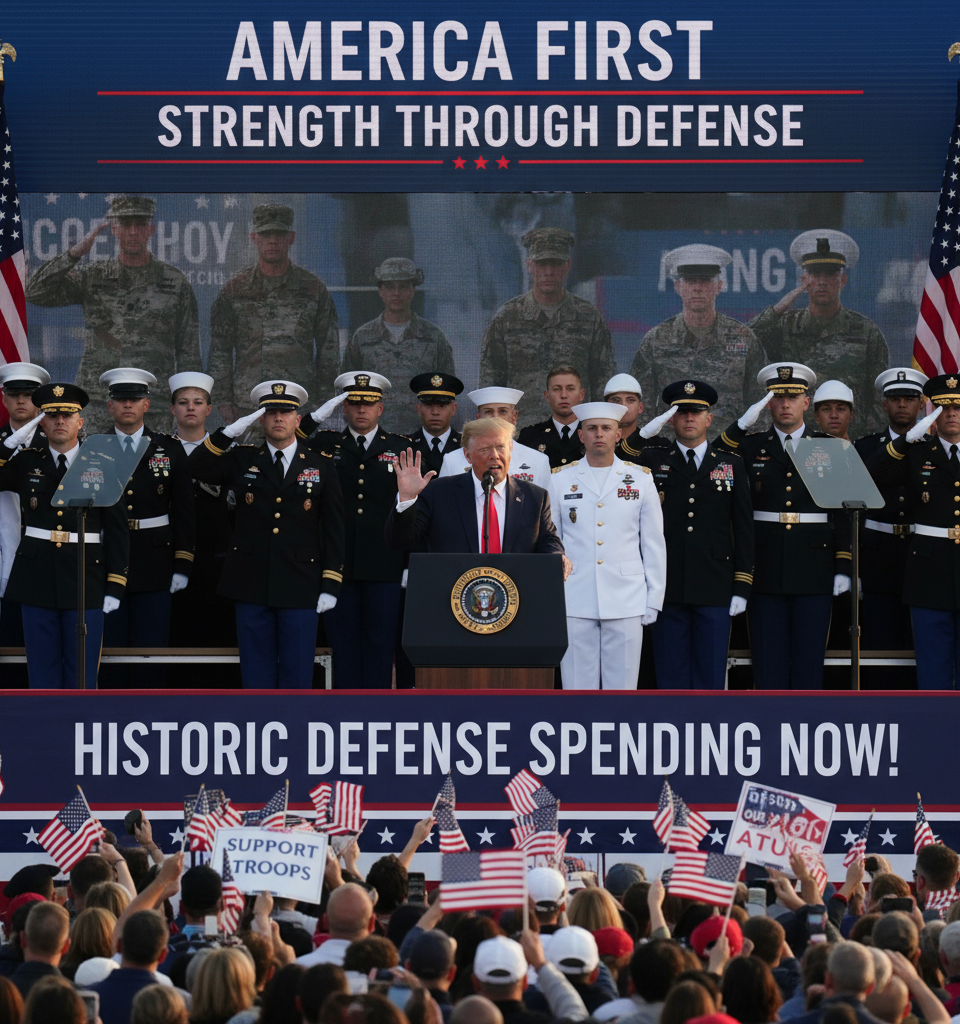
Washington D.C. — Former President Donald Trump is championing a monumental increase in the United States' defense budget, a surge that, if enacted, would represent the largest expansion in military spending in three-quarters of a century. This push comes amidst growing international instability and a perceived shift towards a global security environment less anchored by democratic norms and increasingly reliant on sheer force. The Pentagon, in parallel, continues to prioritize the development and acquisition of highly sophisticated, and inherently expensive, 'exquisite' weaponry, a strategy that underscores the nation's reliance on technological superiority to maintain its strategic advantage.<br/><br/>## Context and Background<br/><br/>The proposal for such a dramatic defense spending hike is rooted in a geopolitical landscape characterized by rising tensions, particularly with adversaries like China and Russia, and a pervasive sense of unpredictability. Historical parallels can be drawn to post-World War II armament booms, but the sheer scale of Trump's envisioned increase suggests a departure from even recent post-9/11 defense outlays. This initiative highlights a fundamental belief within certain political circles that robust military power is the ultimate deterrent and the imperative foundation for national security in an era of heightened global competition. It also reflects a long-standing debate within U.S. defense policy about the optimal balance between conventional might and advanced technological superiority.<br/><br/>## Key Details and Figures<br/><br/>While the precise figures for Trump's proposed budget increase remain under official wraps, sources close to the former president suggest an ambition to elevate defense spending to unprecedented levels, potentially exceeding a trillion dollars annually within the next few years. This would represent a substantial jump from the roughly $886 billion allocated for fiscal year 2024. The Pentagon's current strategy, often encapsulated by its pursuit of 'exquisite' weapons systems, refers to platforms like the F-35 Joint Strike Fighter, advanced stealth bombers, and next-generation naval vessels. These systems, while formidable, come with prodigious price tags. For instance, the F-35 program has already surpassed an estimated $1.7 trillion in lifetime costs, with each aircraft costing upwards of $80 million.<br/><br/>A key factor driving this budgetary pressure is the accelerating pace of technological innovation by near-peer competitors. China's rapid advancements in hypersonic missiles, artificial intelligence, and naval expansion are frequently cited as primary catalysts for the U.S. to not only maintain but expand its qualitative and quantitative military edge. The ongoing conflict in Ukraine has also served as a stark reminder of the importance of conventional defense capabilities and the capacity for sustained military expenditure in a protracted conflict.<br/><br/>## Industry and Market Impact<br/><br/>Should such a significant defense budget surge materialize, the defense industrial base would experience an unparalleled boom. Major contractors such as Lockheed Martin, Boeing, Raytheon Technologies, and Northrop Grumman would likely see a dramatic increase in orders for advanced aircraft, missile systems, shipbuilding, and cyber warfare technologies. This would translate into significant revenue growth, job creation within the defense sector, and potentially a bolstered stock market performance for these companies. However, it could also strain supply chains and skilled labor availability, leading to production bottlenecks and increased costs. Smaller defense technology firms specializing in areas like AI, quantum computing, and advanced materials would also likely benefit from increased research and development funding.<br/><br/>## Expert Perspective<br/><br/>Defense analysts are divided on the implications of such a massive budgetary expansion. Dr. Evelyn Stone, a senior fellow at the Center for Strategic and International Studies, remarks, "While a stronger defense posture is understandable in today's world, an indiscriminate spending surge risks creating a bloated military-industrial complex susceptible to waste and inefficiency. The focus must remain on strategic investments rather than simply throwing money at the problem." Conversely, retired General Mark Holloway suggests, "To maintain global leadership and deter aggression, especially from revisionist powers, a substantial investment in our military is not merely advisable but essential. We cannot afford to fall behind when national security is at stake." The debate often centers on whether existing resources are being optimized before demanding more, and if the strategic benefit truly outweighs the potential economic burden.<br/><br/>## What's Next<br/><br/>The trajectory of defense spending hinges heavily on the outcome of the upcoming presidential election. If Donald Trump secures another term, his administration would likely prioritize pushing through this unprecedented defense budget increase, potentially facing significant opposition from fiscal conservatives and those advocating for reallocation of funds to domestic priorities. Regardless of the electoral outcome, the underlying pressures of global insecurity and technological competition will continue to frame the debate surrounding U.S. defense spending for the foreseeable future. Future discussions will also likely focus on the efficacy of 'exquisite' weapon systems versus a more distributed, resilient, and potentially less costly force posture, especially in light of lessons learned from contemporary conflicts.
Trump Pushes for Historic Defense Spending Hike Amid Global Instability
Key Takeaways
Read this first — then go as deep as you need.
Discussion
Loading comments...
Enjoying this article?
Get more like it delivered to your inbox — free.
This article was compiled by GlobalSell News from publicly available reporting and has been edited for clarity and length. For full details, read the original source.